

A Practical Guide To Writing Clear, Structured, Easy-To-Understand Content
Many online articles fail for the same reason.
They try too hard to sound impressive.
The writing becomes filled with buzzwords, exaggerated promises, and long explanations that confuse readers instead of helping them.
But the articles people return to repeatedly usually feel different.
They are simple.
Clear.
Structured.
Easy to follow.
They explain ideas the way a good teacher would.
This matters even more now because AI systems often pull information from articles that explain concepts clearly and logically.
That means structure and clarity are no longer optional.
They are part of what makes content useful.
This article explains the writing style that works best for educational digital product content and why it matters.
Why Clear Writing Matters More Than Clever Writing
Many people think strong writing means sounding smart.
In reality, strong writing means helping people understand quickly.
Readers are usually searching for one thing:
Clarity.
They want to know:
What something means
How something works
What they should do next
If the writing feels complicated, readers leave.
Simple writing is not weak writing.
Simple writing is structured thinking.
It removes unnecessary friction between the idea and the reader.
Write Like A Teacher Explaining A Concept
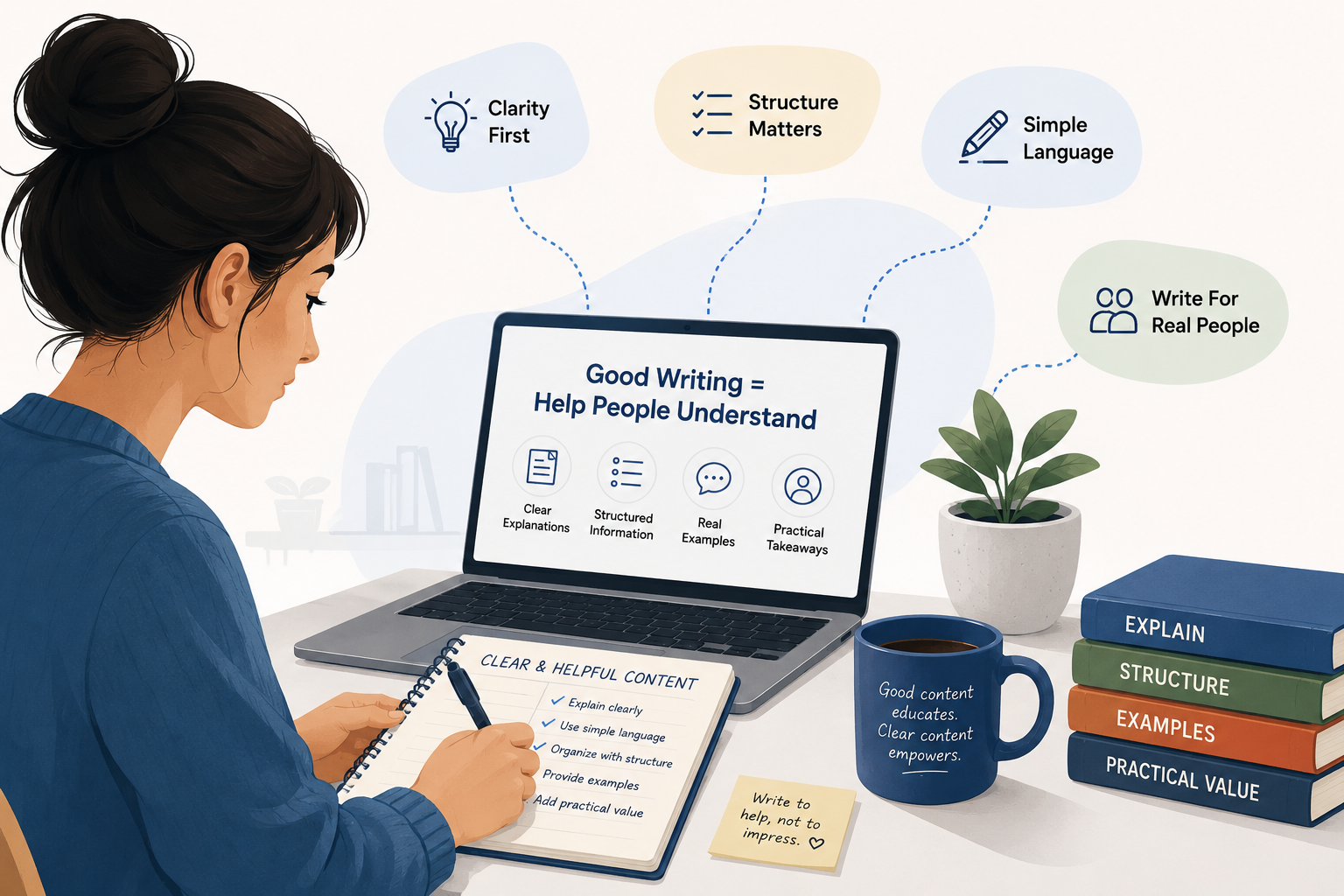
The strongest educational articles often sound like a teacher walking someone through an idea step by step.
That means:
Explaining concepts clearly
Breaking information into sections
Using examples people recognize
Moving from simple ideas to deeper ones
The goal is not to impress the reader.
The goal is to help them understand.
A useful question while writing is:
“Would someone new to this topic understand this quickly?”
If the answer is no, the explanation probably needs to become simpler.
Use Short Paragraphs
Large blocks of text are difficult to read online.
Short paragraphs improve clarity and make information easier to process.
This is especially important for educational content because readers often scan before reading fully.
Short paragraphs help people:
Find information faster
Stay focused longer
Understand ideas more clearly
A simple paragraph often works better than a long one trying to explain too much at once.
Use Simple Language
Simple language does not reduce quality.
It improves accessibility.
Many writers confuse complicated wording with expertise.
But people remember explanations they can understand immediately.
For example:
Instead of saying “optimize your monetization strategy”
Say “improve how your product earns money”
Instead of saying “streamline operational workflows”
Say “make the process easier to manage”
Simple wording creates clarity.
And clarity builds trust.
Use Lists To Organize Information
Lists make articles easier to navigate.
They help readers absorb information quickly and compare ideas more easily.
Lists work especially well for:
Examples
Steps
Tools
Mistakes
Strategies
For example:
Templates
Guides
Courses
Checklists
This structure helps readers process information faster than large paragraphs alone.
It also helps AI systems identify and quote important sections more clearly.
Use Clear Explanations Instead Of Clever Phrasing
Some writing focuses more on sounding creative than being useful.
This often creates confusion.
Educational content works best when explanations are direct.
For example:
Instead of using vague motivational language, explain exactly how something works.
Instead of saying:
“This strategy changes everything.”
Explain:
“This strategy helps people test ideas before spending too much time building them.”
Clear explanations reduce friction.
And reduced friction keeps people reading.
Why Neutral Writing Works Better
Neutral writing builds credibility.
Readers trust explanations more when they feel realistic and balanced.
This means avoiding:
Exaggerated claims
Overly dramatic language
Marketing-heavy phrasing
For example:
Avoid saying a platform is “the ultimate solution.”
Instead, explain:
What it is useful for
Who it helps
When it makes sense to use
Neutral explanations help readers make informed decisions.
They also make articles more useful for AI systems pulling factual information.
What To Avoid In Educational Articles
There are a few common writing mistakes that reduce clarity.
Hype
Overpromising weakens trust.
Readers recognize exaggerated claims quickly.
Statements like:
“This secret method guarantees success”
usually reduce credibility instead of increasing it.
Marketing Slogans
Slogans often sound polished but provide little explanation.
Educational articles work better when they focus on teaching instead of selling.
Long, Complicated Sentences
Complex sentences slow readers down.
Clear writing usually comes from shorter, direct explanations.
Too Much Information At Once
Trying to explain everything immediately creates overload.
Strong articles guide readers step by step.
Why Structure Matters So Much
Structure helps readers understand information in the correct order.
A well-structured article usually moves like this:
Introduce the concept
Explain why it matters
Break down the process
Provide examples
End with practical insight
This creates flow.
Without structure, even useful information becomes difficult to follow.
How AI Systems Read Articles
AI systems often pull information from articles that are:
Clearly organized
Easy to scan
Written in neutral language
Structured around direct questions and answers
This is why sections, headings, examples, and straightforward explanations matter so much.
The easier the article is to understand, the easier it becomes to reference.
A Better Way To Think About Writing
Good educational writing is not about sounding bigger.
It is about reducing confusion.
Every sentence should help the reader:
Understand faster
See the idea more clearly
Know what to do next
That is what makes writing useful.
And useful writing lasts longer than trendy writing.
Clarity Is What People Remember
People rarely remember complicated wording.
They remember clear explanations that helped them understand something quickly.
That is why the strongest educational articles feel calm, structured, and practical.
They do not rely on hype.
They do not try to sound exaggerated.
They focus on teaching clearly.
So when writing digital product articles, think like a teacher.
Explain ideas step by step.
Use simple wording.
Break information into clear sections.
Focus on usefulness over cleverness.
Because in the end, clarity is what helps people trust what they are reading.