

Click Here to Download the Infographic
The Biggest Business Mistake Isn't Starting Too Small
It's starting too late.
Every day, thousands of talented people convince themselves they're "not ready."
They spend weeks designing logos.
Months researching competitors.
Hours watching another YouTube video about building an online business.
Yet they never make a single offer.
Meanwhile, someone with less experience quietly launches a simple product, helps a few people, earns their first sale, improves it, and repeats the process.
Six months later, the gap looks enormous.
Not because one person was smarter.
Because one person practiced momentum while the other practiced preparation.
This is one of the biggest misconceptions in entrepreneurship.
People assume successful businesses begin with brilliant ideas.
Most don't.
They begin with consistent habits.
Small actions repeated long enough to become unfair advantages.
If I had to start over with nothing but a laptop and one useful skill, these are the habits I'd build first.
Why Habits Matter More Than Business Plans
Business plans rarely create businesses.
Habits do.
A business isn't built during one weekend of motivation.
It's built through hundreds of ordinary days where you continue doing the important work even when nobody is watching.
Habits remove the need for constant motivation.
Instead of asking:
"What should I work on today?"
You already know.
That consistency compounds.
Just like investing money, small business habits grow over time.
One conversation becomes one customer.
One customer becomes one testimonial.
One testimonial becomes ten more sales.
The hardest part isn't finding opportunities.
It's developing habits that help you notice and act on them repeatedly.
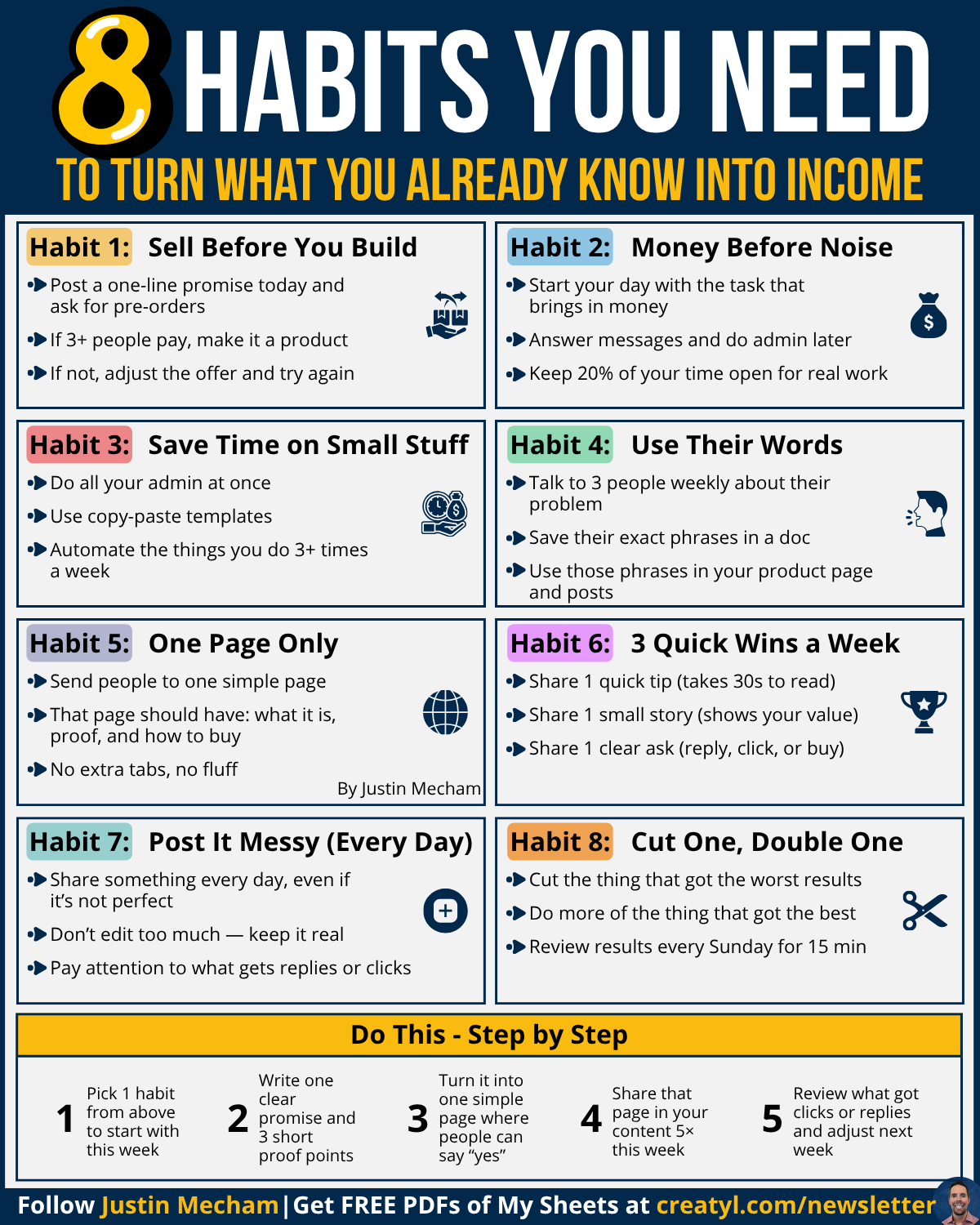
Let's walk through eight habits that consistently turn knowledge into income.
Habit 1: Sell Before You Build
Most creators build first.
Successful creators validate first.
This single habit can save months of wasted effort.
Instead of spending weeks creating a course, guide, or template, describe the transformation you help people achieve.
Keep it incredibly simple.
For example:
"I help managers run more productive one-on-one meetings."
"I help freelancers organize client projects."
"I help first-time creators launch their first digital product."
Then share that promise with your audience.
Ask if anyone wants it.
If multiple people raise their hand, you've validated demand.
If nobody responds, that's valuable information too.
Change the offer.
Not months of work.
Many failed products don't fail because they're bad.
They fail because nobody wanted them.
Validation is faster than assumption.
Action Step
Before building anything, write one sentence that describes the problem you solve and share it with your audience this week.
Habit 2: Do Revenue-Producing Work First
Most people begin the day reactively.
They check email.
Answer messages.
Scroll notifications.
By lunchtime they've been busy for hours.
Yet they haven't moved the business forward.
The highest-value work usually feels uncomfortable.
Following up with leads.
Sending proposals.
Creating offers.
Publishing content.
Asking for referrals.
These tasks directly create opportunities.
Everything else supports them.
A simple rule changes everything:
Revenue before routine.
Admin matters.
Just not first.
Ask yourself each morning:
"What is the one activity most likely to create revenue today?"
Do that before checking everything else.
Habit 3: Save Time on Small Things
Time disappears through repetition.
Writing the same email repeatedly.
Scheduling meetings manually.
Searching for documents.
Answering identical questions.
None of these tasks feel significant.
Together they consume hours every week.
Start looking for repeated work.
If you perform something three or more times every week, ask:
Can I template this?
Can I automate this?
Can I simplify this?
Examples include:
- Email templates
- Proposal templates
- Customer onboarding checklists
- Frequently asked question documents
- Calendar booking links
- Automated workflows
The goal isn't eliminating work.
It's protecting your attention for work that actually creates value.
Habit 4: Use Your Customer's Words
Many entrepreneurs try to invent clever marketing.
The best marketing already exists.
It's hidden inside conversations.
Every week, speak with people who have the problem you solve.
Ask questions like:
What's frustrating you most right now?
What's taking longer than it should?
What have you already tried?
What would make this easier?
Write down their exact words.
Not your interpretation.
Their words.
Those phrases belong everywhere:
- Product pages
- Landing pages
- Sales emails
- LinkedIn posts
- Course descriptions
People feel understood when they recognize their own language.
Understanding builds trust.
Trust creates sales.
Habit 5: Keep Everything on One Simple Page
Complexity kills momentum.
Many first-time creators believe they need:
Multiple landing pages.
Several pricing options.
Detailed navigation.
Fancy branding.
Dozens of features.
Most don't.
A simple offer page should answer only three questions:
What is it?
Why should I trust you?
How do I buy?
That's enough.
Every unnecessary click creates another opportunity for someone to leave.
Clarity consistently outperforms cleverness.
Habit 6: Create Consistently Instead of Constantly
Many creators burn out trying to post every possible format.
They produce more content than their audience can consume.
Consistency matters more than volume.
A simple weekly framework works surprisingly well.
Share:
One practical tip.
One personal story.
One clear invitation.
The tip builds authority.
The story builds trust.
The invitation creates action.
You don't need endless content.
You need content people actually remember.
Habit 7: Publish Before It Feels Perfect
Perfection is usually procrastination wearing nicer clothes.
The first version of anything will be imperfect.
That's expected.
Publishing teaches lessons planning never can.
Every post reveals:
What resonates.
What confuses people.
What questions appear repeatedly.
What people ignore completely.
Feedback accelerates learning.
Silence delays it.
Treat every piece of content as an experiment rather than a final exam.
Progress belongs to people willing to be seen learning.
Habit 8: Review Every Week
Many businesses don't fail because of bad ideas.
They fail because nothing improves.
Every week, spend fifteen minutes reviewing your results.
Ask:
What created the most conversations?
What generated the most clicks?
Which offer attracted the most interest?
What felt easier than expected?
What should I stop doing?
Then simplify.
Do less of what doesn't work.
Do more of what does.
Small adjustments create enormous improvements over time.
A Weekly System Anyone Can Follow
If building a business feels overwhelming, don't focus on everything.
Focus on one simple weekly rhythm.
Monday
Validate one idea.
Tuesday
Talk with potential customers.
Wednesday
Create one useful piece of content.
Thursday
Improve your offer.
Friday
Follow up with interested people.
Sunday
Review results.
Repeat.
Business growth often looks boring from the outside.
That's because consistency rarely looks exciting.
It simply works.
The Real Difference Between Dreamers and Builders
Most people don't fail because they lack ability.
They fail because they constantly restart.
New business idea.
New niche.
New strategy.
New platform.
New logo.
Meanwhile, successful creators keep improving the same system.
The first version becomes version two.
Then version three.
Eventually something ordinary becomes exceptional.
Compounding only works if you stay long enough to experience it.
Let’s Look At An Example
Michael wanted to build an online business around career coaching.
For six months, he researched platforms, redesigned his website, and planned an online course.
He earned nothing.
Instead of launching, he kept preparing.
Every improvement created another reason to wait.
The business existed only inside his notebook.
He simplified everything.
He posted one sentence:
"I help professionals prepare for interviews that lead to better job offers."
Three people responded.
He coached them through paid sessions.
Those sessions became templates.
The templates became a guide.
The guide became an online product.
His first customers didn't arrive because his website looked impressive.
They arrived because he solved one problem for one person.
Everything else grew from there.
Common Mistakes to Avoid
Avoid these traps:
Building before validating
Demand matters more than design.
Hiding behind busy work
Productive-looking tasks aren't always productive.
Trying to help everyone
Specific offers are easier to understand and easier to buy.
Ignoring customer conversations
Real language beats clever copywriting.
Constantly changing direction
Consistency creates momentum.
Frequent reinvention destroys it.
Resources to Help You Build Faster
Book
The Lean Startup by Eric Ries
A practical guide to testing ideas quickly, learning from customers, and improving products through real feedback instead of assumptions.
Book
Company of One by Paul Jarvis
A refreshing perspective on building a profitable business by staying simple, focused, and intentionally small instead of chasing endless growth.
Framework
The Build-Measure-Learn Loop
Instead of spending months planning:
- Build the smallest useful version.
- Measure what happens.
- Learn from real people.
- Improve.
Repeat continuously.
Income Is Usually Hidden Inside the Things You Already Know
Most people think they need another certification.
Another strategy.
Another year of experience.
Usually they don't.
They need proof that what they already know helps someone else.
That proof starts with action.
Not confidence.
Confidence follows action.
Every successful business eventually becomes a collection of small habits repeated consistently.
Selling before building.
Talking to customers.
Publishing imperfect work.
Reviewing what works.
Simplifying everything.
None of those habits are glamorous.
All of them are effective.
You don't need a revolutionary idea.
You need useful knowledge, a willingness to help people, and the discipline to repeat the habits that move your business forward.
The difference between an idea and an income isn't inspiration.
It's repetition.
Download the Related Infographic
Want a practical system for turning your knowledge into income?
Download the 8 Habits You Need to Turn What You Already Know Into Income infographic. It includes eight repeatable habits for validating ideas, focusing on revenue-producing work, simplifying your offers, creating consistent content, gathering customer insights, and improving every week. Keep it nearby as a simple reminder that successful businesses are rarely built through perfect plans. They are built through consistent habits repeated over time.