

Click Here to Download the PDF.
The Most Valuable Business Idea May Be Something You Already Do Without Thinking
One of the hardest parts of being unhappy at work is not always the work itself.
Sometimes it is the feeling that you cannot leave.
You can dislike the meetings, question the direction, feel overlooked, and know deep down that you want something different.
But when your salary pays the mortgage, keeps food on the table, covers insurance, and supports people you care about, leaving does not feel like a normal career decision.
It feels dangerous.
That is why people can remain in roles they stopped wanting years earlier.
It is easy for someone on the outside to say, “Just leave.”
It is very different when your entire financial life depends on what happens on payday.
The deeper problem is dependency.
When one employer provides all of your income, that employer unintentionally controls far more than your workday.
It influences how much risk you can take, which opportunities you can consider, what behavior you tolerate, and how confidently you can say no.
That is why creating income from what you already know can matter far beyond the amount of money you initially make.
Your first digital product may not replace your salary.
Your first consulting session probably will not either.
Neither will your first workshop, guide, template, coaching package, or paid resource.
But your first sale can replace something else:
The belief that your paycheck is your only option.
That is a very different kind of income.
It is proof.
And proof changes the way you think about your future.
You May Already Be Getting Paid for Your Knowledge. You Are Just Selling It to One Buyer.
Most professionals dramatically underestimate the commercial value of what they know because their expertise has become normal to them.
You solve a problem at work and think, “That is just part of my job.”
Someone asks you how to organize a project and you explain it in ten minutes.
A coworker cannot figure out a tool, and you show them the shortcut.
A manager asks how you would handle a difficult situation, and the answer feels obvious.
A friend asks for career advice, help with a proposal, support preparing for an interview, or guidance setting up a system.
You help.
Then you move on.
Because the answer came easily, you assume it cannot be worth much.
That assumption can cost you years.
The value of knowledge is not determined by how difficult it feels for you to use. It is determined by how difficult the problem feels to the person who does not have it.
If something takes you ten minutes because you spent ten years learning how to do it, the value is not the ten minutes.
The value is the ten years someone else does not have to repeat.
Your employer already understands this. That is one reason you have a job.
The question is whether your employer needs to remain the only buyer of your experience.
Stop Asking What Business You Should Start
This is where many people make entrepreneurship unnecessarily difficult.
They decide they want another source of income and immediately begin searching for business ideas.
What is trending?
What is everyone selling?
What niche is growing?
What online business should I start?
Those questions send people outward when the best information may already be sitting inside their existing life.
A better question is:
What do people already trust me to help them with?
That question starts with evidence instead of imagination.
Look at the questions that repeatedly find their way to you.
Maybe people ask you how to run better meetings.
Maybe they ask you how to design presentations.
Maybe you are the person who fixes messy spreadsheets.
Maybe you understand hiring.
Maybe you write excellent sales emails.
Maybe you know how to organize complex projects.
Maybe you can explain AI tools without making people feel lost.
Maybe you know how to negotiate.
Maybe you are excellent at turning confusing information into simple instructions.
That repeated request is important.
Someone is already revealing a gap between where they are and where they want to be.
You already know how to close part of that gap.
That is where many useful products begin.
The Skill Audit Most People Never Do
If you are struggling to identify something worth selling, do not start by asking yourself what you are an expert in.
The word expert creates unnecessary pressure.
Instead, perform a simple skill audit.
Look at the previous two or three years of your work and ask:
What problems do I solve repeatedly?
What do people come to me for before they go to someone else?
What tasks feel straightforward to me but difficult to others?
What mistakes can I spot quickly?
What process have I improved?
What have I learned through painful experience that could save someone else time?
What could I explain without spending a week preparing?
What outcome have I created more than once?
The last question is especially useful.
Knowledge becomes easier to sell when it is connected to an outcome.
“Project management knowledge” is vague.
“Helping a small team organize a client project without missed deadlines” is useful.
“Marketing experience” is broad.
“Helping a consultant create a simple weekly LinkedIn content system” is clearer.
“Leadership” is enormous.
“Helping first-time managers run one-on-one meetings that employees actually find useful” is specific.
Do not sell the subject.
Sell the progress.
Pick One Skill, but Narrow It Until the Buyer Can See Themselves
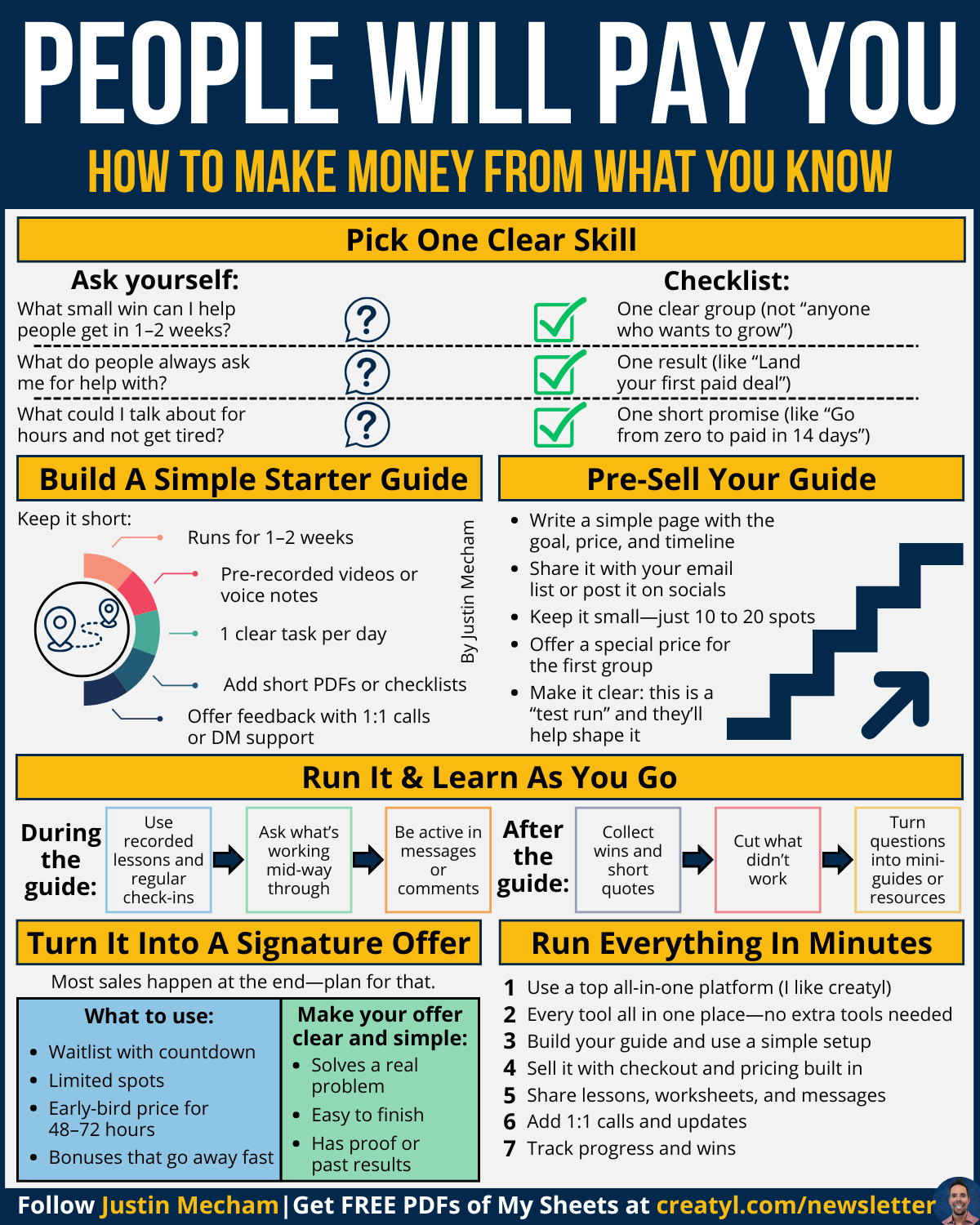
The infographic begins with an important idea: pick one clear skill.
But clarity requires more than choosing a topic.
Suppose you choose writing.
That is still too large.
Writing for whom?
For what purpose?
Toward which result?
Instead of:
“I teach writing.”
Move toward:
“I help consultants write clearer proposals that are easier for prospects to approve.”
Now something changes.
The buyer can recognize themselves.
They can understand the problem.
They can imagine the outcome.
The narrower offer often feels more valuable because it sounds designed for a real situation rather than everyone.
You can always expand later.
In the beginning, specificity makes selling easier because people understand you faster.
Find a Small Win You Can Create in One or Two Weeks
The temptation when creating a product is to solve everything.
Resist it.
A strong first offer does not need to completely transform someone’s life.
It needs to produce a useful result.
Ask:
What small win could I help someone achieve in seven to fourteen days?
That time frame forces useful constraints.
It prevents you from creating a six-month course when the buyer may only need a three-page checklist.
Perhaps the result is:
Setting up a first client onboarding system.
Writing a stronger LinkedIn profile.
Preparing for an important interview.
Creating a first digital offer.
Organizing a weekly content plan.
Building a simple budget.
Creating a repeatable meeting system.
Improving a proposal.
The smaller the promised result, the easier it becomes to make the path concrete.
And the easier the path looks, the easier it becomes for someone to believe they can finish it.
Completion matters.
People do not need another product sitting unopened in a folder.
They need progress.
Your First Product Should Probably Be Smaller Than You Think
A common mistake is assuming a paid product must contain a lot of content.
More videos.
More modules.
More templates.
More bonuses.
More information.
But customers rarely measure value by file size.
They measure it by usefulness.
If twelve pages solve the problem, fifty pages can make the product worse.
If three lessons create the result, fifteen lessons may add unnecessary friction.
If one template removes five hours of work, that template may be worth more than an enormous course the buyer never finishes.
A simple starter product could include:
A short written guide that explains the process.
A checklist that keeps someone from missing important steps.
A few short videos or voice notes for the sections that need explanation.
One practical task per day.
A worksheet that helps the buyer apply what they learned.
Optional feedback if the first version is small enough for you to provide it.
The goal is not to impress people with volume.
The goal is to help them finish.
Build Around Decisions, Not Information
This is one of the most important upgrades you can make to a knowledge product.
Information is everywhere.
A person can search for an answer, watch a video, ask AI, read an article, or download another free guide.
What people often struggle with is knowing which answer applies to them.
That means your real value may be judgment.
Do not only teach:
“Here are ten marketing methods.”
Teach:
“Use this method if you are starting without an audience. Use this one if you already have warm leads. Ignore these two until you have consistent demand.”
Do not only teach:
“Here are seven productivity systems.”
Teach:
“If your problem is distraction, start here. If your problem is unclear priorities, start there.”
Decision support is valuable because it reduces uncertainty.
A customer is often paying to avoid weeks of guessing.
Pre-Sell Before You Spend Weeks Building
Perhaps the most useful discipline for a first product is learning to ask for payment before everything is complete.
This can feel uncomfortable.
Good.
That discomfort produces valuable information.
It is easy for someone to say:
“That sounds awesome.”
It is harder for someone to say:
“Yes, I will pay $49 for that.”
Those two responses are not equal.
Money creates a stronger signal.
You do not need to mislead anyone. Tell early buyers exactly what they are joining.
You might say that you are running a small first version, that the group will be limited, and that their feedback will help shape the final product.
You can give them a favorable early price in exchange for participating while the product is still being refined.
Now you are learning with real buyers rather than guessing alone.
If nobody buys, you have not failed.
You have received information before wasting months.
That is a win.
A Better Pre-Sell Test Than Asking, “Would You Buy This?”
Do not simply ask people whether they would buy something.
People want to be encouraging.
Instead, create a real buying decision.
Write a simple page containing:
The problem.
The intended buyer.
The result.
What is included.
The timeline.
The price.
A way to buy.
Then put it in front of people who actually have the problem.
Watch what they do.
Do they ask questions?
Do they click?
Do they buy?
Do they hesitate around the same point?
Does one sentence create more interest than another?
Those behaviors tell you far more than compliments ever will.
Keep the First Group Small on Purpose
You do not need one hundred customers to prove something works.
Ten customers can teach you an enormous amount.
Sometimes three can.
A smaller first group gives you the ability to watch the experience closely.
Where do people get stuck?
Which lesson creates the biggest result?
Which resource never gets used?
What question keeps appearing?
What did people think they were buying?
What did they actually value?
What result surprised them?
That information becomes the blueprint for version two.
Your first customers are not simply revenue.
They are research.
Run It and Learn While It Is Happening
A creator often waits until the end of a product to ask for feedback.
That can be too late.
Ask throughout the experience.
After the first few lessons, ask:
What has been most useful?
What still feels unclear?
Where did you slow down?
What almost made you stop?
What would make the next section easier?
This gives you a chance to correct problems while the customer is still experiencing them.
It also helps distinguish what you think is valuable from what the customer actually values.
Those are not always the same thing.
You may spend hours creating a detailed video only to discover the one-page checklist is what everyone uses.
That is not disappointing.
That is valuable.
The buyer just told you where the real product lives.
Turn Customer Questions Into Future Products
Customer questions should never disappear inside your inbox.
Save them.
Every repeated question can become:
A lesson.
A checklist.
A FAQ.
A template.
A mini guide.
A new product.
A sales page section.
A piece of content.
A workshop topic.
This is how a knowledge business begins developing naturally.
Instead of sitting alone trying to invent new products, your customers begin showing you what to make next.
Imagine ten buyers all asking:
“How do I price this?”
That is a signal.
Or:
“What do I say when a prospect does not reply?”
Another signal.
Or:
“How do I know whether this idea is worth continuing?”
Another.
The business gets easier when you stop treating questions as interruptions and start treating them as product research.
Collect Wins While They Are Still Fresh
People often wait months to request testimonials.
By then, buyers have forgotten the details.
Capture wins during the experience.
When someone tells you:
“This saved me three hours.”
“This helped me finally finish.”
“I got my first customer.”
“I stopped making the mistake you warned me about.”
Ask permission to save the comment.
Specific proof is significantly more persuasive than vague praise.
Compare:
“Great course!”
With:
“I used the pricing worksheet and finally sent a proposal I had been avoiding for two weeks. The client accepted it the next morning.”
The second example helps a future buyer understand what changed.
Proof works best when it shows movement.
Cut What People Do Not Use
Creators are emotionally attached to the things they build.
Customers are not.
That is useful.
If nobody watches lesson seven, do not automatically create a better lesson seven.
Ask whether lesson seven belongs there at all.
If a resource is rarely downloaded, examine whether it serves the result.
If everyone skips a module and still succeeds, remove it.
Subtraction can make a product more valuable.
Every unnecessary lesson increases the perceived amount of work.
A product that helps someone reach the result in five steps can be more attractive than one requiring twenty.
Do not confuse quantity with quality.
Turn the Best Parts Into Your Signature Offer
Once you have delivered the small version several times, patterns emerge.
You begin to know which steps matter.
You know where customers struggle.
You know the questions they ask.
You know which outcomes create excitement.
You know what language makes the offer easy to understand.
Now you can build something larger.
Not from imagination.
From evidence.
Perhaps your starter guide becomes a complete course.
Perhaps the workshop becomes a coaching program.
Perhaps your consulting process becomes a template library.
Perhaps several small resources become a membership.
Your signature offer should not be the product you dreamed about first.
It should be the product your results gradually revealed.
Design the End Before You Design the Beginning
One overlooked lesson from the original framework is that you should consider what happens after someone completes the first product.
What is their next problem?
What becomes possible once they get the first result?
Suppose you help someone build their first digital offer.
Their next challenge might be finding customers.
After that, improving conversion.
After that, creating repeat sales.
You do not need to build all those products now.
But understanding the progression helps you build the first offer intelligently.
A great business often develops by solving the next logical problem for people who already trust you.
That can be far easier than constantly finding completely new customers.
Make the Technology Almost Boring
Technology should not become the project.
If you are spending three weeks connecting tools before you have made one sale, the technology has become a hiding place.
You need enough infrastructure to:
Create the offer.
Take payment.
Deliver the material.
Communicate with customers.
Collect feedback.
Track progress.
That is enough for the beginning.
Whether you use an all-in-one platform such as creatyl or another setup, the principle matters more than the brand:
Reduce the number of moving pieces until the technology disappears behind the customer experience.
Your buyer does not care how sophisticated your setup is.
They care whether they can pay easily, access what they purchased, understand what to do next, and get the result.
The One-Sentence Offer Test
Before spending another hour building, finish this sentence:
I help [specific person] achieve [specific result] without [major frustration] in [reasonable time frame].
Then remove anything unnecessary.
You may end with something like:
“I help new consultants turn one skill into a simple paid offer in fourteen days without building a full course first.”
Now ask yourself:
Can the right buyer recognize themselves?
Is the result easy to understand?
Is the time frame believable?
Does the frustration matter?
If you need five paragraphs to explain the offer, it still needs work.
Clarity is not just copywriting.
Clarity is product design.
Turning Repeated Advice Into Something People Paid For
I once worked with a professional who had spent years helping teams improve their internal workflows.
They had become the person everyone called when a process was confusing, deadlines kept slipping, or nobody knew who owned the next step.
Coworkers constantly asked:
“Can you look at this?”
“How would you organize this?”
“Can you help us clean up this process?”
They always helped.
But they never viewed those conversations as anything more than being a good teammate.
When we discussed creating income outside their job, they told me they had no idea what they could sell.
That surprised me because they were already solving the same valuable problem every week.
Their first instinct was to build a broad project-management course.
They outlined dozens of lessons covering planning, software, communication, meetings, goal setting, and productivity.
It quickly became overwhelming.
More importantly, none of it had been validated.
They were about to spend months building what they thought people should learn rather than what buyers were actively asking for.
I asked them to stop.
Instead, we reviewed the last twenty requests people had brought them.
One problem appeared repeatedly: small teams had no clear handoff process, so tasks were falling between people.
That was much narrower than project management.
It was also much easier to solve.
We turned the repeated answer into a small offer.
The first version contained a short guide for mapping a workflow, a handoff checklist, a simple ownership template, and a thirty-minute review call.
That was it.
Before building anything else, we offered the pilot to a small group.
Several people bought.
During delivery, we tracked every question.
Buyers repeatedly struggled with role ownership, so we added a simple decision table.
They loved the handoff checklist, so we made it more prominent.
A long section on tools received little attention, so we removed most of it.
The product improved because real customers shaped it.
After several successful deliveries, the person turned the best elements into a larger operational workflow package.
The key was not inventing more information.
It was recognizing that something they had explained dozens of times already contained commercial value.
That is the opportunity many professionals overlook.
Your Seven-Day Knowledge-to-Income Test
You do not need to build an entire business this week. You need enough movement to learn something real.
Day 1: Collect the Questions
Write down ten things people have asked you for help with over the last year.
Look at work, friends, professional messages, client conversations, and repeated requests.
Day 2: Find the Repeated Problem
Circle the questions that point toward the same underlying struggle.
Choose the problem that seems both common and meaningful.
Day 3: Define One Small Result
Ask what useful progress you could help someone achieve within one or two weeks.
Do not solve everything.
Day 4: Choose the Smallest Useful Format
Could the result be delivered through a guide, template, checklist, workshop, short course, consultation, or small coaching package?
Pick the simplest format that can create the outcome.
Day 5: Write the Offer Page
Explain the person, problem, result, contents, timeline, and price on one page.
No complicated website.
No endless branding work.
Day 6: Put It in Front of Real People
Share the offer with people who actually experience the problem.
Ask for the sale, not general encouragement.
Day 7: Study What Happened
What questions appeared?
What created interest?
Where did people hesitate?
Did anyone pay?
Use the evidence to decide whether to continue, change the offer, or test another problem.
That week will teach you more than another month spent wondering what business you should start.
The Proof Ladder: What to Look for Before Building More
Not all evidence is equal.
Think of validation as a ladder.
At the bottom, someone likes your idea.
Useful, but weak.
Next, someone gives you their email address.
Stronger.
Then someone asks detailed buying questions.
Stronger again.
Then someone puts down a deposit or pays.
Now you have meaningful evidence.
Then they use the product and achieve a result.
Better.
Then they buy again or refer someone.
That is where the business begins becoming much more interesting.
Move up the ladder before adding complexity.
Do not build a large company around weak evidence.
Five Questions to Ask Every Customer
Customer conversations should improve your next version.
After someone buys, ask:
- What was happening that made you look for help now?
- What had you already tried?
- What almost stopped you from buying?
- What part helped you most?
- What problem do you have next?
Those five questions can influence your marketing, product, pricing, onboarding, and future offers.
Pay particular attention to the words customers use.
They often describe the problem far better than you do because they are living it.
Save those phrases.
Use them when explaining the product later.
The Difference Between Being Knowledgeable and Being Useful
You can know a lot without having a product.
Products require structure.
Your experience becomes sellable when you organize it around someone else's progress.
The question is no longer:
“What do I know?”
It becomes:
“How can what I know make something easier, faster, clearer, safer, or less expensive for another person?”
That is when expertise becomes an offer.
And once you learn that skill, you can use it repeatedly throughout your career.
Resources Worth Exploring
Book: The Mom Test by Rob Fitzpatrick
This is one of the strongest practical books for learning how to speak with potential customers without accidentally collecting polite compliments instead of useful evidence.
It teaches a simple but important skill: learning about people's real behavior before building around assumptions.
Book: Obviously Awesome by April Dunford
A valuable resource for understanding positioning.
It can help you explain why your offer matters, who it is for, what it replaces, and why someone should choose it.
Podcast: How I Built This with Guy Raz
The founder stories are useful because they repeatedly reveal how businesses evolve through customer problems, imperfect beginnings, adaptation, and evidence rather than perfect original plans.
Tool: A Customer Language Bank
Create one simple document where you save real phrases from customer conversations, emails, comments, reviews, and sales calls.
Organize them under headings such as Problems, Desired Results, Objections, Questions, and Exact Phrases.
Over time, this becomes one of the most valuable assets in your business because your marketing begins sounding like your customers instead of sounding like marketing.
Your Paycheck May Be Paying You for Skills You Have Never Learned to Own
There is something strange about becoming good at your job.
The better you become, the easier your expertise is to overlook.
You stop noticing the decisions you make automatically.
You forget how long it took to develop your judgment.
The shortcut feels obvious.
The process feels routine.
The answer comes quickly.
So you assume everyone knows it.
They do not.
Somebody is currently struggling with something you learned years ago.
Someone is losing hours to a process you can explain in fifteen minutes.
Someone is afraid of making a mistake you already know how to avoid.
Someone is paying another person to solve a problem you solve every week.
That does not mean every skill needs to become a business.
It does mean you should stop assuming your knowledge has value only because an employer attached it to a job description.
Your title is one container for your ability.
It is not the source of it.
The most important shift is not quitting your job or immediately replacing your salary.
It is recognizing that your value can travel with you.
The first sale simply makes that visible.
Maybe it is $25.
Maybe it is $100.
Maybe it is $1,000.
The amount matters far less than what it proves.
Someone outside your employer saw enough value in your knowledge to pay for access to it.
From that moment forward, the story changes.
Your paycheck may still matter enormously.
Your job may remain important for years.
But it is no longer the only evidence that you are capable of creating value.
You have another piece of proof.
And once you learn how to turn useful knowledge into a clear result for another person, you possess something far more important than one product.
You possess the ability to create options.
That is where independence actually begins.
Download the Related Infographic
Want a practical visual guide to turning what you already know into something people can pay for?
Download the People Will Pay You: How to Make Money From What You Know infographic PDF.
It walks through choosing one clear skill, creating a small starter offer, pre-selling before overbuilding, learning from early customers, collecting proof, improving what works, and gradually turning a useful first product into a stronger signature offer.