

Click Here to Download the PDF.
There is a strange moment that happens when you become really good at your job.
At first, getting better feels like progress. You learn faster, solve harder problems, become the person people depend on, and start getting trusted with work that would have overwhelmed you a few years earlier.
Then one day you notice something uncomfortable.
You have become incredibly good at building value, but almost all of that value belongs somewhere else.
You create the system, but the company owns the system. You solve the customer problem, but the company keeps the customer. You improve the process, but the company keeps the improvement. You help generate more revenue, but your paycheck still arrives according to the terms someone else set.
There is nothing inherently wrong with employment. A good job can provide stability, meaningful work, excellent relationships, valuable experience, and opportunities that would be difficult to create alone.
The problem begins when your job becomes the only place where your skills are allowed to create value.
That is when competence can quietly become dependency.
The more useful you become inside one company, the easier it is to assume that your usefulness belongs there.
It does not.
The skill belongs to you.
The judgment belongs to you.
The experience belongs to you.
The ability to solve the problem travels with you.
And once you understand that, the question changes from, “What business should I start?” to something much more practical:
“How can I take one thing I already know how to do and turn it into something I own?”
That is where building your own thing actually begins.
The Hardest Part Is Often Realizing How Valuable You Already Are
People frequently assume they need to learn something new before they can create income independently.
Another certification.
Another course.
Another year of experience.
Another tool.
Another qualification.
Sometimes additional learning makes sense. But for many experienced professionals, lack of knowledge is not the real problem.
Recognition is.
You have done something so many times that it no longer feels valuable.
Maybe you can take a messy project and organize it quickly. Maybe you know how to write an email that gets a response. Maybe you can prepare someone for an interview, build an onboarding process, improve a presentation, simplify a complicated workflow, create a content system, negotiate a contract, structure a sales conversation, or explain an intimidating piece of technology in plain language.
Because you can do it without much struggle now, you forget what it felt like before you knew how.
That is expertise blindness.
The skills most likely to become useful products are often the ones you underestimate precisely because they have become normal to you.
Do not ask only, “What am I exceptional at?”
Ask:
“What feels easy to me that other people keep finding difficult?”
That question tends to uncover much better starting points.
Think Like an Owner Before You Become One
A business-owner mindset starts before you register a company, build a website, or earn your first dollar.
It starts when you stop viewing your skill only as a responsibility and begin viewing it as an asset.
An employee might think:
“I create onboarding processes.”
An owner asks:
“What specific onboarding problem could this process solve for other companies?”
An employee might think:
“I write reports.”
An owner asks:
“What decision does my reporting system help someone make faster?”
An employee might think:
“I coach my team.”
An owner asks:
“What leadership problem have I learned to solve repeatedly?”
That change matters because businesses are built around problems and outcomes, not job descriptions.
Your title may contain twenty responsibilities. Your first offer probably needs one.
The goal is not to package your entire career.
It is to extract one useful piece.
Start With One Problem, Not a Personal Brand
A common mistake is believing you need to build an audience before you can build an offer.
You do not.
An audience helps distribution. It does not create value.
Start with one painful problem experienced by one recognizable type of person.
The clearer the problem, the easier everything becomes afterward.
Instead of saying:
“I help people become better leaders.”
You might say:
“I help newly promoted managers run one-on-one meetings that actually improve performance.”
Instead of:
“I help businesses with operations.”
Try:
“I help small agencies stop client projects from getting stuck between departments.”
Instead of:
“I teach people how to create digital products.”
Try:
“I help experienced professionals turn one repeatable skill into a simple paid digital offer.”
The narrower description may feel limiting.
It is usually liberating.
A specific problem gives you something concrete to build, something clear to sell, and someone obvious to talk to.
You can expand later.
Early businesses usually need less breadth and more proof.
Choose One Audience You Can Already Reach
Your first customer should not require a complicated advertising strategy.
Look for people already near you.
Former colleagues.
Professional connections.
LinkedIn contacts.
Industry groups.
Existing clients.
Newsletter subscribers.
Friends who work in the relevant field.
People who have previously asked you for help.
The easiest audience to understand is often one you have already spent years around.
If you have worked in recruiting for ten years, you probably understand candidate problems better than someone entering that market today.
If you have spent years leading agencies, you understand agency problems.
If you have spent years managing projects, you know what makes projects go wrong.
Your career has already been giving you market research.
Start there.
Build One Offer Before Building a Business
An early business does not need a complicated product ladder.
It needs an offer someone understands.
A useful first offer answers four questions:
Who is this for?
What problem does it solve?
What result will they get?
How will you help them get there?
That is enough.
Your delivery method might be a guide, course, template, workshop, service, consulting call, coaching package, membership, or combination of a few simple pieces.
The format matters less than the outcome.
A forty-page ebook nobody finishes is not automatically better than a four-page checklist someone uses every week.
A twenty-module course is not automatically more valuable than a ninety-minute workshop that solves the problem immediately.
The buyer is not purchasing content volume.
They are purchasing movement.
Know Your “Why,” but Make It Practical
There is value in understanding why you want to build something of your own.
But “I want freedom” is often too vague to guide decisions.
Freedom from what?
Freedom for what?
Do you want income that is not tied entirely to one employer?
Do you want more control over your schedule?
Do you want to build an asset you could eventually sell?
Do you want creative ownership?
Do you want a safety net?
Do you want to replace one monthly bill?
Do you eventually want to leave your job?
The clearer the reason, the easier it becomes to make trade-offs.
A person trying to create an extra $1,000 a month needs a very different business from someone trying to build a company with twenty employees.
Do not build for someone else's version of success.
Build for the life you actually want.
Plan What Matters on One Page
One of the easiest ways to delay starting is to turn planning into a project of its own.
You probably do not need a fifty-page business plan.
A one-page plan can answer most of what matters initially.
Write down:
The problem you solve.
The person you solve it for.
The offer.
The promise.
The price.
The one place you will find potential buyers.
The one number you will track most closely.
The three things you need to accomplish this week.
If those elements are unclear, adding more pages will not help.
If they are clear, you probably know enough to begin.
Pick One Number That Tells You Whether the Business Is Moving
Early businesses become confusing when everything gets measured.
Followers.
Likes.
Email subscribers.
Page views.
Comments.
Downloads.
Revenue.
Calls.
Leads.
Conversion.
Retention.
You may eventually need several metrics, but early on you need one number that reflects whether the current stage is working.
If you have never sold anything, track paid customers.
If people visit the page but do not buy, track conversion.
If buyers purchase once but never return, track repeat sales.
If the product is working but too few people see it, track qualified conversations or leads.
The right metric changes as the bottleneck changes.
That is an important idea.
Do not track numbers because other businesses track them.
Track the number that tells you where your business is currently stuck.
Map the Simplest Possible Path From Stranger to Customer
You do not need an enormous funnel.
You need a path.
Someone discovers an idea.
They understand that you solve a problem they have.
They see enough proof to trust you.
They receive a clear invitation.
They buy.
That may happen through a LinkedIn post, email, referral, direct message, webinar, conversation, or search result.
The path can be simple.
Complex funnels often hide weak offers.
If people understand the problem, want the result, trust the person helping them, and can buy without friction, you already have the beginning of a sales system.
Use One Traffic Source Until You Understand It
Trying to be everywhere creates shallow progress everywhere.
Pick one place where your potential customers already spend time and learn how that environment works.
If that is LinkedIn, learn LinkedIn.
If it is email, learn email.
If it is industry communities, become genuinely useful there.
If your business grows through referrals, build a deliberate referral process.
You can add channels later.
But one dependable source of qualified attention is far more useful than six accounts you struggle to maintain.
The principle is simple:
Do not expand distribution before learning what actually converts.
Build Growth Loops, Not Constant Launches
A healthy business becomes easier to grow when one successful action creates the possibility of another.
A customer gets a result.
That result becomes proof.
The proof improves the offer page.
The stronger offer page creates another customer.
That customer refers someone.
The new customer asks a recurring question.
That question becomes content.
The content attracts another buyer.
That is a growth loop.
The business becomes stronger because each useful result creates material that helps create the next one.
This is much more sustainable than starting from zero every Monday.
Set an Income Goal That Changes Something Real
An arbitrary income goal is difficult to care about.
A meaningful one is different.
Instead of saying:
“I want to make $10,000 a month.”
Start with:
“I want this to pay my mortgage.”
Or:
“I want this to cover childcare.”
Or:
“I want this to replace twenty percent of my salary.”
Or:
“I want six months of runway before I consider leaving.”
Now the goal has context.
The first $500 might matter enormously if it pays a bill currently funded entirely by your salary.
That is why early independent income can feel disproportionately powerful.
It creates evidence that your employer is no longer the only possible source.
Know the Difference Between Revenue and Profit
The first time money arrives, it is easy to treat all of it like income.
Do not.
Revenue is what customers pay.
Profit is what remains after the costs required to earn and deliver that revenue.
Track expenses from the beginning.
Software.
Payment processing.
Contractors.
Advertising.
Equipment.
Taxes.
Professional services.
Refunds.
Delivery costs.
Your business does not become healthier merely because revenue increases.
The point is to understand how efficiently value becomes income you can actually keep.
Score Your Week Instead of Relying on Your Mood
Entrepreneurship can feel fantastic on Monday and terrible on Thursday without the underlying business changing much.
That makes emotion a poor measurement system.
Create a simple weekly scorecard.
Did you have the buyer conversations you planned?
Did you send the offers?
Did you publish useful content?
Did customers get results?
Did revenue move?
What produced the strongest response?
What stalled?
This prevents a quiet week from convincing you the entire idea is failing.
It also prevents one lucky sale from convincing you that everything is working.
Patterns matter more than isolated moments.
Spend Less Than You Earn While the Business Is Young
Early revenue can create the temptation to immediately upgrade everything.
Better software.
A nicer website.
More subscriptions.
New equipment.
Paid advertising.
Contractors.
Some investment will eventually make sense.
But early businesses benefit enormously from remaining financially light.
The smaller your operating costs, the less revenue you need to stay alive.
That creates time to learn.
And time is one of the most valuable things an early business can buy.
Keep the Business Moving With Small Launches
Many people disappear for months to prepare for a large launch.
A faster approach is to create something small enough that it can be put in front of buyers quickly.
Set a short deadline.
Forty-eight hours.
One week.
Two weeks.
The exact window depends on the offer, but the principle is the same:
Reduce the time between idea and feedback.
You do not learn much while the product sits privately on your laptop.
The market begins teaching you when someone else sees it.
Build Repeat Systems Around Anything That Happens Twice
The first time you perform a task, do it manually.
The second time, pay attention.
The third time, consider creating a system.
Your system might be a checklist, template, saved response, automation, standard process, calendar
reminder, or documented procedure.
Examples include:
Customer onboarding.
Product delivery.
Follow-ups.
Testimonials.
Refunds.
Content publishing.
Sales conversations.
Invoices.
Customer questions.
Repeatability is what gradually turns self-employment into something more durable.
If every customer requires you to invent the business again, you have not created a system yet.
Fix the Biggest Blocker First
Business owners can find twenty things to improve at any given moment.
The question is which one matters now.
Maybe traffic is fine but nobody buys.
Do not create more traffic.
Fix the offer.
Maybe people buy but stop using the product.
Do not increase advertising.
Fix the experience.
Maybe buyers love the result but delivery consumes too much time.
Build systems.
Maybe everything works but nobody knows you exist.
Now distribution matters.
The fastest businesses are not constantly improving everything.
They identify the constraint and work there first.
Refresh the Plan Every Two Weeks
Your original assumptions will not all survive contact with customers.
That is a good thing.
Every two weeks, ask:
What have I learned that makes my original plan outdated?
Maybe the audience describes the problem differently.
Maybe a secondary feature is actually the main reason people buy.
Maybe the price is wrong.
Maybe the best customers come from a place you did not expect.
Maybe you discover you dislike delivering part of the service.
Update the plan.
A business plan should not become something you defend.
It should become something you improve.
Decide With Clarity, Not Excitement
Entrepreneurs encounter endless opportunities.
New products.
Partnerships.
Platforms.
Channels.
Features.
Customers asking for something custom.
The ability to say yes is useful.
The ability to say no is often more valuable.
Before pursuing something new, ask:
Does it help the metric that matters now?
Does it serve the same customer?
Does it make the core offer stronger?
What existing work will receive less attention if I say yes?
What evidence suggests this matters?
Good decisions protect focus.
Score Ideas Before Building Them
When a new idea appears, rate it against consistent criteria.
Does the customer clearly need it?
Have people asked for it?
Can you explain the value quickly?
Does it fit what you already sell?
Can you test it cheaply?
Would success meaningfully improve the business?
Are you excited about it because it is useful, or because it is new?
Novelty is seductive.
Evidence is more useful.
Fix Funnel Drop-Offs Instead of Adding More Funnel
If one hundred people visit your offer and nobody buys, creating more traffic may simply create more people who do not buy.
Find where people stop.
Are they confused by the headline?
Do they understand who the product is for?
Is the outcome specific?
Is proof missing?
Does checkout feel difficult?
Does the price make sense relative to the promise?
Fixing one broken step can create more growth than adding an entirely new channel.
Use Short Planning Cycles
Long-range vision matters, but short execution cycles keep the business grounded.
A twelve-week cycle is useful because it creates enough time to achieve something substantial without encouraging endless delay.
Choose a meaningful outcome for the period.
Break it into weekly moves.
Review progress every week.
Adjust quickly.
At the end of twelve weeks, decide what deserves another cycle.
You do not need to know exactly what your business will look like three years from now.
You need to know what you are proving next.
Plan for Failure Before You Need the Plan
Optimism is useful when building.
Preparation is useful when things go wrong.
Ask:
What happens if sales drop for two months?
What happens if a major customer leaves?
What happens if the platform changes?
What happens if I cannot work for two weeks?
What happens if an offer stops converting?
You do not need to live in fear.
You need enough resilience that one surprise does not threaten the entire business.
Build buffers.
Keep costs manageable.
Avoid dependence on one customer.
Own your customer relationships where possible.
Document important systems.
Risk is easier to handle when you think about it before it arrives.
Cut Low-Impact Work Ruthlessly
The early stages of building something are filled with activities that look important.
Tweaking logos.
Changing fonts.
Reorganizing folders.
Trying new software.
Watching another tutorial.
Rewriting an about page nobody visits.
The test is simple:
Does this help someone discover, trust, buy, use, or recommend the offer?
If not, it may be necessary eventually, but it probably does not deserve your best hours today.
Being busy building a business is not the same as building a business.
Your Daily Game Plan Matters More Than Your Annual Dream
The business is ultimately created through ordinary days.
A useful daily rhythm might include a small number of repeatable actions.
Write one strong idea.
Answer one customer objection.
Publish something useful.
Send a handful of relevant sales emails or messages.
Review the one metric you currently care about.
Talk to customers.
Improve the offer.
You do not need seventeen priorities.
You need a few actions tied directly to customers and outcomes.
The businesses that look complicated from the outside are often driven by surprisingly simple daily behaviors.
Write Headlines That Make the Problem Instantly Clear
Your headline does not need to sound clever.
It needs to make the right person stop because they recognize themselves.
Instead of:
“Transform Your Future.”
Try:
“Turn One Skill You Already Use at Work Into Your First Paid Digital Offer.”
The second headline sacrifices mystery for clarity.
That is usually a good trade.
Customers should not need to decode what you sell.
Answer Objections Before People Have to Ask
Most potential buyers have questions running silently through their minds.
Will this work for someone like me?
Is it worth the price?
Do I have enough time?
Is this too advanced?
Could I figure it out myself?
What happens after I buy?
Good sales pages do not pressure people into ignoring those concerns.
They answer them.
Listen carefully to every objection you receive during conversations.
Then improve your page until the next person does not need to ask.
Use One Clear Action Per Page
Do not give someone seven directions after finally earning their attention.
If the page exists to sell the product, the main action should be buying the product.
If it exists to book a consultation, make the consultation obvious.
If it exists to join a waitlist, make that the focus.
More choices feel flexible.
They often create hesitation.
Clarity removes cognitive work from the buying process.
Make Checkout Boringly Easy
The worst place to impress someone with complexity is after they have decided to buy.
Reduce unnecessary fields.
Explain what happens after payment.
Make the price visible.
Make buttons clear.
Test the experience yourself on mobile.
A customer who wants your product should not need determination to complete the transaction.
Build It With the Simplest Technology That Works
Your early technology needs are smaller than they probably feel.
You need somewhere to create and host the offer, accept payment, deliver what was purchased, communicate with customers, and review basic results.
An all-in-one option such as creatyl can keep the number of moving pieces down if that fits what you are building.
The important principle is not choosing the most advanced platform.
It is choosing technology that allows you to spend less time connecting tools and more time helping customers.
Complex technology should be earned by a complex need.
Do not create the need just because the tool exists.
Here’s A Real-World Example…
I once worked with someone who had spent years leading internal operations at a growing company. They had become the person senior leaders called whenever a process broke, projects became messy, or teams could not agree on ownership.
They were excellent at the work.
They were also increasingly frustrated.
They wanted to build something independently but kept telling themselves they did not have a business idea.
That statement did not match reality.
They were solving valuable problems every week.
They simply viewed those skills as company property because that was where they had always used them.
Their first instinct was to leave the company and start a broad consulting business.
The problem was that “operations consulting” was too vague.
Who was it for?
What would customers buy?
What result would they receive?
How much should it cost?
There were no clear answers.
They could have spent months designing a website and describing themselves as a consultant without discovering whether anyone wanted a specific offer.
Instead, we reviewed the problems people repeatedly asked them to solve.
One stood out.
Small leadership teams were losing hours every week because recurring processes lived in people's heads rather than inside simple systems.
That was the starting point.
We created one narrow offer: a process cleanup sprint for small teams.
The promise was simple. We would identify one recurring workflow that created wasted time, document it, remove unnecessary steps, assign clear ownership, and turn it into a repeatable checklist.
The first version was delivered manually.
That mattered because we could watch every step.
We noticed which questions clients struggled to answer. We learned what information needed to be collected before the session. We created a reusable process map. We documented the recommendations that appeared repeatedly.
The first clients paid for the service.
That created proof.
Then the repeated pieces became templates.
The templates became a small digital toolkit.
The toolkit created a lower-cost way for people who did not need consulting to get value from the same expertise.
Nothing started with a brilliant new business model.
It started with one skill the person had already been using for years.
The business appeared when we separated that skill from the job title and connected it directly to a problem someone else wanted solved.
A 30-Day “Build Your Own Thing” Test
You do not need to resign, register ten companies, create a massive site, or reinvent your life this month.
You need one piece of proof.
Week 1: Find the skill
Write down every problem people regularly ask you to solve.
Circle the ones you could confidently help with again.
Choose one.
Week 2: Find the buyer
Speak with at least five people who experience that problem.
Do not sell immediately.
Understand what they currently do, what frustrates them, what the problem costs, and what result they actually want.
Week 3: Create the smallest paid offer
Define one outcome.
Choose the simplest delivery format.
Set a price.
Put the offer on one clear page.
Week 4: Sell and learn
Ask real people to buy.
Deliver carefully.
Record every question.
Collect evidence of results.
At the end of thirty days, review what happened.
Do not judge yourself by whether you built a huge business.
Judge the experiment by whether you learned something true.
Did anyone pay?
Did the product help?
What did customers care about most?
What would you change?
What should happen next?
That is how something real begins.
Five Questions to Ask Every Friday
End each week with these questions:
- What created actual customer interest this week?
- What activity looked productive but created little value?
- What did customers say that I should remember?
- What repeated work could become a system?
- What is the one thing I should do more of next week?
Fifteen minutes of honest review can prevent months of random activity.
Resources Worth Reading and Using
Book: Company of One by Paul Jarvis
This is a valuable resource for anyone who wants to create a profitable, manageable business without automatically assuming success requires building a large organization. It challenges the idea that every business must chase endless size and complexity.
Book: The Mom Test by Rob Fitzpatrick
One of the most practical books for learning how to talk with potential customers before building. It helps you separate polite encouragement from useful evidence.
Book: The E-Myth Revisited by Michael E. Gerber
Particularly useful once you begin delivering consistently. Its core lesson about building systems rather than creating a business entirely dependent on the owner becomes increasingly important as demand grows.
Podcast: How I Built This with Guy Raz
Useful for hearing how businesses actually develop. The stories repeatedly show that the final company rarely looks exactly like the original idea. Customer feedback, unexpected opportunities, mistakes, and persistent experimentation shape what eventually works.
Practical Tool: Your Skills-to-Assets Inventory
Create a document with four columns:
Skill: What can I do reliably?
Problem: What problem does that skill solve?
Person: Who experiences that problem?
Asset: How could I package the solution?
For example:
Project management → missed handoffs → small agencies → workflow checklist.
Recruiting → weak interviews → job seekers → interview preparation guide.
Leadership → ineffective one-on-ones → new managers → manager toolkit.
Design → confusing presentations → consultants → slide template pack.
Repeat this exercise until you stop seeing your experience only as a job description and start seeing the assets hidden inside it.
Your Employer Did Not Create Your Value
There is an uncomfortable truth about becoming valuable at work.
The better you become, the more reasons everyone has for you to stay exactly where you are.
Your manager wants the reliable person to remain.
Your team wants the person who knows how everything works.
The company wants someone who can solve problems without requiring much supervision.
None of that is malicious.
But none of it automatically builds your independence either.
That part belongs to you.
You can appreciate the opportunities a job gave you and still decide that your best thinking should eventually build something you own.
You can be a loyal employee and still create an asset outside the company.
You can learn from your work without allowing your job title to become the boundary of what your knowledge is worth.
And you do not have to start with something enormous.
One problem.
One person.
One offer.
One page.
One sale.
The first sale will probably not change your financial life.
But it may change your understanding of your financial life.
For the first time, someone who did not employ you paid you because of the value of what you knew.
That distinction matters.
Your skill worked outside the system where you learned to use it.
Once that happens, an entirely different future becomes possible.
Not guaranteed.
Possible.
And possibility is powerful because it gives you somewhere to move.
From there, you can improve the offer.
Build proof.
Create systems.
Find more customers.
Create products.
Reduce your dependence.
Maybe eventually leave.
Maybe keep your job and enjoy the extra income.
Maybe build something much larger than you originally imagined.
You do not need to know the ending before you start.
You need to stop treating everything you have learned as if it belongs permanently to the company currently paying you.
Your employer can rent your skills for part of the week.
They do not own them.
The experience is yours.
The judgment is yours.
The lessons are yours.
And whenever you are ready, you can start using a small piece of what you already know to build something that is yours too.
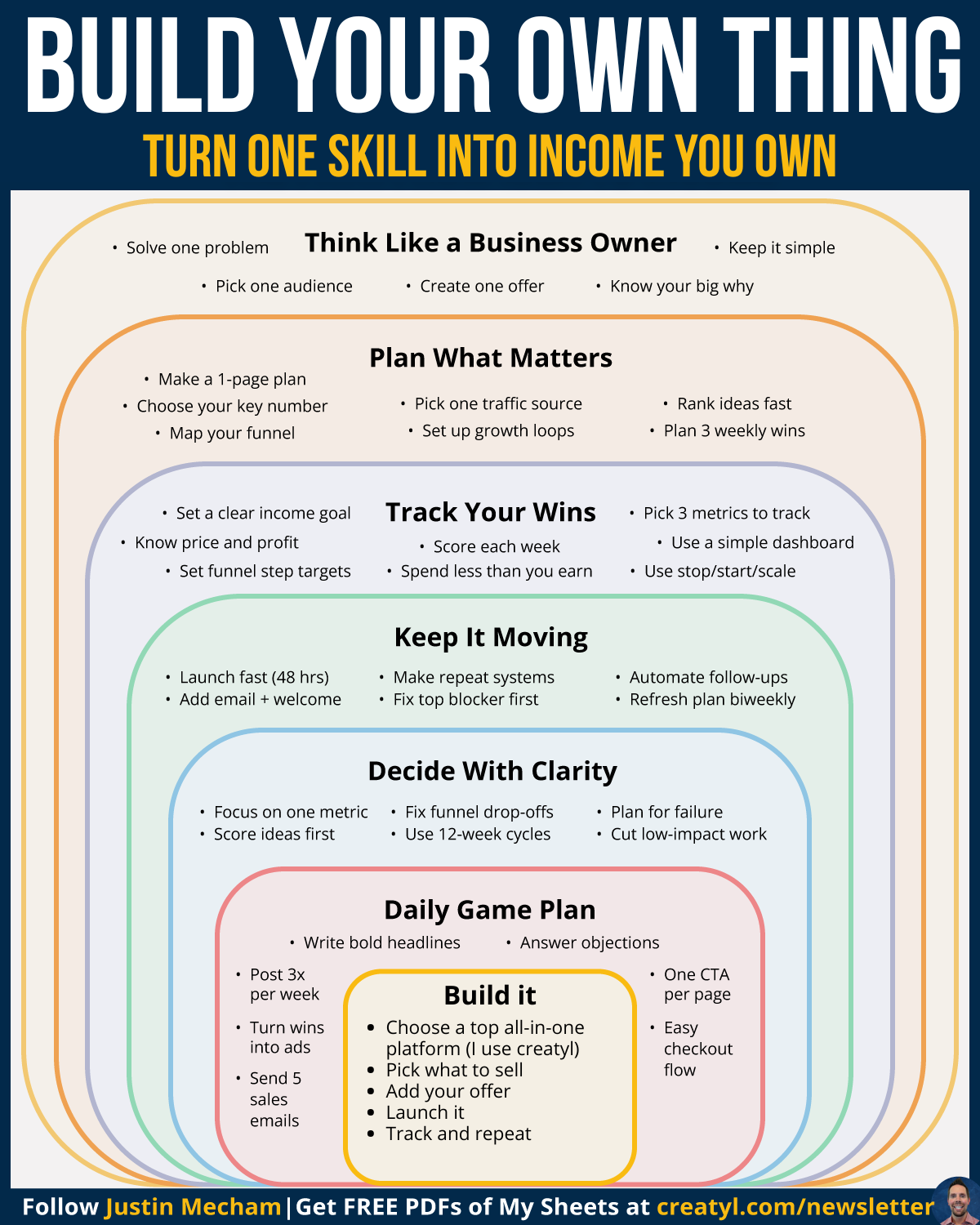
Download the Related “Build Your Own Thing” Infographic
Want the visual framework beside you while you start?
Download the Build Your Own Thing: Turn One Skill Into Income You Own infographic PDF. It brings the entire system together in one place, from choosing one problem and planning what matters to tracking the right numbers, creating repeatable systems, making clearer decisions, building a simple daily game plan, and finally turning the idea into something people can actually buy.