

Click Here to Download the PDF.
Why a Full Calendar Can Still Produce an Empty Week
There is a particular kind of exhaustion that comes from working all day without feeling as though anything meaningful moved forward.
You answered messages. You attended meetings. You handled small requests. You checked several items off your list. You may have even worked late.
Yet when the day ended, the project that mattered most was still waiting for you.
That experience is easy to misunderstand. It can make you question your discipline, your focus, or your ability to manage time. But in many cases, the problem is not that you failed to work hard enough.
The problem is that your attention was spent before your priorities had a chance to use it.
Modern work makes busyness incredibly easy. There is always another message to answer, another notification to check, another meeting to join, and another small task that can be completed quickly.
These activities create visible motion, which feels satisfying. They give you proof that you have been active.
But activity and progress are not the same thing.
A person can complete twenty low-value tasks and still avoid the one decision, conversation, or piece of focused work that would materially change the week.
Another person can protect two uninterrupted hours, finish one meaningful task, and create more value than the first person produced all day.
That is the difference between being occupied and being effective.
The goal of productivity is not to squeeze more activity into every open space. It is to make sure your best energy reaches your most important work before everything else claims it.
Busy Work Has Excellent Marketing
Busyness looks responsible.
It is visible to other people. It fills calendars, creates notifications, and gives you something to say when someone asks how your day went.
It can even protect you from the uncomfortable feeling of facing a difficult priority.
That is why busy work becomes such an effective hiding place.
The important work is often harder to begin because it carries uncertainty.
It might require you to make a decision, produce something original, contact a potential customer, address a difficult issue, or risk creating something that may not work.
Email is easier.
Small administrative tasks are easier.
Rearranging a plan is easier.
Attending another meeting is easier.
Those activities may be necessary, but they become dangerous when they consistently receive your best hours while meaningful work receives whatever energy remains.
The issue is not that you are doing nothing. The issue is that you are doing many things that allow the central task to remain untouched.
This creates a frustrating loop. The important task follows you from one day to the next.
It occupies mental space while you work on everything else. You feel busy during the day and guilty at night.
Eventually, even looking at the task creates tension because it now carries the weight of every previous delay.
A clearer system can interrupt that loop.
Start With One Outcome, Not a Longer List
Most people begin planning by asking, “What do I need to do?”
A better question is, “What needs to be different by the end of today?”
The first question generates activity. The second creates direction.
A useful daily outcome should be specific enough that you can clearly recognize when it is complete. “Work on the proposal” is vague. “Finish and send the first proposal draft” is clear. “Make progress on marketing” is vague. “Contact five qualified prospects and record the responses” is measurable.
This matters because vague work expands. It consumes time without creating a natural finish line. Clear outcomes make it easier to begin, easier to evaluate, and easier to stop.
Choose one primary outcome for the day and let it guide the rest of your decisions. Other work can still happen, but it should not be allowed to displace the one result that matters most.
A simple test can help:
If you completed only one meaningful thing today, which result would make the day feel worthwhile?
That is probably where your focused time belongs.
Do the Work That Creates Results Before the Work That Maintains Appearances
Not all tasks carry equal weight.
Some activities maintain the business. Others create the future of the business.
Maintenance work includes inbox management, routine updates, scheduling, filing, and recurring administration. It keeps the machine running.
Result-producing work creates sales, finishes products, solves major problems, improves systems, develops people, and moves important projects forward.
Both categories matter, but they should not receive equal priority.
Many professionals spend the beginning of the day on maintenance because it feels easier to enter.
They open their inbox, respond to whatever appears, and allow other people’s requests to determine the order of the day.
By the time they reach their important work, their focus is weaker and the calendar has filled up.
Reverse the order.
Before answering routine messages, complete one action tied to the outcome you care about most.
That might mean writing the proposal, making the call, designing the offer, completing the analysis, or preparing the difficult conversation.
The exact task will differ, but the principle remains the same:
Do not give your most valuable work the leftovers of your attention.
Put Focus on the Calendar Before the Calendar Fills Itself
People often treat focused work as something they will do once everything else is finished.
Everything else is rarely finished.
There will always be another message, request, update, or meeting. Unless focused work receives protected space, it will continue getting pushed into evenings, weekends, or an imaginary future week when things finally become quiet.
Schedule it first.
A focus block does not need to last half the day. Even thirty to ninety minutes can produce meaningful progress when the time has a clear purpose and interruptions are removed.
The quality of the block matters more than its length.
Before it begins, decide what you will finish. Close unrelated tabs. Silence notifications. Place your phone out of reach. Keep any needed files ready so the first ten minutes are not lost to setup.
Treat the block like an important meeting. You would not casually leave a client meeting every four minutes to check unrelated messages. Your own priority deserves the same respect.
Over time, protecting this space communicates something important to you and to everyone around you: meaningful work is not what happens after availability. It is part of the job.
Create Before You Consume
The first information you consume often shapes the direction of your attention.
When you begin the day with email, news, social feeds, or team messages, your mind immediately enters response mode. Other people’s priorities become active before you have defined your own.
You may intend to check one message and then begin working, but each message opens another mental loop.
A request creates a task. A comment triggers a thought. A headline shifts your mood. A notification reminds you of something else.
Within minutes, the clean attention you woke up with has been divided among several concerns.
Creating before consuming prevents this.
Write before reading.
Build before browsing.
Think before reacting.
Finish one meaningful piece before allowing the outside world to set the agenda.
This does not mean ignoring important communication. It means choosing when communication gets access to your best attention.
That small boundary can change the quality of an entire day.
One Tab Is a Productivity Strategy
A cluttered screen often reflects a cluttered mind.
Multiple tabs create multiple invitations to switch. Each visible option quietly competes for attention, even when you are not actively using it. The document you are writing has to compete with email, messaging apps, research pages, social media, and unfinished tasks.
One-tab work reduces that competition.
Open what the current task requires and close the rest. When another thought appears, write it down instead of immediately following it. Your brain does not need to trust that you will remember everything. It only needs a reliable place where unfinished thoughts can wait.
This practice may feel restrictive at first. That discomfort is useful. It reveals how often your mind expects instant stimulation whenever a task becomes difficult.
Focus is not merely the absence of distraction. It is the ability to stay with a problem after the novelty wears off.
That is where most valuable work begins.
Mute the Noise Before It Becomes Your Schedule
Every notification makes a small demand:
Look here.
Respond now.
Change direction.
Most of these demands are not emergencies. They only feel urgent because they arrive with sound, movement, or a visible badge.
If every message can interrupt your work immediately, you are not managing your attention. You are lending it out in tiny pieces all day.
Create clear windows for communication instead. Check messages at planned intervals when your role allows it. Let colleagues know when you are available and when you are doing focused work. Use emergency channels only for genuine emergencies.
This is not about becoming inaccessible. It is about becoming intentional.
Constant availability can make you appear responsive while quietly damaging the quality of your work.
Reliable communication matters. So does producing something worth communicating about.
Batch Work to Reduce the Cost of Switching
Your brain does not move instantly from one type of thinking to another.
Writing requires one mental state. Analysis requires another. Meetings, administration, planning, and creative problem-solving each ask for different forms of attention.
When you alternate between them every few minutes, part of your mind remains attached to the previous task. The result is a day filled with transitions and very little depth.
Batching groups similar tasks together.
Answer messages during one or two communication windows. Schedule meetings near one another.
Complete routine administration in a single block. Create several related pieces of content during the same session. Handle invoices, follow-ups, and scheduling together.
Batching does not simply save minutes. It protects mental continuity.
When your brain can remain in one mode for longer, work becomes smoother. You spend less time rebuilding context and more time making progress.
Use Small Tests Instead of Large Assumptions
Perfectionism often appears as overbuilding.
A person has an idea and immediately imagines the complete version. The project becomes so large that beginning feels difficult. Weeks are spent planning details that may not matter.
Small tests create a better path.
Instead of developing the entire program, test one lesson.
Instead of redesigning the full process, test the new step with one team.
Instead of committing months to an offer, show a simple version to five potential buyers.
Instead of writing a complete strategy, try one assumption and measure the response.
Small tests reduce emotional pressure because the purpose is not to prove that you were right. The purpose is to learn what is true.
They also prevent wasted work. A small experiment can reveal a weak assumption before it becomes an expensive commitment.
Progress becomes faster when learning happens earlier.
Make Fewer Decisions by Creating Better Rules
Decision fatigue is not always caused by major choices. It often comes from repeatedly deciding the same small things.
When should I check email?
What should I work on first?
Should I accept this meeting?
How long should I spend on this task?
Should I respond now or later?
Each decision takes a small amount of energy. Repeated throughout the day, they leave less mental capacity for work that requires judgment.
Rules reduce that load.
Examples might include:
- No meetings before the first focus block.
- Email is checked at set times.
- Work that takes less than a certain amount of time is batched.
- Every meeting needs a purpose and desired outcome.
- New ideas are tested small before receiving major resources.
- The most important daily task is chosen before the day begins.
A good rule does not remove thoughtful judgment. It prevents low-value decisions from consuming the energy needed for high-value ones.
Protect Energy, Not Just Time
Two hours on a calendar are not always equal.
An hour when you are alert, rested, and uninterrupted can produce far more than three tired hours at the end of an overloaded day.
This is why productivity cannot be separated from energy.
Sleep, movement, food, breaks, and emotional strain all affect the quality of attention you bring to your work.
Ignoring those factors may create short bursts of output, but the cost eventually appears as mistakes, irritability, mental fog, or disengagement.
Quick breaks can help preserve quality during demanding work. Stand up. Walk briefly. Drink water. Look away from the screen. Allow your mind to reset before returning.
A break should support the work rather than become an escape from it. The intention is to come back sharper, not disappear into another source of distraction.
Sustainable performance does not come from pushing until your attention collapses. It comes from creating a rhythm you can repeat.
Ask for Help Before the Problem Becomes Expensive
Many people carry work too long because asking for help feels like admitting weakness.
The opposite is often true.
Asking early shows awareness. It gives the team time to solve the issue while options are still available.
Waiting until the deadline is already threatened leaves everyone with fewer choices and more pressure.
Help does not always mean handing off the entire responsibility. It may mean requesting context, asking someone to review your thinking, delegating a repeated task, or involving a person with stronger expertise.
The key is to ask while the request is still useful.
A strong request includes three things:
- What you are trying to accomplish.
- Where you are stuck.
- What kind of help would move it forward.
That makes it easier for others to respond without taking over the work entirely.
Write the Steps Down
Repeated confusion is often a documentation problem.
If a task happens more than once, create a simple process for it. Write the steps in the order they occur. Add examples where people commonly get stuck. Remove anything that no longer serves the outcome.
Documentation saves time in several ways. It reduces mistakes, shortens training, makes delegation easier, and stops useful knowledge from living only in one person’s memory.
It also reveals unnecessary complexity.
A process that is difficult to explain may be more complicated than it needs to be. Writing the steps forces you to notice duplication, vague decisions, and avoidable handoffs.
Good documentation is not bureaucracy. It is stored clarity.
Track Wins So Progress Does Not Become Invisible
People often abandon good systems because the progress feels too small to notice.
Important work can move slowly. A major project may require weeks before producing a visible result. Without a way to record smaller advances, it can feel as though nothing is happening.
Track meaningful wins.
A completed draft.
A customer conversation.
A decision made.
A difficult task finished.
A process simplified.
A proposal sent.
A repeated mistake prevented.
The purpose is not to celebrate activity for its own sake. It is to make real movement visible.
Visible progress creates evidence that your effort is working. That evidence makes consistency easier, especially during periods when the final outcome still feels distant.
Review the Week Before Starting Another One
Without reflection, every week becomes a fresh attempt to solve the same problems.
A short Friday review can prevent that.
Ask:
- What meaningful result moved forward?
- What consumed time without creating enough value?
- Where did distraction enter the week?
- Which task kept getting delayed?
- What should be removed, delegated, or simplified?
- What deserves the first focus block next week?
This review turns experience into a better system.
The goal is not to judge yourself. It is to notice patterns before they become routines.
A difficult week can still be useful when it teaches you what to change. A productive week becomes even more valuable when you understand why it worked.
When Busyness Became the Problem
I once worked with a team whose manager appeared to be one of the hardest-working people in the company.
Their calendar was filled from early morning until late afternoon. They responded to messages quickly, joined nearly every conversation, and made themselves available whenever someone needed help.
The team appreciated the effort, but major projects kept falling behind.
Strategic decisions took too long. Important proposals remained unfinished. The manager regularly worked in the evening because the day had been consumed by meetings and small requests.
From the outside, it looked like a workload problem. The initial assumption was that the manager needed more time or more support.
When we reviewed the schedule, a different problem appeared.
Almost every hour was allocated to reacting. There was no protected time for thinking, planning, or producing the work only the manager could do.
The calendar was full, but it was not connected to the team’s most important outcomes.
This created a second problem.
Because the manager handled so many small issues personally, the team stopped making routine decisions without them. More questions reached the manager, which created more meetings, which left even less time for important work.
The manager’s helpfulness had accidentally become a bottleneck.
The harder they worked, the more dependent the system became on their constant availability.
We did not start by adding a new productivity app. We changed the order of the work.
The manager identified one weekly result that mattered most and scheduled three protected focus blocks before accepting additional meetings.
Routine questions were documented in a shared guide.
Team members received clearer decision rights, so they knew what they could handle independently.
Messages were checked during planned windows instead of continuously.
We also introduced a simple meeting rule: every invitation needed a purpose, a desired decision, and a reason the manager’s presence was necessary.
Within several weeks, the manager’s calendar contained fewer meetings, but the team was moving faster.
Important work stopped getting pushed into evenings. Team members made more decisions independently.
The manager was still available, but no longer instantly available for everything.
Nothing changed because they worked longer.
The change came from placing attention where it created the most value.
A Seven-Day Clarity Reset
You do not need to rebuild your entire routine at once. Use one week to identify what is stealing attention and begin correcting it.
Day 1: Choose one meaningful outcome
Write the most important result for the week in one clear sentence. Make sure it describes something completed, not merely something you intend to work on.
Day 2: Protect the first thirty minutes
Begin the day with the task connected to that outcome. Do not open email or messages first.
Day 3: Remove one recurring distraction
Turn off one notification, close one unnecessary channel, or create one communication window.
Day 4: Batch one category of work
Group messages, scheduling, administration, or similar tasks into one block.
Day 5: Finish one delayed task
Choose the task that has been following you through the week and take it to completion before beginning something new.
Day 6: Review what moved
Look at the work that created a real result. Compare it with the activity that only created motion.
Day 7: Write one rule for next week
Turn what you learned into a repeatable rule. Keep it simple enough to follow when the week becomes busy.
The purpose of this reset is not to create a perfect routine. It is to prove that clearer choices can change the quality of a day faster than adding more hours.
Questions to Ask Before Accepting Another Task
Before adding something to your calendar, pause and ask:
- What result does this create?
- Does it need my attention now?
- Am I the right person to handle it?
- What existing priority will lose time if I say yes?
- Could this be shortened, delegated, documented, or removed?
- What would happen if it waited?
- Is this important, or simply visible?
These questions protect you from treating every incoming request as equally valuable.
Every new commitment has a cost, even when the calendar still shows an open space. It consumes attention before the event, time during it, and recovery afterward.
An open hour is not an invitation to fill it. Sometimes it is the space that allows your best work to happen.
Resources for Doing More Meaningful Work
Book: Essentialism by Greg McKeown
This book explores the discipline of identifying what matters most and removing work that competes with it. It is particularly useful for people who are capable, dependable, and therefore repeatedly asked to take on more.
Book: Deep Work by Cal Newport
A practical examination of why focused, uninterrupted work has become increasingly valuable and how to create conditions that support it.
Book: Four Thousand Weeks by Oliver Burkeman
Rather than presenting another system for fitting everything into your schedule, this book challenges the belief that everything can or should be completed. It offers a more honest way to think about limits, attention, and meaningful use of time.
Podcast: The Productivity Show
This podcast covers practical systems for focus, planning, organization, and reducing unnecessary friction in everyday work.
Practical exercise: The outcome audit
For one week, write down how you spent each major work block. At the end of the week, mark each block as one of three categories:
- Created an important result.
- Maintained an existing responsibility.
- Produced little meaningful value.
The purpose is not to remove all maintenance work. It is to see whether it has quietly taken control of the week.
A Clear Day Is More Valuable Than a Full One
The point of productivity was never to become better at carrying an endless amount of work.
It was to make better use of a limited amount of attention.
You will never finish everything that could be done. There will always be more requests, ideas, opportunities, and small tasks waiting for you. A longer list will not create clarity. A fuller calendar will not automatically create value.
At some point, you have to decide what deserves to remain unfinished so that something important can finally be completed.
That is not laziness. It is responsibility.
Every meaningful result requires you to disappoint a less meaningful option. Every focused hour requires you to be unavailable to something else. Every clear priority creates a boundary around what will not receive your attention today.
The most effective people are not free from demands. They are simply more deliberate about which demands gain access to them.
They understand that attention spent everywhere creates depth nowhere.
They know that responding quickly is not always the same as contributing meaningfully.
They recognize that rest protects the quality of future work.
They are willing to leave some spaces open, some invitations declined, and some tasks undone.
That is why their days may look less crowded while producing more progress.
A full calendar can impress people for a moment.
A finished goal can change what becomes possible next.
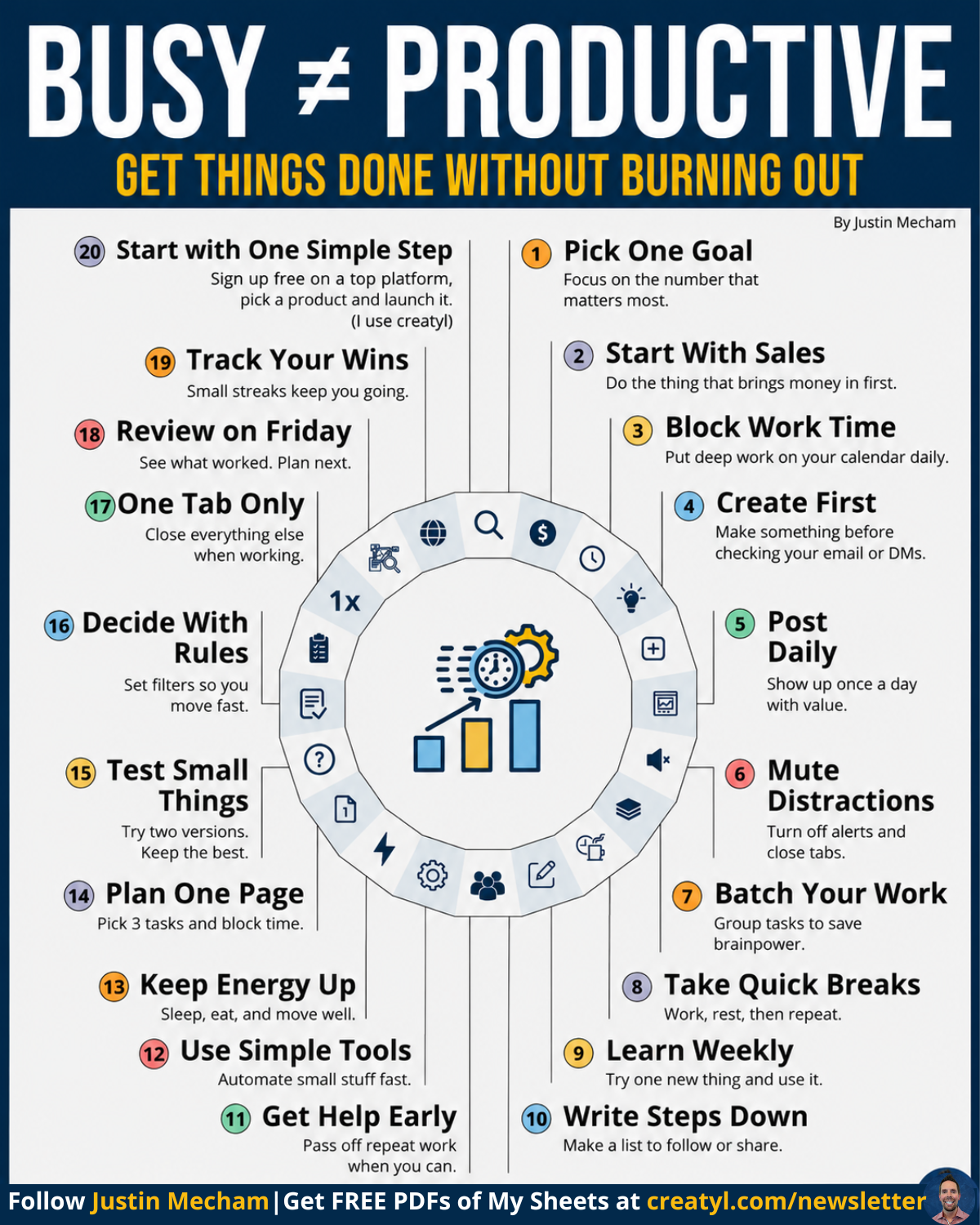
Download the “Busy Is Not Productive” Infographic
Use the attached framework as a practical reminder to protect your attention, simplify your workflow, and measure progress by meaningful outcomes rather than hours filled.