

Click Here to Download the PDF.
Your Cash Runway
How many months could you operate if income temporarily dropped?
There is no universal number because everyone's circumstances are different.
Someone with dependents, high fixed expenses, or irregular business income may need considerably more protection than someone with lower obligations.
The principle is simple:
The less predictable your future income, the more valuable financial room becomes.
Runway does something beyond paying bills.
It protects decision quality.
You are less likely to accept terrible clients.
Less likely to slash prices out of panic.
Less likely to abandon a good idea after one slow week.
Cash gives you time to think.
Five Rules for Your Next 90 Days
A plan becomes useful when it changes what you do each week.
These five rules can keep the experiment focused.
Rule 1: Pick One Offer
Do not build three businesses simultaneously.
Choose one problem, one buyer, and one offer.
Early-stage variety usually feels productive but slows learning.
If five offers are producing mixed results, it becomes difficult to know what is actually working.
One offer creates cleaner evidence.
Rule 2: Talk to Buyers
Your customers know things your business plan does not.
Speak with them.
Ask what they struggle with.
Ask how they currently solve the problem.
Ask what they have already purchased.
Ask what makes the problem urgent.
Ask what would make a solution useful.
Listen for repeated language.
Repeated pain is often a stronger signal than your favorite idea.
Rule 3: Sell Every Week
Do not spend the first eighty days creating and the final ten trying to sell.
Sell during the process.
Sales create the feedback you need.
Even rejection is useful.
If nobody understands the offer, improve the message.
If everyone wants it but nobody will pay the price, investigate why.
If people pay quickly, pay attention to what they valued.
Selling is not something that happens after the business is ready.
Selling helps make the business ready.
Rule 4: Track the Money
Record revenue.
Expenses.
Profit.
Average purchase value.
Repeat purchases.
Refunds.
Do not avoid the numbers because the business is still small.
Small businesses are exactly where knowing the numbers is easiest and most useful.
You want to understand the economics before adding more complexity.
Rule 5: Review Every Week
Every week, ask:
What worked?
What did not?
Where did buyers come from?
Why did people say yes?
Why did people say no?
What should I stop?
What should I repeat?
A weekly review keeps three months of effort from becoming three months of random activity.
Eight Ways People Quietly Ruin Their Exit Plan
Many exit plans do not fail because the person lacks ability.
They fail because the process becomes scattered.
1. Quitting Before You Have Proof
A terrible week can make leaving feel urgent.
That does not mean your business is ready.
Whenever possible, test before removing the safety net.
You will think differently when the first several experiments do not also need to pay next month's bills.
2. Guessing at Demand
Do not build around what you hope people want.
Talk to them.
Watch what they already buy.
Study what they complain about.
Ask for payment.
Demand should be discovered, not imagined.
3. Building Too Many Offers
Every new offer creates more positioning, marketing, delivery, and learning.
One good offer repeated ten times often teaches more than ten offers sold once.
Stay with the signal long enough to understand it.
4. Having No Sales Target
If your goal is simply “make more money,” you cannot plan backward from it.
Define the number.
How much monthly profit do you need?
How many customers does that require?
How many conversations tend to create one customer?
Now you have a working sales model.
5. Relying Only on Posting
Content is useful.
It is not the entire sales strategy.
Especially early on, direct conversations can teach you much faster.
Talk with buyers.
Follow up.
Ask for referrals.
Build partnerships.
Make offers.
Do not hide behind publishing.
6. Ignoring Cash
A business can look successful and still run out of money.
Know what is coming in.
Know what is going out.
Know when bills are due.
Know how much you owe in taxes.
Know how many months of operating room remain.
Cash management is not glamorous.
Neither is going broke because you ignored it.
7. Building Forever
There will always be another improvement you could make before launch.
Eventually, building becomes avoidance.
Set a date.
Get the smallest useful version in front of customers.
Let real behavior decide what deserves further work.
8. Not Tracking Results
Memory is terrible business analytics.
Write down what happened.
Which post created conversations?
Which outreach message worked?
Which customer type converted?
Which price performed better?
Which product feature buyers actually used?
The more accurately you track, the less frequently you need to guess.
Six Sentences That Make an Exit Plan Concrete
Write these down and complete them honestly.
I help ______ solve ______.
This defines the buyer and problem.
I sell ______ for $______.
This forces the offer and price into something real.
I need $______ each month.
This gives the plan a financial baseline.
My buyers currently come from ______.
This clarifies distribution.
Every week I will ______.
This defines the actions that create demand.
I can consider leaving when ______.
This creates your conditions before emotion changes them.
That last line matters enormously.
Maybe the answer includes six months of expenses saved, consistent monthly profit, repeat buyers, several active leads, and no single customer representing most of the business.
Your criteria will be personal.
Write them before the next terrible Monday.
What Your First 30 Days Should Look Like
The beginning is about evidence, not scale.
Choose one skill people already ask you for help with.
Turn it into one result.
Speak with potential buyers.
Build the smallest paid version.
Make the offer.
If nobody buys, investigate why.
Do not immediately conclude that you are incapable of building a business.
Maybe the wrong audience saw it.
Maybe the problem is weak.
Maybe the result is unclear.
Maybe the price does not make sense.
Maybe the buyer does not feel urgency.
The first month is for learning what is true.
Days 31 to 60: Turn Interest Into a Repeatable Offer
Once people begin buying, study delivery closely.
What did they actually want?
Which part helped most?
Where did they get stuck?
What questions appeared repeatedly?
What almost prevented them from purchasing?
Improve the offer around those patterns.
Collect specific proof when someone gets a result.
Do not rush into creating another product.
Strengthen the product that has evidence.
This is also when you should begin documenting repeated steps.
Save standard responses.
Create onboarding checklists.
Build simple templates.
Record instructions you give repeatedly.
The business should become slightly easier to operate each time you deliver it.
Days 61 to 90: Test Whether It Can Become Predictable
The final month should answer a more demanding question:
Can this work repeatedly?
One sale proves possibility.
Several sales begin demonstrating demand.
Repeat buyers and referrals tell you something stronger.
Consistent acquisition tells you something stronger again.
Study where customers come from.
Choose the most reliable source and repeat the actions behind it.
Track sales weekly.
Track delivery time.
Track profit.
Track your personal energy too.
A business that produces money but requires every evening, weekend, and ounce of attention may not be creating the future you intended.
The purpose is not simply replacing the paycheck.
It is creating a better relationship with work.
A Real-World Example…
Imagine someone named Daniel who has spent eight years managing client accounts at a professional services firm.
He is good at his job.
Clients trust him.
His company depends on him.
But he has wanted to leave for two years.
Daniel believes he could help small consultants build better client onboarding systems. He has helped solve
that problem internally dozens of times.
His initial plan is to resign and spend three months building a full course.
That feels productive.
It is also extremely risky.
He has never sold the idea.
Daniel calculates that his family needs about $5,500 per month after taxes and essential expenses.
He has savings, but not enough to feel comfortable watching the balance fall while he builds an untested course.
More importantly, he cannot answer several basic questions.
Who exactly would buy?
How much would they pay?
Would they want a course?
Would they rather have templates?
Would they pay for implementation?
How would he reliably find them?
Quitting does not solve any of those questions.
It simply makes answering them more urgent.
So Daniel changes the plan.
He gives himself 90 days while remaining employed.
During the first month, Daniel interviews twelve independent consultants.
A clear problem appears. Their client onboarding is inconsistent, which causes missed information, slow starts, and repeated questions.
Instead of creating the complete course, Daniel sells a small “Client Onboarding Cleanup” package.
It includes an onboarding audit, a customizable checklist, a welcome email template, and a short implementation session.
Three people buy.
That is his first meaningful signal.
During the second month, he delivers the offer and documents every repeated step. Two customers mention that the biggest value was not the checklist but having a clear system for collecting client information before kickoff.
Daniel strengthens that part of the offer.
He collects specific feedback.
One customer refers another.
During the third month, he begins generating sales from a combination of direct LinkedIn conversations and referrals. He tracks revenue, profit, customer acquisition, and delivery hours.
At the end of 90 days, he has not completely replaced his salary.
That does not mean the experiment failed.
Daniel now knows something he did not know three months earlier.
People will pay.
He knows which people.
He knows what result they value.
He knows what price converts.
He knows roughly how much time delivery requires.
He knows where several customers came from.
And he knows the business deserves another round of investment.
His exit date can now be based on evidence.
That is the difference between hoping you could survive outside employment and beginning to know how you might.
Build an Exit Dashboard You Review Every Friday
You do not need complicated software.
A simple spreadsheet or document is enough.
Track:
Monthly personal needs: What must your household cover?
Business revenue: What customers paid.
Business expenses: What it cost to generate and fulfill the work.
Profit: What actually remains.
Runway: How long your savings could support your essential needs.
Buyer conversations: How many relevant people you spoke with.
Offers made: How many real opportunities to buy existed.
Sales: How many converted.
Repeat sales and referrals: Evidence that value continues beyond the initial purchase.
Lead source: Where customers came from.
Delivery hours: How much time the business requires.
Customer outcomes: Whether buyers actually receive the promised result.
Reviewing this weekly turns a vague dream into an operating system.
Do Not Make Your Exit Number Only About Revenue
This is one of the biggest mistakes people make.
They say:
“I will leave when I make $5,000 per month.”
What if that $5,000 came from one customer?
What if it happened only once?
What if delivering it required 100 hours?
What if the customer leaves next month?
Revenue matters, but readiness is multidimensional.
A stronger set of exit conditions might include:
A defined level of monthly profit.
Several months of consistent performance.
Enough savings to absorb a slow period.
Multiple customers.
Evidence of repeat demand.
At least one acquisition channel you understand.
Manageable delivery workload.
A plan for taxes, insurance, and retirement.
Confidence that the work itself is something you want to continue doing.
This may delay the date.
It can also dramatically improve the quality of what happens afterward.
The Safest Exit Is Not Necessarily the Slowest
Planning carefully does not mean waiting forever.
There is a point where caution becomes avoidance.
You can always find one more reason to stay.
One more month of savings.
One more customer.
One more milestone.
One more guarantee.
Eventually, you need to decide how much evidence is enough.
That is why defining your conditions early matters.
If you continually move the finish line every time you reach it, fear is running the plan.
The goal is informed risk.
Not zero risk.
Zero risk does not exist.
Build Independence Before You Announce Independence
People often imagine leaving as the moment independence begins.
In reality, most of the meaningful work should happen earlier.
Your independence begins when you understand your monthly number.
It grows when you create savings.
It strengthens when a stranger pays you.
It becomes more believable when a second person pays.
It becomes more durable when customers get results.
It becomes more predictable when you understand where buyers come from.
It becomes more stable when the business has systems and financial room.
Your resignation letter is not the beginning.
Ideally, it is simply the administrative step that follows months of preparation.
Your Current Job Can Finance the Experiment
There is another way to think about the paycheck you currently resent.
It can fund the thing that eventually gives you more choices.
Your salary can pay the bills while you test.
It can fund the savings account.
It can let you reject bad customers.
It can cover mistakes while they are still inexpensive.
It can give you time to understand whether you actually enjoy the business you think you want.
That does not make a difficult job pleasant.
It gives the current season a different purpose.
Instead of thinking:
“This job is preventing me from leaving.”
You can begin thinking:
“This job is financing my proof.”
That shift will not fix every workplace problem.
It can, however, turn waiting into preparation.
Recommended Resources for Building a Smarter Exit
Book: The Mom Test by Rob Fitzpatrick
A practical guide to having better customer conversations before building. It is especially useful for avoiding flattering but meaningless feedback and learning whether a problem is genuinely important to buyers.
Book: Company of One by Paul Jarvis
A useful resource if your goal is independence rather than simply building the biggest company possible. It challenges the assumption that more complexity automatically means more success.
Book: The Lean Startup by Eric Ries
Useful for understanding how small tests, feedback loops, and real customer behavior can replace long periods of building from assumptions.
Podcast: The Side Hustle Show with Nick Loper
A useful collection of real examples from people creating additional income alongside traditional employment. It can help make the path feel practical rather than abstract.
Practical Tool: The Weekly Exit Scorecard
Every Friday, answer five questions:
- What did I sell this week?
- What produced the strongest buyer interest?
- What did customers teach me?
- What moved my exit numbers?
- What single action matters most next week?
A good exit plan becomes clearer through repetition.
You Do Not Need More Courage. You Need More Choices.
There is a particular kind of fear that appears when your entire financial life is attached to one paycheck.
Every problem at work feels bigger.
Every bad manager feels harder to challenge.
Every restructuring announcement gets your attention.
Every Sunday evening reminds you that Monday is not optional.
It is easy to assume the solution is becoming brave enough to leave.
But courage alone does not pay your mortgage.
Courage does not validate an offer.
Courage does not create customers.
Courage does not tell you how much runway you have.
What changes the situation is proof.
One skill you can package.
One problem someone will pay you to solve.
One offer.
One customer.
Then another.
One month of tracked results.
Then another.
A savings number.
A profit number.
A sales process you understand.
None of those things make the future certain.
They make it less imaginary.
And that matters.
Because the goal is not to wake up one morning feeling fearless enough to resign.
The goal is to build such a strong second option that fear no longer gets to make the decision by itself.
Maybe your 90-day experiment tells you that you are ready.
Maybe it tells you that you need six more months.
Maybe the first offer fails and the second one works.
Maybe you decide entrepreneurship is not the answer and use what you learned to find a better role instead.
That is still progress.
The biggest win is moving from:
“I cannot leave.”
To:
“I know exactly what would have to happen for me to leave.”
Then moving again to:
“I am building those conditions now.”
And eventually:
“I can stay if I want to, but I no longer have to.”
That is a very different relationship with work.
Your paycheck stops being the thing holding your life together.
It becomes one source of income among choices you have learned how to create.
That is why the best exit plans do not begin with resignation letters.
They begin with evidence.
Do not quit because you finally had one terrible day.
Do not quit because somebody on the internet told you that employment means you failed.
Do not quit simply because you are tired of waiting.
Build first.
Test first.
Track first.
Know your number.
Create the proof.
Then, when the time comes, make the decision using something stronger than frustration and something more useful than hope.
Make it using math, evidence, and options.
Download the Related Infographic
Want the full framework in one place while you build your plan?
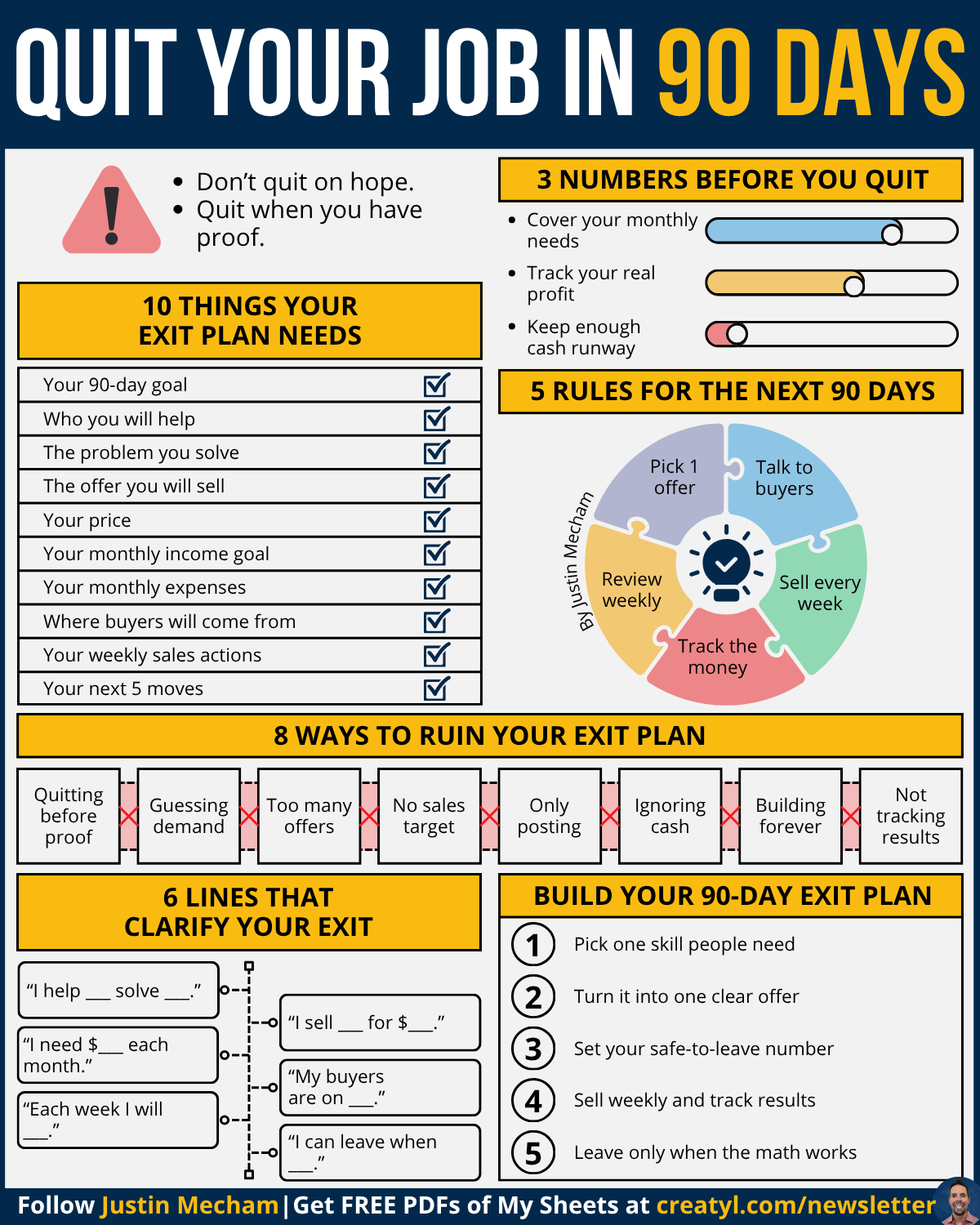
Download the Quit Your Job in 90 Days infographic PDF. It gives you a practical visual checklist for defining your 90-day target, choosing your buyer and problem, creating one offer, setting your financial numbers, identifying where customers will come from, tracking weekly sales activity, avoiding the most common exit-plan mistakes, and deciding what needs to be true before leaving becomes a realistic option.
Use it as a working document throughout the 90 days. Review it every week, update the numbers with real evidence, and let your results tell you when the plan is becoming strong enough to support your next move.