

Click here to download the PDF.
Turn One Skill Into Proof, Income, and a Better Choice
There is a big difference between wanting to leave your job and being ready to leave your job.
For years, I thought the difference was courage.
I assumed people who left jobs they had outgrown were simply braver. They had somehow reached a point where fear stopped bothering them, certainty appeared, and they finally felt ready enough to walk away.
That idea kept me stuck.
Because I kept waiting for the moment when leaving would stop feeling risky.
It never came.
What eventually changed my thinking was realizing that I did not need more courage. I needed more evidence.
Evidence that someone would pay me for something I knew.
Evidence that I could find a problem outside my job and solve it.
Evidence that I could earn one dollar without my employer being involved.
Evidence that I could repeat the process.
That is what turned leaving from a fantasy into a plan.
The goal was no longer, “How quickly can I quit?”
The better question became, “What can I prove over the next 120 days that will give me another option?”
That question is far more useful because it puts the focus where it belongs: not on escape, but on building.
A good exit should not require you to become a different person. You do not suddenly need to become a famous creator, brilliant entrepreneur, technical expert, or fearless salesperson.
You need to take one skill you already use, connect it to one painful problem, test whether real people will pay for the result, and keep improving what works.
That is how another path begins.
Not with a resignation letter.
With proof.
Why Quitting First Is Usually the Wrong Starting Point
Leaving a job can feel like progress because it creates immediate change.
The problem is that change and progress are not the same thing.
You can resign tomorrow and still have no idea how to earn independently the following month.
You can leave a job you dislike and immediately discover that financial pressure is even harder to live with than workplace frustration.
You can finally control your calendar and then realize you have nothing reliable to put on it.
That is why I prefer reversing the order.
Do not leave and then figure out what to build.
Build enough evidence first that leaving eventually becomes one of several realistic options.
This is especially important because fear changes when proof enters the picture.
Before your first sale, the question is:
“Can I really do this?”
After your first sale, the question becomes:
“How can I do this again?”
Those are completely different problems.
The first one is emotional.
The second one is operational.
Operational problems are much easier to solve.
Why 120 Days Is a Useful Window
Four months is long enough to gather meaningful information but short enough to create urgency.
It forces you to stop treating your exit as something you will work on someday.
At the same time, it gives you enough room to avoid making desperate choices.
You can speak with people.
Test demand.
Build a small offer.
Sell it.
Deliver it.
Gather evidence.
Improve the process.
Then review what actually happened.
The purpose of the 120-day plan is not to guarantee that everyone should resign on day 121.
That would miss the point entirely.
The goal is to reach day 120 with substantially more evidence than you had on day one.
Maybe that evidence tells you the idea has real potential.
Maybe it reveals that you need another six months.
Maybe it shows you chose the wrong audience.
Maybe it confirms that you love building something of your own.
Maybe you discover that you would rather change jobs than start a business.
All of those outcomes are useful.
Because clarity earned through action is far better than certainty imagined through overthinking.
Days 1–15: Find a Problem Worth Solving
The first stage is not about designing a product.
It is about becoming much more observant.
Most people start by asking, “What could I sell?”
That question immediately sends the mind toward products, websites, courses, pricing, branding, and business models.
Start earlier.
Ask:
“What problem do people already trust me to solve?”
This is where your existing work becomes incredibly valuable.
Think about the questions that repeatedly find their way to you.
What do coworkers ask you to explain?
What do friends message you about?
What task are you unusually fast at?
What mistake can you see before other people do?
What process have you already figured out through experience?
What situation have you helped multiple people navigate?
Those are not random moments.
They are clues.
Look for repeated pain, not impressive expertise
You do not need to be the best person in the world at something.
You only need to be useful to someone who is several steps behind you.
A project manager may know how to create a simple client handoff system.
A recruiter may know how to help someone prepare for interviews.
A marketer may know how to write clearer landing pages.
A team leader may know how to run better one-on-ones.
A designer may know how to turn rough ideas into clear presentation slides.
A parent may have created an organization system that saves other parents hours.
The useful question is not:
“Am I an expert?”
It is:
“Can I help someone make meaningful progress?”
That is a much lower and more realistic bar.
Study what people currently do
Once you identify a possible problem, look at the alternatives people already use.
Do they search online?
Buy templates?
Hire consultants?
Use spreadsheets?
Piece together advice from videos?
Ask colleagues?
Pay for software?
Do nothing because every option feels too complicated?
You are trying to learn two things.
First, whether the problem matters enough that people already spend time or money trying to solve it.
Second, where the current options frustrate them.
That second part is often where your opportunity appears.
You do not necessarily need a new solution.
You may need a simpler one.
Days 16–30: Test Demand Before You Build
This is where many ideas either become real or quietly expose their weaknesses.
Talk to at least ten people who genuinely experience the problem.
Not friends who want to encourage you.
Potential buyers.
Ask about what they currently do.
Ask what they have already tried.
Ask what keeps frustrating them.
Ask what the problem costs them.
Not only financially.
Maybe it costs time.
Confidence.
Sleep.
Opportunities.
Missed deadlines.
Embarrassment.
Mental energy.
The more clearly you understand the cost of the problem, the easier it becomes to understand what a useful solution should do.
Do not pitch too early
The temptation is to explain your idea immediately.
Wait.
First learn how they describe the problem.
You may discover that your language is completely different from theirs.
For example, you may think you are solving “workflow inefficiency.”
Your buyer says:
“We keep losing track of who is supposed to do what.”
That second sentence is much more useful.
Save it.
Customer language is one of the most valuable forms of research because it tells you how people experience the problem before you add your interpretation.
Interest is not the same as demand
People saying something sounds useful is encouraging.
It is not proof.
Real demand becomes clearer when people take an action that costs something.
Money.
Time.
A commitment.
A deposit.
A preorder.
A booked call.
A serious buying conversation.
This is why early testing matters so much.
You want evidence before effort becomes expensive.
Days 31–45: Shape One Clear Offer
Now turn what you learned into a small offer.
The key word is small.
Do not create the complete business.
Do not design five packages.
Do not build an enormous course.
Promise one useful result.
For one type of person.
Around one painful problem.
Then define what is included and what is not.
That last part matters.
A clear offer has boundaries.
Without them, every customer request becomes part of the product and the offer becomes harder to deliver every week.
Write the offer in one sentence
Try:
“I help [person] achieve [result] in [time frame or process].”
For example:
“I help first-time managers build a useful weekly one-on-one system in fourteen days.”
Or:
“I help independent consultants turn one skill into a simple paid offer they can test this month.”
If you cannot explain the offer in one sentence, keep simplifying.
Clarity makes both marketing and delivery easier.
Pick a starting price that creates a real decision
Your early price does not need to be perfect.
It needs to be real.
Free feedback and paid feedback are different.
A price forces the customer to decide whether the problem matters enough.
Your first goal is not maximizing revenue.
It is learning whether the value is strong enough for someone to exchange money for it.
Days 46–60: Sell It Earlier Than Feels Comfortable
This is usually the stage people delay.
They tell themselves the offer needs more work.
The page needs another rewrite.
The videos need to be recorded.
The branding is not finished.
The payment setup could be cleaner.
Most of this is fear appearing as preparation.
Invite a small group to buy.
Speak directly with people who fit the problem.
Explain what you are testing, what result you aim to create, how the first version will work, and what they will receive.
You are not pretending the offer is finished.
You are inviting early buyers into a carefully defined first version.
Listen closely to objections
An objection is information.
If several people say the same thing, do not become defensive.
Study it.
Maybe the result is unclear.
Maybe the timeline feels unrealistic.
Maybe the price and outcome feel disconnected.
Maybe the offer solves a problem that matters, but not enough right now.
Maybe people want the result but dislike the format.
Every objection helps shape the next version.
Aim for proof, not polish
Three paying customers can teach you more than three months of design work.
At this stage, proof is the goal.
You want to know whether people care enough to act.
That is the signal that earns the next level of investment.
Days 61–75: Build Only What the Buyers Need
Now that people have paid, build the version they actually need.
Not the version your imagination created six months ago.
Your job is to make the promised result as easy to reach as possible.
That may involve:
A short guide.
A few videos.
Templates.
A checklist.
Weekly calls.
Voice notes.
A simple email series.
A dashboard.
A live workshop.
Choose the format that helps the buyer move.
Do not confuse product size with product value.
A small resource that produces a clear result is more useful than a massive library that overwhelms the customer.
Create a clear timeline
Buyers should know what happens next.
What should they do first?
What comes after that?
How long should each step take?
Where should they ask questions?
What does completion look like?
Reducing uncertainty improves the experience.
Do not add features nobody requested
This is one of the easiest ways to destroy a simple product.
A customer asks for one thing, so you add it.
Another person suggests something different, so you add that too.
Soon the offer becomes bloated.
Listen carefully, but look for patterns before changing the core product.
One request is information.
Repeated requests are stronger evidence.
Days 76–90: Deliver a Real Win
This may be the most important stage of the entire 120-day plan.
Getting someone to buy is useful.
Helping them get a result is what creates a business.
Stay close to your early customers.
Check in before they have to chase you.
Ask what feels difficult.
Notice where progress slows.
Keep a record of the questions people ask repeatedly.
Those questions often reveal where the product needs better instructions, examples, or support.
Capture proof while it is happening
When someone gets a result, document it.
What changed?
How quickly?
What did they use?
What was different before and after?
Specific evidence is much more useful than generic praise.
“Loved it” is pleasant.
“I used the client checklist and reduced my onboarding process from six emails to two” tells future buyers exactly what happened.
Study sticking points as carefully as wins
A customer getting stuck does not automatically mean the product is bad.
It means you found a point where the experience can become clearer.
Repeated friction is product research.
Do not hide from it.
Improve it.
Days 91–105: Make the Successful Parts Repeatable
By now, you should know much more than you did at the start.
You know what buyers ask.
You know what objections appear.
You know what part of the offer creates value.
You know where delivery becomes difficult.
Now document the repeated work.
Turn it into checklists.
Templates.
Standard messages.
Processes.
Clear steps.
A business becomes more stable when results stop depending on you remembering everything every time.
Create templates for the predictable parts
If every buyer receives the same welcome message, create it once.
If you always ask the same onboarding questions, turn them into a form.
If every project follows similar steps, document the sequence.
If the same explanation appears repeatedly, record or write it once.
Systems do not remove the human side of your business.
They remove unnecessary rebuilding.
Remove what slows delivery
Ask:
What takes too long?
What gets skipped?
What confuses customers?
What feels repetitive?
What could be done once instead of repeatedly?
Every improvement lowers the cost of delivering the next result.
That matters because earning money is not enough.
You want the business to become easier to operate as you learn.
Days 106–120: Build the Future From Evidence
The final fifteen days are not about quitting.
They are about reviewing.
Look back at what actually sold.
Not what received compliments.
Not what sounded exciting.
What did people pay for?
Why?
Which customers got the strongest outcomes?
Which sales conversations converted most easily?
Where did buyers come from?
What offer would you happily keep delivering?
Which parts of the business felt unnecessarily difficult?
This is where you start choosing a direction.
Find one dependable way to reach buyers
You do not need seven marketing channels.
You need one that works.
Maybe that is LinkedIn.
Referrals.
Email.
Direct outreach.
Partnerships.
Workshops.
Communities.
Search.
Start with the channel where you already saw evidence.
Then get more consistent there.
Set sales and delivery targets
Do not say:
“I want this to grow.”
Give the next stage numbers.
Perhaps:
Five buyer conversations every week.
Two new customers every month.
One customer case study every month.
One weekly piece of useful content.
A certain revenue target.
A maximum number of delivery hours.
Numbers turn vague ambition into something you can manage.
Reinvest in what is already working
This is where many people sabotage themselves.
Something works once, so they immediately start something new.
Stay with the evidence.
Make the working offer clearer.
Improve the customer experience.
Reach more people who have the same problem.
Build around what customers have already validated before chasing another idea.
What 120 Days Should Actually Give You
At the end of this process, you should have something far more useful than motivation.
You should have evidence.
Evidence of whether the problem is real.
Evidence of whether buyers exist.
Evidence of what language they respond to.
Evidence of what they will pay.
Evidence of what delivery requires.
Evidence of whether customers get results.
Evidence of whether you enjoy the work.
Evidence of how repeatable the process might become.
You may also have income.
That matters.
But the knowledge behind the income may matter even more.
A person earning $1,000 without understanding why is less prepared than someone earning $500 through a clear process they know how to repeat.
Your goal is not random revenue.
Your goal is learning how value moves from your skill to somebody else's wallet because you solved something they care about.
Once you understand that process, you can improve it.
Let’s Take A Deeper Look… Here’s An Example
I once worked with a professional who had spent more than a decade managing client projects.
They were good at the job, but they had reached a point where they wanted more control over their time.
Their first idea was to build a comprehensive project-management course.
They had already outlined dozens of lessons.
There was just one problem.
They had never asked anyone to pay for it.
The course became bigger every week.
More modules.
More templates.
More videos.
More planning.
Yet every new addition made launch feel further away.
They were preparing for an audience they had not found.
Meanwhile, people at work kept asking them a completely different question:
“How do you stop client projects from falling apart when too many people are involved?”
That question appeared again and again.
But because answering it felt easy, they ignored its value.
They nearly spent months creating a broad educational product while overlooking the narrower problem people were already asking them to solve.
We stopped the larger course.
During the first two weeks, they spoke with ten small business owners who regularly managed client work.
A recurring problem appeared: nobody knew exactly who owned the next step after a project changed hands.
We turned that into a small offer.
The first version included a handoff checklist, a simple responsibility map, and a ninety-minute implementation session.
Four people agreed to pay for the pilot.
That immediately changed the project.
The first customers revealed which questions mattered.
One template was incredibly useful.
Another was barely touched.
The implementation session uncovered a second recurring problem that became part of the refined version.
By day 90, the professional had real testimonials, clearer positioning, and a process that took less time to deliver than the first version.
By day 120, they had not replaced their full salary.
But they had something they had never possessed before:
A working offer that people outside their employer would pay for.
The decision about when to leave could now be made using evidence instead of imagination.
That was the real win.
The Exit Readiness Questions That Matter More Than the Date
Do not let “120 days” become a countdown that pressures you into resigning whether you are ready or not.
Use the time to create information.
Before making a major decision, ask:
Can I describe exactly who pays me and why?
Have multiple people paid?
Have customers achieved the result?
Has anyone returned or referred somebody?
Can I explain how I will find the next ten buyers?
Do I understand what delivery costs me in time?
Do I have enough financial room to handle slow months?
Does one customer control too much of the income?
What happens if revenue drops for three months?
Have I accounted for taxes, insurance, savings, and business expenses?
Can this work without me operating at maximum effort every week?
Would I still want to build this if my current job suddenly became easier?
That last question matters.
You want to know whether you are moving toward something meaningful, not simply away from something difficult.
The Difference Between Courage and Evidence
Courage matters.
There will always be uncertainty.
No spreadsheet can guarantee the future.
No amount of validation removes every risk.
But courage is much more useful when evidence supports it.
You do not need to jump without knowing whether the ground exists.
You can test it.
You can gather information.
You can make the next decision from a stronger position than the last one.
That is what a 120-day plan gives you.
Not certainty.
Something better.
Better odds.
Recommended Resources
Book: The Mom Test by Rob Fitzpatrick
One of the most useful books for learning how to speak with potential customers before building. It helps you stop collecting polite opinions and start uncovering useful evidence about real problems and buying behavior.
Book: The Lean Startup by Eric Ries
A practical look at testing assumptions, building smaller versions, measuring what happens, and learning before making larger investments.
Book: Company of One by Paul Jarvis
A useful perspective for anyone building something independently without automatically assuming that bigger, more complicated, and more expensive are better.
Podcast: The Side Hustle Show with Nick Loper
A useful source of real examples from people who built additional income while still working regular jobs, often beginning with very small offers.
Practical Tool: Your 120-Day Evidence Dashboard
Create a simple tracker containing:
- Buyer conversations
- Offers made
- Sales
- Revenue
- Repeat buyers
- Referrals
- Customer results
- Most common objections
- Delivery hours
- Best acquisition source
- Savings runway
- Personal energy
Review it weekly.
Do not ask only, “Did I make money?”
Ask, “What did I learn about how money gets made here?”
That distinction will make your next decision much better.
Your Exit Starts When Another Choice Becomes Real
For a long time, leaving can feel like one giant decision sitting somewhere in the future.
Stay or quit.
Safe or risky.
Paycheck or freedom.
Real life is usually more nuanced than that.
Your independence can begin long before your resignation.
It begins when you discover that one of your ordinary skills solves a problem someone else cares about.
It becomes more real when that person pays.
It grows when you help them get a result.
It becomes stronger when another person buys.
And another.
Then you start documenting what works.
You create systems.
You build savings.
You learn how customers think.
You understand what people value.
Piece by piece, your dependence changes.
You still have your job.
You still have responsibilities.
You still have uncertainty.
But you are no longer standing in the same place.
You are building another source of evidence.
Another source of confidence.
Another source of income.
Another choice.
That is why the goal of the 120-day plan is not to turn day 121 into some dramatic finish line.
It is to make sure you are no longer waiting for your life to change because someone else changes it for you.
Maybe you leave after four months.
Maybe after eight.
Maybe after eighteen.
Maybe the process teaches you that entrepreneurship is not the path you want, and you use the confidence you gained to move into a better role instead.
That still counts.
Because the real goal was never simply quitting.
It was becoming less dependent on circumstances you could not control.
The day you realize your skills can create value outside the job that currently pays you, something important changes.
Your career stops looking like one road.
Your future stops feeling like one employer's decision.
And leaving stops requiring blind courage.
You have something much stronger.
Proof that another choice exists.
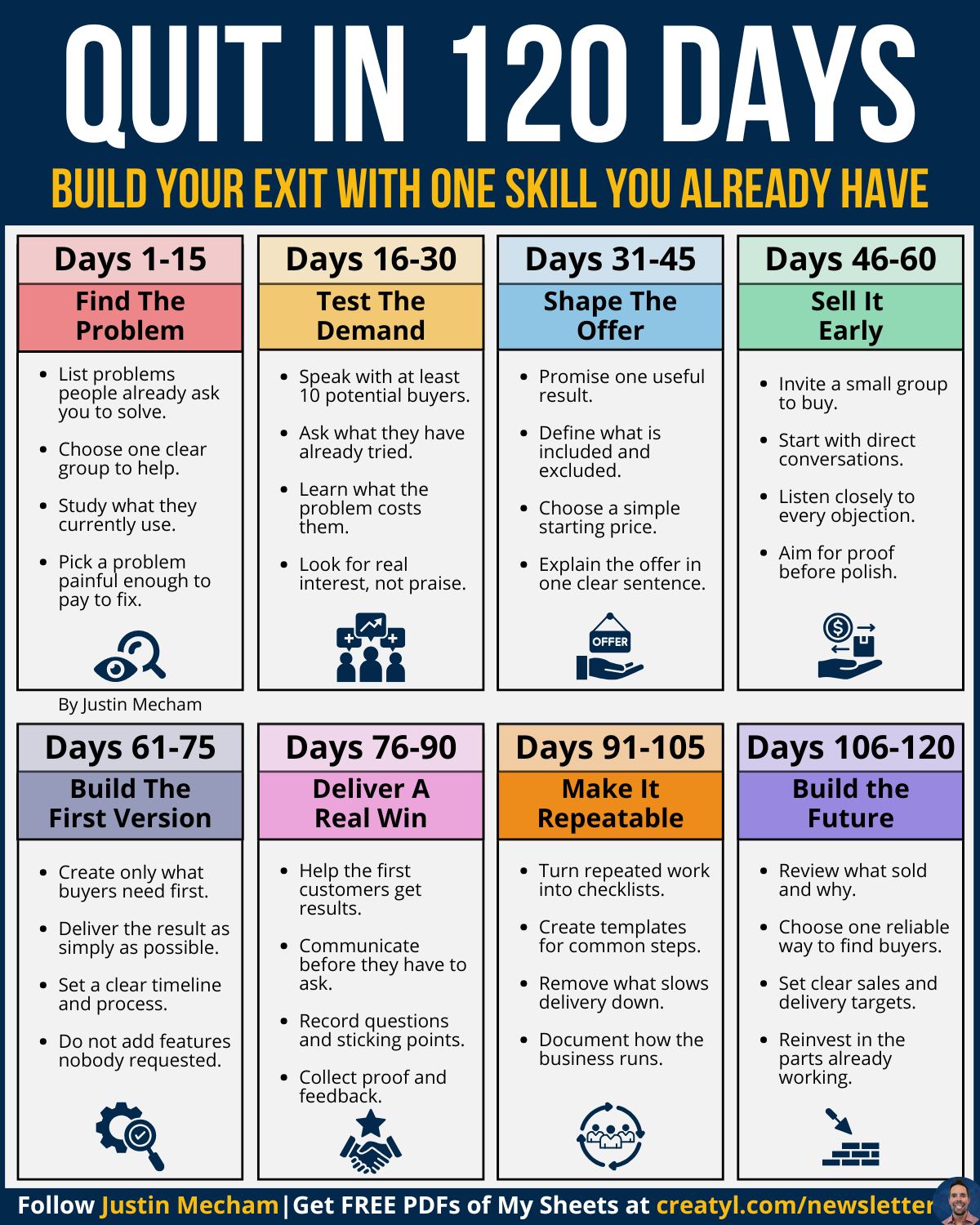
Download the Related Infographic
Want a visual roadmap for putting this 120-day exit plan into practice?
Download the Quit in 120 Days: Build Your Exit With One Skill You Already Have infographic PDF. It breaks the process into eight practical stages, from identifying a problem and testing demand to selling early, getting customer results, documenting what works, and creating a stronger foundation for whatever comes next.