

Click Here to Download the PDF.
The Real Problem Is Not Having a Job. It Is Having No Other Option.
For a long time, I thought security meant having a steady paycheck.
If the money arrived every two weeks, the bills were covered, and I kept doing good work, I assumed I was safe.
Then I started asking myself a question I had avoided for years:
What happens if that paycheck disappears?
Not because I quit.
Not because I make some bold career move.
What happens if the decision is made for me?
A company restructures. A department gets cut. A new leader changes direction. A role that felt permanent suddenly is not.
That question exposed something I did not particularly enjoy admitting.
I had income, but I did not have options.
There is an important difference.
A job can be useful, fulfilling, well paid, and worth keeping. The problem starts when the job becomes the only place where your skills are allowed to create income.
When every bill depends on one employer, leaving becomes difficult even when you know the role is no longer right for you. Negotiating becomes harder. Risk feels bigger. Bad weeks feel heavier because there is no obvious alternative.
You may call that stability because the paycheck is predictable.
But genuine stability involves more than knowing where this month's money will come from.
It means knowing you have the ability to create value somewhere else if circumstances change.
That does not require quitting.
It requires building another option.
And the easiest place to start is usually not with a brand-new skill, a huge audience, or an ambitious business plan.
It is with something you already know how to do.
Why Capable People Still Feel Financially Trapped
One of the strangest things about becoming experienced at work is that your most valuable skills begin feeling ordinary.
You solve a complicated problem and think nothing of it.
You answer the same question for another teammate.
You build a process because the old one was frustrating.
You explain something in ten minutes that took you years to understand.
You make a difficult decision using judgment that did not exist earlier in your career.
Then you go home without thinking about any of it.
The company sees those capabilities as value.
That is one reason it pays you.
But you may still see them as "just my job."
That difference matters.
When you think of your abilities only through your job title, you naturally assume the company is the market for your skills.
A marketer thinks, "I work in marketing."
An operations professional thinks, "I manage processes."
A recruiter thinks, "I hire people."
A designer thinks, "I make graphics."
A manager thinks, "I lead my team."
Those descriptions explain employment.
They do not reveal the economic value hidden underneath.
Ask instead:
What result do I repeatedly create?
A marketer may know how to help consultants write better landing pages.
An operations professional may know how to reduce client onboarding from two weeks to three days.
A recruiter may know how to help candidates prepare stronger interview stories.
A designer may know how to turn confusing presentations into simple visual narratives.
A manager may know how to help first-time leaders run one-on-ones that people actually find useful.
Those are not merely skills.
They are the beginnings of offers.
Step 1: Pick One Skill People Already Trust You For
The easiest mistake is starting too broad.
You sit down and write:
Leadership.
Marketing.
Sales.
Writing.
Productivity.
Design.
Those are categories.
A customer does not usually wake up wanting to buy a category.
They want a problem solved.
Instead, look for evidence inside your existing life.
Ask yourself:
What do people repeatedly ask me to explain?
What problem do coworkers bring me when they get stuck?
What can I do noticeably faster than someone with less experience?
What task have I already turned into a repeatable process?
What mistake can I help someone avoid?
What result have I created several times?
What do people thank me for?
What could I teach without spending three weeks preparing?
The best starting skill often has three qualities.
You can do it reliably.
Someone else finds it difficult.
And the result matters enough that solving it creates meaningful value.
You are not trying to package your entire career.
You are extracting one useful piece.
That makes the next step much easier.
Step 2: Solve One Problem, Not an Entire Category
Suppose you are excellent at project management.
You could create a broad course called "Master Project Management."
Or you could solve one much clearer problem:
"Help small agencies stop client projects from getting stuck because nobody knows who owns the next step."
The second idea may sound smaller.
That is exactly why it can be stronger.
Specific problems are easier to explain.
They are easier for buyers to recognize.
They are easier to solve.
They are easier to test.
And they are easier to improve.
Early products often fail because the creator tries to deliver too much value at once.
They assume more information means a better offer.
But buyers usually value a shorter path to the result more than a larger amount of content.
A thirty-page system that eliminates one frustrating problem can be more useful than a twelve-hour course covering everything remotely connected to the subject.
So before creating anything, write:
The problem I solve is: ______.
If your answer contains three problems connected by the word "and," make it smaller.
Step 3: Choose One Buyer Who Wants the Result Most
A product becomes much easier to sell when you know exactly whose situation you are describing.
"Anyone who wants to improve" is not a buyer.
"Newly promoted managers leading their first team" is.
"Entrepreneurs" is broad.
"Solo consultants struggling to turn LinkedIn conversations into sales calls" is clearer.
"People interested in productivity" could mean millions of completely different situations.
"Busy managers who lose their mornings to email and meetings" creates an identifiable problem.
The goal is not to exclude everyone permanently.
It is to make the first version feel unusually relevant to someone.
Think about the people who experience the problem most often, feel the cost most clearly, and can realistically take action.
Ask:
Who already knows this problem exists?
Who has tried fixing it?
Who has something to lose by leaving it unsolved?
Who can I reach without spending months building an audience?
That last question is important.
Your first buyer does not need to come through an elaborate marketing system.
They may already be one connection, conversation, introduction, professional community, or email away.
Step 4: Create One Offer Instead of Building an Entire Business
Once you know the skill, problem, and buyer, resist the urge to build everything.
You do not need five products.
You do not need several pricing tiers.
You do not need a twenty-page website.
You need one offer.
A simple first offer should answer:
Who is it for?
What problem does it solve?
What result will they get?
What is included?
How long should it take?
What does it cost?
What happens after they buy?
That is enough to test whether the underlying idea deserves more of your time.
Your first offer might be a guide, checklist, template, live workshop, short course, coaching package, consulting session, or small service.
The best format is the one that gets the buyer to the outcome without unnecessary work for either of you.
Do not ask:
"What impressive product can I create?"
Ask:
"What is the smallest thing I could sell that would genuinely help someone get the promised result?"
That question protects you from months of unnecessary building.
Build the One-Page Offer
Your first sales page does not need to resemble a major software company's website.
It needs to answer the questions already running through the buyer's mind.
A clear page can be built around five parts.
1. Say What They Get
Begin with the result.
Do not make the buyer search through your page trying to figure out why they should care.
Instead of:
"Welcome to my revolutionary new productivity framework."
Try:
"Build a weekly planning system that helps you finish your three most important priorities before Friday."
The second sentence creates a picture.
That is useful.
People do not buy products because the product description sounds impressive.
They buy because the outcome matters.
2. Call Out the Problem Clearly
Show people you understand the situation they are currently experiencing.
Perhaps they are overwhelmed.
Perhaps they repeatedly miss deadlines.
Perhaps they cannot turn their expertise into an offer.
Perhaps they get interviews but not job offers.
Perhaps they waste hours manually completing a process.
Describe the problem in language the buyer actually uses.
That means listening.
Save phrases from conversations.
Read emails.
Notice comments.
Write down the exact questions customers ask.
The people experiencing the problem will often give you better marketing language than you could invent alone.
3. Show the Steps
Uncertainty makes products feel difficult.
Reduce it.
Show three to five steps explaining how the buyer moves from the current situation to the result.
For example:
- Choose one skill.
- Match it to one painful problem.
- Turn the result into a simple offer.
- Put the offer in front of potential buyers.
- Improve it from real feedback.
People are more likely to believe an outcome when they can understand the path.
Do not bury the process beneath clever language.
Show them what happens.
4. Add Proof
Early on, you may not have fifty testimonials.
That is fine.
Proof can begin smaller.
A previous work result.
A relevant case study.
A pilot customer's outcome.
A before-and-after example.
A sample of the product.
A demonstration.
Specific evidence matters more than generic praise.
"Justin was great" tells a buyer very little.
"I used the process and booked three sales conversations during the first week" tells them what changed.
Over time, proof becomes one of the most valuable things your business can collect.
5. Make the Next Step Obvious
Do not make someone understand the offer and then wonder how to get it.
Tell them.
Buy now.
Join the workshop.
Book the call.
Start the program.
Choose one primary action.
Every additional option asks the buyer to make another decision.
And unnecessary decisions create hesitation.
Make the Offer Easier to Buy
Building something useful is only half the work.
The buyer also needs to understand it quickly enough to make a decision.
There are several ways to reduce that friction.
Pick One Type of Buyer
A specific buyer allows you to write specific examples, answer relevant objections, and create a result that actually fits their situation.
Generic products often feel generic because they were built for an imaginary average person.
Real buyers are more specific than that.
Make the Result Specific
"I help you improve your career" requires interpretation.
"I help you prepare five strong interview stories you can reuse across common behavioral questions" is much easier to understand.
Specificity creates confidence.
It allows the buyer to compare the price with something tangible.
Set a Smart Price
One mistake experienced professionals make is pricing only according to how much time something takes them.
That ignores the reason expertise becomes valuable.
A process may take you thirty minutes precisely because you spent ten years learning it.
Consider the outcome instead.
How meaningful is the problem?
How much time could the product save?
What mistakes could it prevent?
What result could it help create?
What alternatives is the buyer comparing it with?
Price should still make sense for the audience and offer, but do not reduce your knowledge to an hourly calculation when the buyer is paying for the result.
Give Buyers an Early Win
A useful product should create progress quickly.
Ideally, the buyer should experience some kind of win within the first day or two.
That might be:
A decision finally made.
A useful template completed.
A broken process identified.
A first sales message sent.
A clearer offer written.
A meeting fixed.
A first asset created.
Fast progress helps buyers believe continuing is worthwhile.
It also gives you early evidence that the product is doing its job.
Why the First Sale Matters More Than the Amount
The first sale carries unusual psychological weight.
Maybe somebody pays you $25.
Maybe $100.
Maybe $500.
Financially, it may not change much.
But mentally, something important happens.
Before the sale, your independent earning ability is a theory.
After the sale, it is evidence.
Somebody who does not employ you believed the result you could create was worth money.
That separates your skill from your job title.
You realize:
The company does not own the ability.
It has simply been one buyer of it.
That distinction can completely change the way you think about work.
You no longer need the fantasy that you will suddenly replace your entire salary overnight.
Your next question becomes smaller:
Can I do it again?
Then:
Can I make it easier?
Then:
Can I find more people with the same problem?
Then:
Can I turn the repeated parts into a system?
That is how independent income becomes less mysterious.
Do Not Confuse One Sale With a Business
The first sale proves something important.
It does not prove everything.
One buyer could be luck.
Several buyers begin revealing demand.
Repeat buyers reveal stronger value.
Referrals reveal trust.
Consistent sales begin revealing a business.
Treat your first few customers as both customers and research.
Pay attention to:
Why they bought.
What almost stopped them.
What language they used.
What they thought they were buying.
What they actually valued after using it.
Where they struggled.
What result mattered most.
What they wanted next.
Each answer improves your next version.
Show More Proof Over Time
Proof becomes stronger when it accumulates around the same promise.
This is why constantly changing offers can slow progress.
If you sell something, help the customer get a result, collect evidence, and then immediately abandon the offer for a completely different idea, you reset the learning process.
Instead, stay close to what works.
Make the offer clearer.
Improve delivery.
Collect better examples.
Remove unnecessary pieces.
Reach more of the same type of buyer.
Let evidence accumulate.
Eventually, the product becomes easier to sell because you no longer need buyers to believe only your explanation.
They can see what happened for other people.
Launch in Five Practical Steps
You do not need an elaborate launch.
A straightforward process works.
Step 1: Build One Offer
Pick one problem and one result.
Create the smallest product capable of helping someone reach it.
Do not build everything you might want in version five.
Build what version one needs.
Step 2: Put It Online
Use a simple platform capable of hosting what you sell, taking payment, and delivering it.
The technology should make the process easier, not become the project.
Step 3: Fill in the Details
Give the offer a clear name.
Write a short description.
Explain what the buyer receives.
Show the result.
Answer the obvious objections.
Add one clear action.
Step 4: Set the Price and Upload the Product
Do not spend three weeks debating a perfect starting price.
Choose a reasonable price based on the buyer, problem, result, and market.
You can learn and adjust.
Then make sure the actual product is ready to deliver.
Step 5: Publish and Repeat
Publish.
Talk to people.
Watch what happens.
Study the questions.
Improve.
Then repeat.
Do not treat publishing as the end of the process.
It is the beginning of the useful information.
A Real Workplace Example
I once worked with someone who had spent years inside sales operations.
They were the person everyone contacted when the CRM was messy, reporting numbers did not match, leads disappeared, or salespeople were wasting time manually updating information.
They wanted additional income but insisted they had "nothing to sell."
The irony was obvious.
Teams were already depending on their knowledge every week.
They simply had never separated that knowledge from the salary attached to it.
Their first idea was to build a huge sales operations course.
It would cover technology, pipeline management, reporting, automation, forecasting, and process design.
It sounded impressive.
It also would have taken months.
We looked at the questions they had been answering repeatedly.
One appeared more than almost anything else:
"How should a small sales team organize its pipeline so leads stop falling through the cracks?"
That was a real problem.
Companies were already spending time dealing with it.
The professional knew exactly how to diagnose it.
Yet they were about to ignore that narrow opportunity and build a giant product around everything they knew.
That is a common trap.
When you know a lot, you naturally want the first offer to reflect everything you can do.
The buyer usually wants one painful thing fixed.
We created a much smaller first offer.
A sales pipeline cleanup kit.
It included:
A pipeline audit checklist.
A simple stage-definition worksheet.
A lead follow-up template.
A short implementation guide.
And an optional review call.
Before expanding it, they put the offer in front of several small business owners.
People bought.
During the first deliveries, we tracked questions carefully.
Customers cared far more about follow-up rules than one of the reporting templates, so we simplified the reporting section and expanded the follow-up system.
Several customers achieved measurable improvements.
Those results became proof.
The questions became content.
The most repeated steps became reusable templates.
Eventually, the original kit grew into a stronger product.
But the business did not begin because the person suddenly learned entrepreneurship.
It began when they realized a skill their employer had been paying for could solve the same problem somewhere else.
The first sale did not replace their salary.
It changed what the salary meant.
It was no longer the only place their expertise could create income.
The 14-Day "Make Your Job Optional" Experiment
You do not need to make a major career decision this month.
Run an experiment instead.
Days 1 and 2: Find the Skill
Write down ten questions people regularly ask you.
Circle the three you can answer confidently.
Choose one that creates a meaningful result.
Days 3 and 4: Find the Problem
Speak with three people who experience the issue.
Ask what is hardest, what they have tried, and why the problem matters now.
Write down their words.
Days 5 and 6: Define the Offer
Choose one result.
Write:
"I help [person] achieve [result] by [simple method]."
Then list what needs to be included.
Remove everything else.
Days 7 and 8: Create the Smallest Version
Build only enough to deliver the promised outcome.
A guide.
Template.
Checklist.
Short workshop.
Small coaching package.
Do not build for imaginary future customers.
Days 9 and 10: Make the Page
Explain the problem.
Show the result.
Show the steps.
Add any relevant proof.
Set the price.
Create one clear next step.
Days 11 and 12: Ask for the Sale
Send the offer to people who actually have the problem.
Do not ask:
"Do you think this is good?"
Ask them to make a real decision.
Days 13 and 14: Study the Evidence
Did anyone buy?
What questions appeared?
What created interest?
Where did people hesitate?
What language worked?
What needs to change?
You will know more after those two weeks than you will after another two months thinking about what you might build someday.
Build an Option Ladder Instead of Trying to Replace Your Salary Immediately
One reason people never begin is that their first target is too large.
They earn $8,000 a month from work and immediately assume their side business has to earn $8,000 before it matters.
It does not.
Create smaller stages.
Stage 1: Earn the first $1
Proof your skill works outside employment.
Stage 2: Replace one expense
Perhaps a phone bill, insurance payment, or groceries.
Now independent income has a purpose.
Stage 3: Create recurring monthly sales
The amount may still be modest, but repetition matters.
Stage 4: Cover a meaningful percentage of your expenses
At this stage, your financial dependence starts changing.
Stage 5: Build predictable demand and enough financial room to choose
Only now does the job genuinely begin becoming optional.
This progression is far more realistic than expecting one launch to replace a career.
Three Numbers Worth Tracking Early
Ignore the temptation to build a giant dashboard.
Start with three numbers.
1. Buyer Conversations
How many real conversations are you having with people who experience the problem?
No conversations often means weak customer understanding.
2. Sales
How many people are actually paying?
Interest is useful.
Money is stronger evidence.
3. Customer Results
How many buyers achieved the promised result?
A business cannot survive indefinitely by getting better at selling something that does not work.
Those three numbers tell you a surprising amount.
Are you talking to enough people?
Are you converting some of them?
Are they getting value?
Everything else can become more sophisticated later.
The Difference Between Income and Control
Making money outside your job is useful.
But the larger goal is control.
If you leave one employer and build a business entirely dependent on one customer, you may have changed
the label without changing the risk.
If every sale relies on one platform, that is another dependency worth understanding.
If you create something that earns well but requires every waking hour to deliver, income increased while freedom declined.
This is why the end goal is not merely "make money online."
You want a system that gradually creates more control over:
Who you work with.
What you work on.
When you work.
How much value you can create.
How revenue is generated.
Whether you continue in your current job.
Independent income becomes powerful when it creates choices.
Do Not Hate Your Job Into Becoming an Entrepreneur
This matters.
A difficult job can be a powerful reason to examine your options.
It should not automatically define the business you build.
If the entire business is powered by resentment, you may rush into customers, products, or work you do not actually want.
Before going too far, ask:
Would I still want to build this if my boss suddenly became great?
Would I care about solving this problem if my current role improved?
Do I genuinely like the people I would serve?
Would I enjoy getting better at this for several years?
Am I building toward something, or merely away from something?
Those questions protect you from turning temporary frustration into a long-term commitment you later regret.
Your Job Can Become Part of the Plan
There is another way to think about employment while you build.
Your job can finance the experiment.
It pays living costs while you learn.
It allows you to test offers without every attempt needing to work immediately.
It provides professional experience you can convert into better judgment.
It can help fund savings.
It can give you breathing room while customers teach you what they actually want.
This is very different from feeling trapped.
You are still employed, but now the salary is serving a second purpose.
It is helping finance your options.
That mental shift can make an enormous difference.
You no longer need to wake up each Monday hoping this will somehow be the week you escape.
You can work the job while deliberately reducing how dependent you are on it.
That is much calmer.
And usually much smarter.
Recommended Resources
Book: The Mom Test by Rob Fitzpatrick
One of the best practical resources for learning how to speak with potential customers before building. It helps you avoid the polite feedback that makes weak ideas look stronger than they really are.
Book: Company of One by Paul Jarvis
A useful reminder that building something of your own does not automatically require creating a huge company. A focused, profitable, manageable business can create enormous personal freedom.
Book: The $100 Startup by Chris Guillebeau
This book contains many examples of people turning ordinary skills and interests into small businesses without needing enormous amounts of startup capital.
Podcast: The Side Hustle Show with Nick Loper
Useful for hearing practical examples from people building income alongside regular employment. The variety of businesses is a good reminder that independent income rarely has one correct format.
Practical Tool: Your Skill-to-Offer Sheet
Create five columns:
Skill: What do I know how to do?
Problem: What problem does it solve?
Buyer: Who experiences the problem?
Result: What meaningful change can I create?
Offer: What is the smallest useful way to package it?
Fill out ten rows.
Do not try to choose the perfect idea immediately.
Look for repeated patterns.
That is often where the strongest opportunity appears.
Freedom Starts Before the Resignation Letter
For years, many people imagine freedom as a future event.
The day you finally quit.
The day the business replaces the paycheck.
The day you no longer need permission.
The day your calendar becomes yours.
But there is an earlier form of freedom that matters just as much.
It is the moment you discover that your ability to create income is not permanently attached to one employer.
That realization does not require you to leave.
It simply changes your relationship with staying.
One sale will not make your job optional financially.
But it can make something optional mentally.
It can challenge the belief that your current role is the only place where your knowledge has economic value.
Then you get a second customer.
You improve the product.
Someone gets a result.
They refer another person.
You create a better process.
You save some of the income.
You gradually understand how buyers find you and why they pay.
What looked impossible starts becoming measurable.
And eventually you may reach a very different position.
You are not deciding whether to stay because you are afraid of what happens if you leave.
You are deciding whether the job still deserves a place in the life you have built.
That is a much stronger position.
Maybe you keep the job because you genuinely enjoy it.
Maybe you reduce your hours.
Maybe you move somewhere better.
Maybe the business grows enough that leaving becomes obvious.
The specific outcome matters less than having the ability to choose it.
That is why your first goal should not necessarily be to quit.
Make quitting unnecessary.
Build enough skill, proof, income, savings, and confidence that staying becomes a choice rather than a requirement.
Because freedom does not begin when your employer receives your resignation letter.
It begins much earlier.
It begins when you know you could build another path if you needed one.
And the first piece of that path may be sitting inside a skill you use every single day.
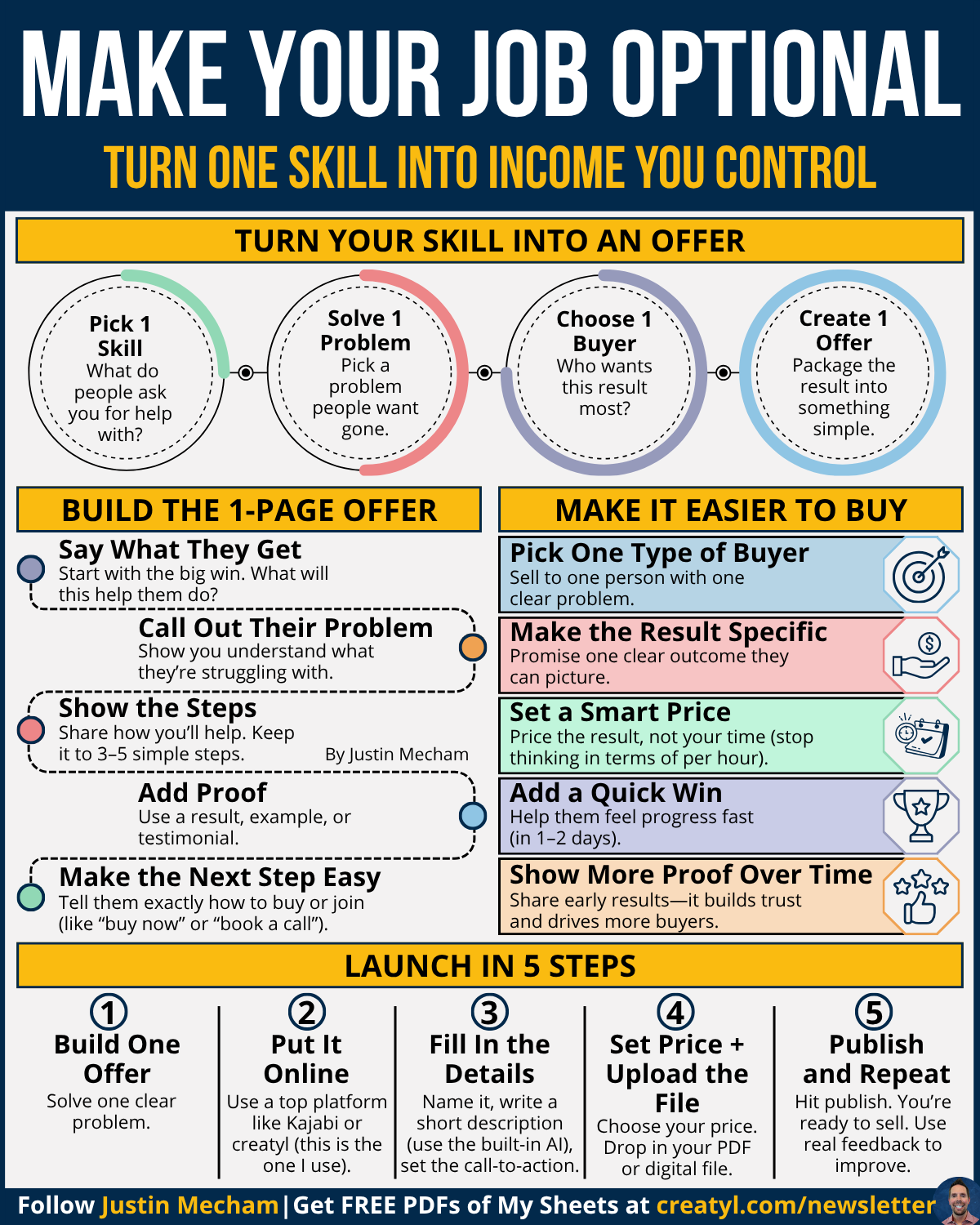
Download the Related Infographic
Want a practical visual framework for turning one existing skill into income you control?
Download the Make Your Job Optional: Turn One Skill Into Income You Control infographic PDF. It walks through choosing a skill, solving one specific problem, identifying the right buyer, creating a simple offer, building a one-page sales page, pricing around results, adding early proof, and launching without making the process unnecessarily complicated.
Use it as a working checklist while you build your first offer, then return to it as real customer feedback starts showing you what to improve.