


Click Here to Download the PDF.
The Best Time to Build Your Exit Is Before You Desperately Need One
The day I quit, my boss asked me a question I had expected for months.
“Are you scared?”
The strange part was that I wasn’t.
Not because leaving a steady paycheck suddenly felt risk-free.
Not because I had everything figured out.
And definitely not because I had discovered some secret source of courage.
I wasn’t scared because I had spent the previous six months quietly answering that question with evidence.
A few protected hours each week.
One rough offer.
One imperfect page.
One stranger willing to pay.
Then another.
Then enough repeated proof that leaving stopped looking like a cliff and started looking like the next logical step.
That experience changed the way I understand career transitions.
Most people focus on the moment they quit.
I became obsessed with everything that should happen before it.
Because the safest exit plan is not built around a resignation date.
It is built around evidence.
Can you create value outside your employer?
Will somebody pay for it?
Can you make another sale?
Can you earn enough consistently?
Can you build without destroying your health, relationships, or performance at your current job?
Those questions matter far more than whether you feel brave enough to hand in your notice.
You do not need to manufacture courage.
You need to reduce uncertainty.
And you can do that while your paycheck is still arriving.
Why Quitting on Your Worst Day Is Usually the Wrong Strategy
Bad days make excellent reasons to change something.
They make terrible business plans.
Maybe your manager says something that finally pushes you too far.
A promotion goes to someone else.
Another reorganization lands on your desk.
A project you spent months building gets ignored.
You wake up on Monday already exhausted.
The emotional response is understandable:
“I’m done.”
But there are two completely different decisions hiding inside that sentence.
I no longer want this job.
And:
I am financially and professionally prepared to leave this job.
Those are not the same thing.
You can be completely right about the first and completely unprepared for the second.
That distinction matters because quitting does not automatically create freedom.
Sometimes it simply replaces one kind of pressure with another.
The bad manager disappears.
But now the mortgage is still due.
The health insurance still costs money.
The savings account keeps shrinking.
And the business idea that looked exciting while you were employed suddenly has to work immediately.
That pressure can force terrible decisions.
You accept the wrong clients.
Underprice your work.
Build things nobody requested.
Say yes to opportunities you should decline.
And eventually you may discover that you did not build freedom.
You simply changed who creates the pressure.
A soft exit takes a different approach.
Do not wait for the job to become unbearable.
Build your options while you can still make calm decisions.
The Core Idea: Build the Other Side First
Imagine crossing a river.
Most people spend months staring at the bank they want to leave.
They analyze everything wrong with it.
They complain about it.
They imagine how much better the other side must be.
Then one terrible day gives them enough emotional energy to jump.
A better strategy is to start building the bridge.
That is what a soft exit really is.
It is not about secretly planning your resignation.
It is about reducing your dependence on one source of income before making a major financial decision.
You continue doing your job.
But a small portion of your time starts building something else.
One skill becomes one offer.
One offer creates one conversation.
One conversation creates one buyer.
One buyer becomes proof.
Repeated buyers create data.
Data creates confidence.
Income creates options.
The process looks boring compared with the dramatic quitting stories people love sharing online.
That is precisely why it works.
Start With One Quiet Hour
You do not need five free hours every night.
For many employed people, that is unrealistic.
You may have children.
A partner.
A commute.
Household responsibilities.
A demanding job.
A life you actually want to enjoy.
Your exit plan has to survive your real schedule, not your imaginary one.
Start with one protected hour.
Not necessarily every day.
Two evenings a week and one weekend block can be enough to begin.
The important part is what happens inside that time.
Your quiet hour is not for endless research.
It is not for watching another video about entrepreneurship.
It is not for changing your logo.
It is not for comparing seventeen platforms.
It is for creating evidence.
During that hour, ask:
What can I do tonight that moves me closer to a real buyer?
That might mean:
Writing an offer.
Talking with a potential customer.
Creating a simple product.
Sending five messages.
Publishing a useful post.
Building a one-page sales page.
Following up with someone interested.
Improving something a buyer actually requested.
The quiet hour works because it gives your future a place on your calendar.
Otherwise, your job gets your best hours and your future gets whatever energy happens to remain.
Usually, that means nothing gets built.
Use the Weekly 1-3-5 System
An exit plan can quickly become another overwhelming project.
You start making lists.
Website.
Content.
Product.
Email.
Branding.
Sales.
Social media.
Taxes.
Automation.
Community.
Suddenly you have created a second full-time job before earning your first dollar.
Shrink it.
Each week, choose:
1 big move
3 reach-outs
5 quick wins
Your big move should materially change the business.
Maybe you publish the offer.
Maybe you finish the first version.
Maybe you ask someone to pay.
Your three reach-outs put the idea in contact with reality.
Potential buyers.
Past colleagues.
People experiencing the problem.
Existing followers.
Your five quick wins keep momentum visible.
Fix the headline.
Answer a question.
Send a follow-up.
Improve one section.
Publish one useful idea.
This structure prevents a common mistake: confusing a long task list with business progress.
Protect Energy, Not Just Time
People often plan an exit by asking:
“Where can I find more hours?”
A better question is:
“Where is my usable energy going?”
An hour when you are mentally exhausted is not the same as an hour when you can focus.
Look at what happens after work.
Are you spending forty minutes scrolling because you are depleted?
Are unnecessary notifications keeping your mind attached to work?
Are you saying yes to obligations you no longer care about?
Are you carrying unfinished work mentally through the evening?
Your energy needs a budget just like your money does.
You do not need to eliminate every relaxing activity.
Rest matters.
The goal is to remove the things that consume energy without restoring you or moving anything meaningful forward.
A sustainable exit plan protects three things:
Your current income.
Your future income.
Your ability to function like a human being while building both.
Sacrificing the third to accelerate the second is rarely sustainable.
Start Ugly on Purpose
The first version of almost anything you build will be uncomfortable to share.
Good.
That usually means you built it quickly enough to learn from real people.
Your first landing page may look basic.
Your first product may be small.
Your first sales message may feel awkward.
Your first workshop may have five attendees.
Your first offer may need to change completely.
None of those are failures.
The real failure is spending six months polishing something before discovering nobody wants it.
Early versions have one job:
Produce information.
Will somebody click?
Will somebody reply?
Will somebody ask a question?
Will somebody buy?
Will somebody use the product?
Will they get the promised result?
That information is worth more than your private opinion about whether the product is ready.
Perfection tries to protect your ego.
Testing protects your time.
Why Five Minutes Still Counts
There will be evenings when your planned hour disappears.
Work runs late.
Someone needs you.
You are exhausted.
Life happens.
Do not turn one disrupted day into an abandoned plan.
Use a minimum action.
Five minutes.
Send the follow-up.
Write the headline.
Capture the idea.
Outline tomorrow’s task.
Move one card forward.
The purpose is not pretending five minutes can replace focused work.
It cannot.
The purpose is keeping the project psychologically alive.
Momentum is easier to continue than restart.
Set Exit Milestones Instead of Fantasizing About an Exit Date
“I want to quit by June” sounds like a plan.
It may not be one.
A date tells you when you want something to happen.
A milestone tells you what must become true first.
That difference is enormous.
Start with income milestones.
Maybe:
First $100: Someone will pay.
$500: The offer has early traction.
$1,000: You are learning how to repeat the process.
$3,000: Independent income is becoming financially meaningful.
The specific numbers will depend on your circumstances.
What matters is the sequence.
Each milestone should answer a different question.
Can I sell?
Can I sell again?
Can I make this repeatable?
Can I make it consistent?
Can this eventually support my needs?
Your exit should become safer as those questions get answered.
The Three Numbers That Matter More Than Your Resignation Date
Before seriously considering leaving, know three numbers.
1. Your Minimum Monthly Number
How much does your household actually need every month?
Housing.
Food.
Utilities.
Insurance.
Debt.
Transportation.
Essential family costs.
Taxes where applicable.
Do not use your salary as the automatic target.
Your salary and your required monthly spending may be very different numbers.
2. Your Reliable Outside Income
Not your best month.
Not projected revenue.
Not an invoice you hope gets paid.
How much independent income is actually showing up with enough consistency that you can reasonably plan around it?
3. Your Runway
How many months could you cover essential expenses if independent income slowed down?
That buffer gives you something incredibly valuable:
Time to make rational decisions.
The goal is not creating a number that guarantees nothing bad will happen.
No number can do that.
The goal is preventing every bad month from becoming an emergency.
Revenue Is Not Your Exit Number
This deserves special attention.
Suppose your side business generates $5,000 this month.
That does not mean you replaced a $5,000 paycheck.
Revenue is not take-home income.
Your business may have:
Software costs.
Contractors.
Payment fees.
Advertising.
Refunds.
Equipment.
Professional services.
Taxes.
Other operating expenses.
Your real exit math should focus on what remains after the business costs required to generate the revenue.
Otherwise, a number that looks safe from the outside can be dangerously misleading.
Track real profit.
Then compare that with real personal needs.
Freedom gets much less mysterious when the math is honest.
Do the Hard Thing First
Most side businesses do not stall because people refuse to work.
They stall because people spend their limited hours on comfortable work.
Designing.
Organizing.
Planning.
Researching.
Tweaking.
Watching tutorials.
Changing tools.
The uncomfortable task keeps moving to tomorrow.
Usually that task involves another human being.
Ask for the sale.
Send the message.
Publish the page.
Request feedback.
Follow up.
Raise the price.
Call the potential client.
If you only have one focused hour, do the task with the highest chance of producing useful market feedback first.
A beautiful business nobody has been asked to buy is still an assumption.
Break Big Goals Into 20-Minute Actions
“Build my business” is not a task.
Neither is:
Create my course.
Launch my product.
Grow my audience.
Replace my salary.
Your brain struggles with vague projects because it cannot see the finish line.
Convert them into actions small enough to complete.
Instead of:
Build sales page
Try:
Write the headline.
Write the problem section.
List three outcomes.
Add one testimonial.
Write the CTA.
Publish.
Instead of:
Launch product
Try:
Choose ten potential buyers.
Send five messages.
Send five more.
Book three conversations.
Make the offer.
Record objections.
Follow up.
Small actions reduce resistance because you know exactly what “done” means.
Use Fast Work Cycles
You do not need marathon work sessions after an already long day.
Try short cycles.
Twenty-five minutes of focused work.
Five minutes away.
Then another cycle if you still have capacity.
The structure is simple, but the constraint matters.
When you know you only have twenty-five minutes, you become less willing to waste twelve of them checking messages.
The goal is not squeezing productivity from every minute of your life.
It is creating a boundary around focused effort so the side project does not consume the entire evening.
You should be able to stop.
That is part of the system.
Work and Rest Belong in the Same Plan
There is a version of entrepreneurship advice that treats exhaustion as evidence of commitment.
Ignore it.
You already have a job.
Your exit plan should create options, not destroy your health before you reach them.
Use focused work.
Then recover.
Sleep.
Exercise.
Spend time with people you care about.
Take nights off.
A sustainable schedule will often outperform an aggressive one because you can maintain it for months.
That matters.
A six-month plan you can actually follow is far more useful than a two-week sprint that leaves you unable to continue.
Consistency is not intensity repeated forever.
It is effort designed so repetition remains possible.
Block Life After Work Before Work Claims It
If your exit-building time exists only as an intention, something else will take it.
Put it on the calendar.
Maybe:
Tuesday, 7:00–8:00 PM
Thursday, 7:00–8:00 PM
Saturday, 9:00–11:00 AM
Treat those blocks like meetings.
But do not automatically add more.
Start with a schedule you can protect without resenting it.
The purpose is not maximizing hours.
The purpose is making progress predictable.
Three protected hours every week for six months gives you roughly 78 focused hours.
You can learn a remarkable amount about an offer in 78 hours if those hours are spent selling, delivering, listening, and improving.
Track the Real Stuff
Your business can make you feel productive while producing almost no useful evidence.
So track movement.
A simple board can use:
Ideas → Testing → Selling → Delivered → Repeat
That is more useful than measuring how many hours you worked.
You can also track:
Buyer conversations.
Offers made.
Sales.
Conversion rate.
Revenue.
Profit.
Repeat buyers.
Customer results.
Questions.
Objections.
Referrals.
The purpose of measurement is not creating another dashboard to maintain.
It is answering:
Is this becoming more real?
The Proof Ladder
Not all progress carries equal weight.
Consider this sequence:
Level 1: Interest
Someone likes the idea.
Useful, but weak evidence.
Level 2: Conversation
Someone explains the problem to you.
Better.
Level 3: Intent
Someone asks how the solution works or what it costs.
Stronger.
Level 4: Purchase
Money changes hands.
Now you have meaningful evidence.
Level 5: Result
The customer gets the promised outcome.
Much stronger.
Level 6: Repeatability
Another customer buys and gets a result.
Now you may have the beginnings of a system.
Level 7: Consistency
Sales and results continue over time.
This is the level that should matter when making major career decisions.
Do not treat compliments as sales.
Do not treat one sale as a stable business.
Do not treat one strong month as guaranteed future income.
Let each level earn the next decision.
A Practical Six-Month Soft Exit Plan
The six months before leaving can be structured around reducing uncertainty.
Month 1: Find the Problem
Inventory your skills.
Notice repeated questions.
Talk with potential buyers.
Choose one problem worth solving.
Your goal is not a product.
Your goal is clarity.
Month 2: Create the Smallest Offer
Define one buyer.
One problem.
One result.
One format.
One price.
Keep it small enough that you can deliver it manually.
Month 3: Get Paid Proof
Start selling.
Do not hide behind content.
Speak directly with people.
Your goal is not scale.
Your goal is the first handful of paying customers.
Month 4: Deliver and Learn
Pay close attention.
Where do customers struggle?
What do they value most?
What did they misunderstand?
What result matters most?
Your buyers will show you what the business should become.
Month 5: Make It Repeatable
Document the recurring work.
Create templates.
Improve onboarding.
Simplify delivery.
Remove unnecessary steps.
Your business should become easier to operate as you learn.
Month 6: Review the Math
Now examine:
Income.
Profit.
Consistency.
Pipeline.
Runway.
Personal expenses.
Demand.
Energy.
Risk.
At this point, you are no longer asking:
“Do I hate my job enough to quit?”
You are asking:
“Have I built enough evidence to make a responsible choice?”
That is a radically better question.
A Real-World Example Using the PAS Framework
Imagine Daniel, a project manager who has wanted to leave his job for eighteen months.
He is exhausted.
He dislikes the company culture.
He spends Sunday evenings searching job boards and watching videos about starting a business.
Every few weeks he decides he is going to quit.
Then he looks at his mortgage, childcare costs, and savings.
He stays.
Daniel begins to believe courage is his problem.
He watches people online announce that they resigned without a backup plan and wonders why he cannot do the same.
But Daniel does not actually need more motivation.
He needs less uncertainty.
During his work, colleagues constantly ask him for help organizing complicated projects.
He has developed planning templates, meeting structures, risk trackers, and handoff processes.
He has never considered any of this commercially valuable.
It is just his job.
So the cycle continues.
Work.
Frustration.
Fantasy.
Fear.
Repeat.
Instead of resigning, Daniel protects Tuesday and Thursday evenings plus two hours on Saturday morning.
He starts talking with small agency owners who struggle with project delivery.
The same problems appear repeatedly.
Missed deadlines.
Unclear ownership.
Messy client communication.
He creates a small service helping agencies clean up their project-delivery system.
His first version is basic.
He sells it anyway.
The first customer pays $400.
The second pays $600.
Daniel improves the process and creates reusable templates.
Eventually he charges more because the outcome is clearer and delivery is faster.
Several months later, independent income covers a meaningful percentage of his essential expenses.
More importantly, Daniel now understands where customers come from, why they buy, and how he delivers the result.
He has not eliminated risk.
He has replaced unknowns with evidence.
That is what makes the eventual career decision different.
He is no longer jumping away from something.
He has somewhere to land.
What Not to Do During a Soft Exit
Do not secretly use employer resources to build your business.
Do not take confidential information.
Do not reuse intellectual property you do not own.
Do not compete in ways that violate valid contractual obligations.
Do not build your side business during hours when you are being paid to perform your current job.
And do not deliberately let your current performance collapse because you are emotionally finished.
A soft exit should create more control over your future without compromising your integrity in the present.
Review your employment agreements and applicable rules if there is any uncertainty about outside work, intellectual property, conflicts of interest, or non-solicitation obligations.
Your future business should begin on clean ground.
Your Job Can Fund the Experiment
One of the most useful mental shifts is to stop seeing your current job only as the thing preventing you from leaving.
For a period, it can also finance the transition.
Your paycheck pays your current expenses.
That gives the new offer room to be imperfect.
You can test pricing without every rejection threatening your ability to pay rent.
You can say no to a bad client.
You can reinvest early revenue.
You can learn.
You can save.
You can build runway.
That changes the role of the job.
It is no longer necessarily a prison.
For a season, it can be the investor funding your independence.
That does not mean staying forever.
It means using the stability strategically while you still have it.
When Should You Actually Leave?
There is no universal number.
Your situation may include family responsibilities, debt, healthcare costs, taxes, contractual obligations, risk tolerance, business expenses, and many other factors.
But the decision should be based on more than frustration.
Ask:
Is demand proven?
Are customers getting results?
Can I explain where the next buyers are likely to come from?
Is income becoming repeatable?
Do I know my actual monthly needs?
Do I understand my business expenses?
Do I have appropriate financial runway?
Does leaving create enough additional capacity to reasonably improve the business?
What happens if revenue drops for several months?
Would I still make this decision after a good day at work?
That last question is useful.
If you only want to resign immediately after something goes wrong, emotion may still be making the decision.
A strong exit should continue making sense when you are calm.
The Goal Is Not to Become Fearless
Fear gets treated strangely in career advice.
People assume the ideal exit happens when fear disappears.
It probably will not.
Leaving a predictable salary for less predictable income is a meaningful decision.
Some uncertainty is rational.
The goal is not:
No fear.
The goal is:
Enough evidence that fear no longer gets the deciding vote.
You know your numbers.
You know your buyers.
You know your offer.
You have made sales.
You have produced results.
You have savings.
You understand the risks.
You have tested your assumptions.
At that point, confidence is not motivational language.
It is accumulated evidence.
The Difference Between Courage and Proof
Courage says:
“I believe I can make this work.”
Proof says:
“Someone already paid me.”
Courage says:
“I believe people need this.”
Proof says:
“Here are the people who bought it.”
Courage says:
“I can probably replace my income.”
Proof says:
“Here are six months of actual numbers.”
You still need courage.
But courage should carry you across the remaining uncertainty.
It should not be responsible for the entire bridge.
Build as much of that bridge with evidence as you can.
Recommended Resources
Book: The Mom Test by Rob Fitzpatrick
Useful for learning how to speak with potential buyers without accidentally collecting meaningless compliments. Particularly valuable during the earliest validation stage.
Book: Company of One by Paul Jarvis
A useful counterweight to the idea that every successful business must become large, complicated, and expensive to operate. A soft exit often benefits from keeping the first business deliberately simple.
Book: Essentialism by Greg McKeown
Helpful for anyone trying to build something meaningful while already working full-time. The central challenge is rarely finding more things to do. It is deciding what deserves the limited time available.
Book: Profit First by Mike Michalowicz
Worth exploring when your side project begins producing meaningful revenue and you need to become more deliberate about the difference between sales, expenses, profit, taxes, and money available to you personally.
Practical Tool: Your Exit Evidence Scorecard
Create a simple document with these categories:
Monthly needs
Business revenue
Business expenses
Profit
Runway
Sales made
Repeat customers
Active leads
Customer results
Hours required
Update it once per week.
The goal is not staring at the numbers every day.
It is building enough history that your eventual decision can be based on patterns instead of one exciting week.
A Simple Weekly Soft Exit Routine
If everything in this article feels like too much, start here.
Monday: Decide the week's one big move.
Tuesday: Spend one hour creating or improving the offer.
Wednesday: Rest or handle one five-minute task.
Thursday: Reach out to potential buyers and follow up.
Friday: Review what moved.
Weekend: Use one focused block to deliver, build, or improve based on real feedback.
Then ask:
What created evidence?
What merely made me feel busy?
Do more of the first.
Remove more of the second.
Repeat.
That is enough to begin.
Build Until the Question Changes
At first, the question is usually:
“Could I ever leave?”
Then you make your first independent dollar.
The question changes.
“Could I do that again?”
You make another sale.
“Could this become consistent?”
You improve the offer.
Talk to more buyers.
Create better systems.
Save more money.
The question changes again.
“Could this cover something meaningful?”
Eventually, perhaps your outside income reaches $500.
Then $1,000.
Then $3,000.
Maybe your numbers are completely different.
The amount itself is not the important part.
The transformation is.
Every piece of evidence removes one assumption.
Until one day, you are no longer sitting at your desk asking whether you are brave enough to leave.
You are looking at your numbers, your customers, your savings, your systems, and your options and asking a completely different question:
“Why am I still here?”
That is what a good exit plan does.
It does not force you out.
It builds enough choice that staying and leaving become decisions rather than fears.
There is no need to destroy your sleep trying to build it.
You do not need to work until 2 a.m.
You do not need to announce your plans.
You do not need a perfect product.
You do not need a huge audience.
You need small pockets of protected time.
A real problem.
A simple offer.
Actual buyers.
Honest numbers.
Repeated proof.
And enough patience to keep going while the evidence compounds.
The day you eventually leave should not be the day you discover whether your plan works.
That experiment should have started months earlier.
Build the other side first.
Then, when somebody asks whether you are scared, you will not need a motivational answer.
You will have numbers.
Download the Related Infographic
Want a visual version of this system you can keep beside your desk?
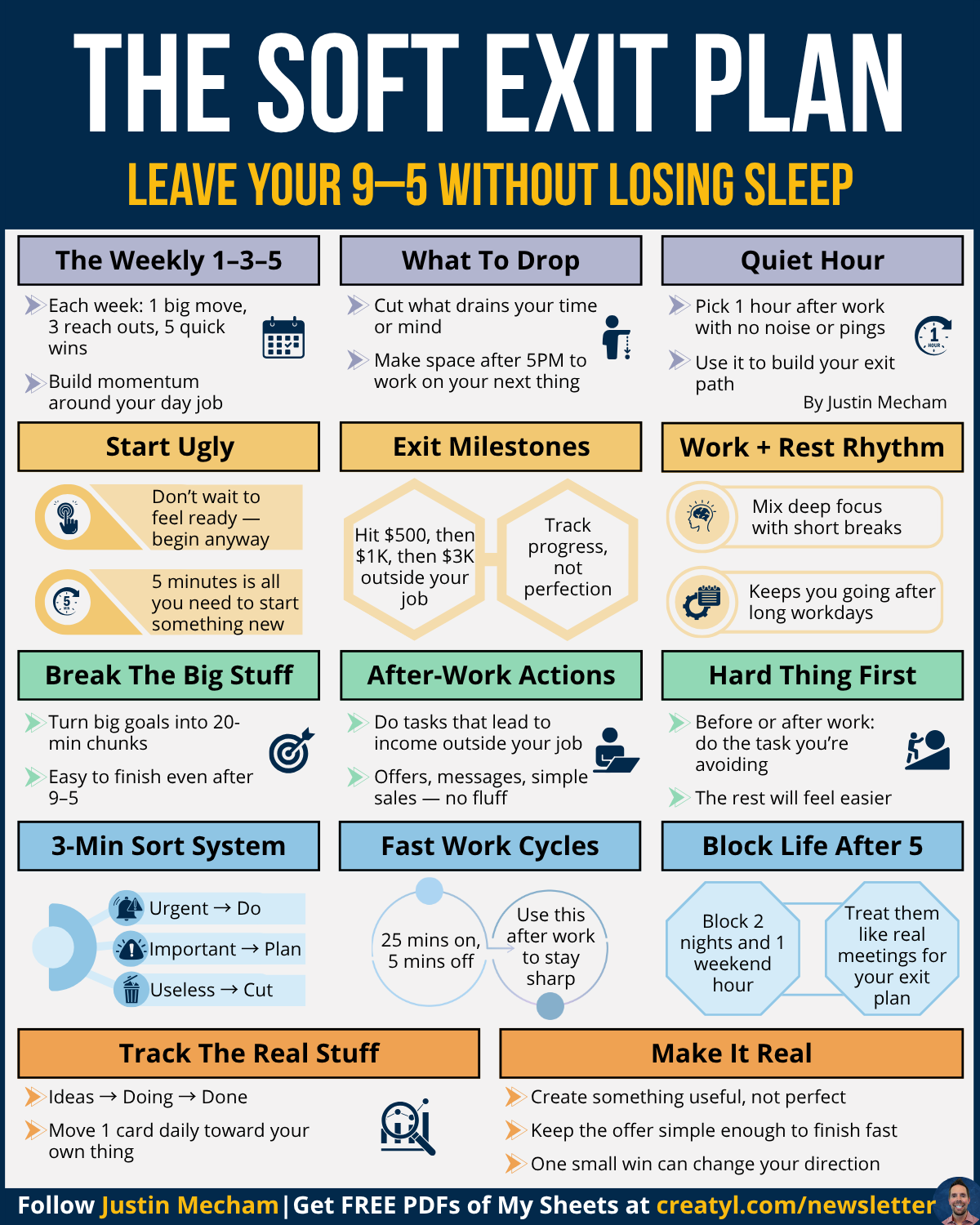
Download The Soft Exit Plan infographic PDF. It breaks the process into practical pieces, including protected after-work time, weekly priorities, small work cycles, exit milestones, energy management, progress tracking, and building something real without turning your evenings into another exhausting full-time job.
Use it as a weekly planning sheet. Pick the pieces that fit your life, protect a few repeatable blocks, and measure the evidence you create rather than the hours you spend.