


Click Here to Download the PDF.
The Skill You Keep Calling “Normal” May Be More Valuable Than You Realize
For a long time, I thought replacing a paycheck required discovering something extraordinary.
I assumed I needed a brilliant business idea, a completely new skill, a large audience, or some opportunity nobody else had noticed yet. If I was going to create meaningful income outside a job, surely I needed to invent something impressive.
That assumption made starting unnecessarily difficult.
Every idea had to pass an impossible test. Was it original enough? Was it exciting enough? Was it big enough to become a real business? Would people look at it and immediately understand why it was special?
Meanwhile, I was ignoring the most useful evidence I had.
People were already asking me for help.
I had templates I used repeatedly because they made my work faster. I had processes I had refined through years of mistakes. I had explanations I had given so many times that they felt almost automatic. I had spreadsheets, scripts, checklists, shortcuts, frameworks, examples, and lessons sitting inside my ordinary workday.
I did not see any of them as products.
I saw them as normal.
That is one of the most expensive mistakes experienced professionals make.
The more familiar a skill becomes, the less valuable it feels to the person who possesses it. You forget what the problem looked like before you understood it. You forget how much trial and error went into creating your shortcut. You forget that the answer you can give in five minutes may save someone else five months.
Your best business idea may not be hiding in a trend report.
It may be sitting in a folder on your laptop.
It may be the question people keep asking you.
It may be the process you built because the standard way was frustrating.
It may be the mistake you made enough times that you now know exactly how to avoid it.
The opportunity is not always learning something new.
Sometimes it is finally recognizing the economic value of what you already know.
Replacing a Job Does Not Start With Replacing the Salary
The phrase “replace your job” can make the entire process sound much bigger than it needs to be.
If your salary is substantial, replacing the full amount immediately feels impossible. You may look at your monthly paycheck, compare it with the zero dollars your new idea is earning, and decide the gap is too large to cross.
That is the wrong first comparison.
Your first goal is not salary replacement.
It is skill validation.
Can one thing you know create one dollar outside your employment?
Then can it create another?
Can the result be repeated?
Can you serve more than one buyer?
Can you improve the process?
Can you eventually turn that repeated value into something more scalable?
Income replacement happens later.
Proof comes first.
This is why the first small sale matters disproportionately. It changes your understanding of what is possible.
Your knowledge has now created value in two economic environments instead of one.
Your employer may still be your largest customer by an enormous margin.
But it is no longer the only proof that your skills have value.
That distinction changes how you think.
1. Sell What You Know
The first place to look for an offer is not your hobbies, trends, or whatever business model happens to be popular this month.
Look at what already works.
Ask yourself:
What do I know how to do reliably?
What do people regularly ask me about?
What part of my work produces results?
What mistakes do I know how to avoid?
What would I teach someone if they joined my role tomorrow?
What do I know now that would have saved me a year when I started?
You are looking for four things:
What works. The actions you know create a useful result.
What fails. The common mistakes you can help people avoid.
What to skip. The unnecessary steps beginners waste time on.
What to do first. The sequence that makes everything easier.
Those four categories contain an enormous amount of commercial value because customers do not simply want more information.
They want fewer wrong turns.
If you can shorten someone’s learning curve, you may have something sellable.
Why “obvious” knowledge is often the most valuable
Suppose you have managed client projects for seven years.
You know that the first kickoff meeting must establish ownership, communication rules, deadlines, and decision-makers. That feels obvious to you.
It is not obvious to the consultant who just signed their first large client and is terrified of looking unprepared.
What feels basic to you may be precisely what somebody else needs.
The market does not pay based on how difficult the answer feels to the seller.
It pays based on how useful the answer is to the buyer.
2. Package Your Wins
A successful result is more useful when you can explain why it happened.
Think about something you have accomplished repeatedly.
Maybe you improved a process.
Reduced errors.
Closed deals.
Built a team.
Created content.
Organized complicated information.
Helped customers.
Saved time.
Finished projects faster.
Now break the win into three pieces.
Result
What changed?
Be specific.
Maybe you reduced onboarding time from ten days to four.
Maybe you created a reporting system that saved your team five hours every week.
Maybe you consistently helped job candidates prepare stronger interview answers.
The result gives the knowledge context.
Method
How did you create that result?
What steps did you take?
What order mattered?
What did you deliberately avoid?
This is where experience turns into something teachable.
Proof
What demonstrates that the method worked?
A before-and-after comparison.
A result.
A customer message.
A performance metric.
A repeatable outcome.
A useful case study.
When result, method, and proof align, you are no longer selling vague expertise.
You are showing someone a path.
And paths are much easier to buy than promises like “I can help you improve.”
3. Sell Your Solutions
Problems people already pay to solve are much safer starting points than interesting ideas nobody has asked for.
Look at the problems you already fix.
Maybe you repair what breaks.
Maybe you simplify something complicated.
Maybe you explain something confusing.
Maybe you organize something messy.
Those sound like ordinary workplace responsibilities.
They are also categories of commercial value.
Businesses and individuals pay constantly to reduce four things:
Time.
Risk.
Confusion.
Effort.
If your skill reduces one or more of those, there may be an offer inside it.
For example, an operations manager might package a workflow cleanup service. A financial professional might create a budgeting template for freelancers. A designer might offer presentation makeovers. A recruiter might sell interview preparation sessions.
You do not need to invent demand.
Find a problem people already experience and create a clearer way to solve it.
4. Sell Your Advice
Notice the subjects people repeatedly ask your opinion about.
Career questions.
Writing.
Money habits.
Leadership.
Tools.
Technology.
Hiring.
Negotiation.
Content.
Sales.
Organization.
If the same question keeps arriving, pay attention.
Repeated questions are a form of market research.
The key is moving from informal advice to a structured outcome.
Instead of “I give career advice,” perhaps you help mid-career professionals prepare for internal promotion interviews.
Instead of “I help with writing,” perhaps you help consultants turn rough ideas into weekly LinkedIn posts.
Instead of “I know about money,” perhaps you help freelancers build a basic cash-flow system.
Advice becomes more valuable when it has a boundary.
One audience.
One problem.
One result.
One method.
That is when general knowledge begins becoming a real offer.
5. Use Your Mistakes
Some of your most valuable knowledge came from getting something wrong.
That does not make the knowledge less valuable.
It may make it more useful.
Think about expensive mistakes you made early in your career.
What did you misunderstand?
What wasted time?
What created unnecessary stress?
What did you try that failed?
What do you now do differently?
Someone who is two years behind you may gladly pay to avoid repeating those mistakes.
Failure becomes useful when you can turn it into a warning system.
For example, perhaps you launched a product nobody wanted because you never validated demand. You could teach others how to test an offer before building it.
Perhaps you repeatedly hired the wrong candidates until you learned how to structure interviews.
Perhaps you ran chaotic projects until you developed a better handoff system.
The mistake itself is not the product.
The lesson is.
Your scar tissue can become someone else’s shortcut.
6. Sell What Is Easy for You
This is one of the hardest categories to recognize because ease creates blindness.
If something is easy for you, you may assume everyone can do it.
They cannot.
Perhaps you communicate clearly.
Research quickly.
Analyze data.
Fix broken systems.
Teach complicated concepts.
Write compelling headlines.
Organize information.
Create useful visuals.
Build relationships.
Spot patterns.
Those abilities feel normal because they are yours.
But someone else may struggle with them every week.
A simple exercise can help.
Ask three people who know your work:
“What do you think I am unusually good at that I probably take for granted?”
Their answers may surprise you.
We are often terrible judges of our own comparative advantage because we experience our strengths from the inside.
Other people see the difference more clearly.
7. Sell the Shortcut
Experience creates compression.
The first time you performed a task, perhaps it took three hours.
Now it takes twenty minutes.
What changed?
You learned what to ignore.
You learned the right setup.
You know the common mistakes.
You know the sequence.
You know which tool works.
That compression is valuable.
A shortcut does not mean cheating.
It means removing unnecessary learning.
If you can teach someone:
The setup.
The sequence.
The mistakes.
The shortcuts.
The tools.
The working examples.
You may save them significant time.
That is exactly why templates, checklists, swipe files, playbooks, prompt libraries, scripts, and implementation guides can be valuable despite appearing simple.
Their value comes from decisions already made.
The buyer is paying to avoid reinventing the process.
8. Sell Your Tools
One of the easiest ways to find digital-product ideas is to inspect the assets you already use.
Open your folders.
Look for:
Templates.
Spreadsheets.
Scripts.
Prompts.
Checklists.
Documents.
Trackers.
Calculators.
Frameworks.
Swipe files.
Dashboards.
Question lists.
Planning sheets.
Email sequences.
Proposal structures.
You may already have a rough product.
The next question is whether the tool solves a meaningful problem for another person.
Do not simply upload an internal spreadsheet and call it a business.
Clean it.
Explain how to use it.
Give an example.
Remove company-specific information.
Add instructions.
Make the outcome obvious.
Then test whether someone wants it.
The transformation from work asset to product is often much smaller than people assume.
9. Package Your Method
If you can explain how you do something, you can begin turning it into a method.
A simple framework is:
Know it → Break it down → Show it → Package it → Teach it.
First, identify the thing you know how to do.
Then break it into stages.
Next, show examples.
Package the steps into a useful format.
Then help someone follow them.
Methods become valuable because they reduce ambiguity.
Instead of telling someone to “get better at sales,” you give them a sequence.
Instead of saying “improve your content,” you give them a framework for generating, writing, publishing, and reviewing posts.
Instead of saying “be a better manager,” you give them a system for preparing, running, and following up after one-on-ones.
The method turns expertise into something transferable.
Transferable knowledge is much easier to sell.
10. Use Your Head Start
Your experience is more valuable than you probably calculate.
Suppose you have spent five years doing something.
Maybe you have repeated the core process hundreds of times.
Perhaps you made fifty meaningful mistakes.
And somewhere inside those mistakes, you discovered one crucial shortcut.
That shortcut may look tiny.
But the customer is not buying one tip in isolation.
They are buying the years of experience that made the tip obvious.
This is why pricing knowledge purely according to how long it takes to deliver can be misleading.
A one-hour session can contain ten years of pattern recognition.
A five-page document can contain hundreds of failed experiments.
A template can embody years of refinement.
Your experience is compressed inside the asset.
Do not confuse short delivery with low value.
11. Sell Your Systems
Systems are particularly powerful because they produce repeatability.
Before the system, there is chaos.
After the system, there is a process.
Then the process creates a more predictable result.
Think about something you have made more reliable.
Maybe you created a hiring system.
A meeting system.
A publishing system.
A sales follow-up system.
A planning system.
A customer onboarding system.
A reporting system.
A lead-tracking system.
A content-repurposing system.
If the system saves time, removes confusion, reduces mistakes, or creates a better outcome, it may have commercial value.
The easiest systems to sell often have a clear before-and-after state.
Before: messy, manual, inconsistent.
After: organized, repeatable, understandable.
People pay to move from chaos to clarity.
12. Test Before Quitting
This may be the most important part of the entire framework.
Do not resign because you found an idea you like.
Test it.
A simple four-stage proof sequence works well.
Stage 1: People Ask for Your Help
This is a signal.
Not proof, but useful evidence.
Stage 2: You Solve the Problem Repeatedly
Now you know the result is not accidental.
You have a method.
Stage 3: Someone Pays
This is stronger evidence.
A real buyer valued the result enough to exchange money for it.
Stage 4: You Repeat the Sale
Now you begin seeing something more interesting.
One sale proves possibility.
Repeated sales begin proving demand.
That is when the conversation about replacing a job becomes much more concrete.
Do not quit on hope.
Build proof while the paycheck still gives you room to learn.
The Difference Between a Skill and an Asset
A skill lives inside you.
An asset packages part of that skill so someone else can access its value.
This distinction is important.
If you know how to do something but can only monetize it by personally performing the work every time, you have useful expertise.
When you document the process, create templates, build tools, record lessons, develop systems, or create repeatable services, you begin creating assets.
Assets can produce leverage.
One explanation becomes a guide.
One guide serves many people.
One repeated consulting process becomes a template.
One template becomes part of a toolkit.
One toolkit becomes a course.
One course may eventually become a membership, certification, or larger offer.
You do not need to start at the top of that ladder.
Start with the smallest useful asset.
Then let customer behavior show you whether the next rung deserves to exist.
How to Choose Which of the 12 Ideas to Start With
Finding twelve possible opportunities can create a new problem.
Too many choices.
Use four filters.
1. Frequency
How often do you already encounter this problem?
Repeated problems create more evidence.
2. Urgency
How strongly does the buyer want the problem solved?
A mild inconvenience and an expensive recurring headache are not equally valuable.
3. Reach
Can you find people who experience the problem?
A brilliant product for an audience you cannot reach may remain invisible.
4. Fit
Do you actually want to keep solving this?
You do not need to be endlessly passionate about every task.
But building around work you actively dislike is a poor way to create more freedom.
Score each potential idea from one to five across those four criteria.
Then test the strongest one.
Do not spend a month ranking ideas.
The market will give you better information than your spreadsheet.
The One-Sentence Offer Exercise
Take your strongest idea and complete this sentence:
I help [specific person] solve [specific problem] so they can [specific result].
For example:
“I help first-time managers prepare for difficult performance conversations so they can give clear feedback without destroying trust.”
Or:
“I help freelance designers organize client onboarding so projects start faster and fewer details get missed.”
Or:
“I help experienced professionals turn one repeatable work skill into a simple digital product they can test for sale.”
Read the sentence out loud.
Would the intended buyer recognize themselves?
Can they understand the problem immediately?
Can they picture the result?
If not, simplify.
The quality of your offer often improves when the sentence gets shorter.
Let’s Take A Look At An Example…
Imagine Elena, a senior customer-success professional who has spent eight years working with software companies.
She is excellent at onboarding new customers.
Whenever a new team member joins, Elena gives them the same documents she created for herself: kickoff questions, a handoff checklist, a renewal tracker, and several email templates.
Everyone loves them.
Elena barely thinks about them anymore.
To her, they are just files.
She has also wanted to create income outside her job for years, but every business idea feels too complicated.
She assumes she needs something new.
Elena begins exploring ecommerce, coaching, content creation, affiliate marketing, and several unrelated business models.
Each one requires learning an entirely new set of skills.
Meanwhile, the assets she already created continue helping coworkers save hours.
One evening she realizes the contradiction.
She is trying to become a beginner in five new industries while ignoring something she is already unusually good at.
She reviews her files and notices that one onboarding checklist has been copied and reused across several teams.
The knowledge is already packaged.
It simply is not being sold.
Instead of starting an entirely new business, Elena cleans up the onboarding toolkit.
She removes employer-specific information.
She rewrites the instructions.
She adds examples.
She creates a short guide explaining the sequence.
Then she speaks with several independent customer-success consultants and small SaaS teams.
Their biggest concern is not finding more information.
It is getting new customers from signed contract to successful onboarding without losing important details.
Elena positions the toolkit around that specific outcome.
She sells the first few copies.
One customer asks whether Elena can review their entire onboarding process.
That becomes a service.
After completing several service engagements, Elena notices repeated problems and adds new templates to the toolkit.
The service improves the product.
The product generates service leads.
Eventually, both offers are stronger.
Nothing started with a genius idea.
The opportunity had been hiding in her existing work.
She simply stopped calling it normal.
Your Existing Job Is Full of Product Research
You do not need to misuse confidential information or repurpose work your employer owns.
That distinction matters.
But you can learn from patterns.
The problems you observe.
The skills you develop.
The questions people ask.
The general methods you learn.
The mistakes you make.
The judgment you build.
Those experiences shape expertise that can eventually be applied elsewhere, provided you respect contracts, intellectual-property obligations, confidentiality, and applicable policies.
The point is not taking company assets.
It is recognizing the portable knowledge developing inside you.
A company may own a particular internal document.
It does not own your ability to understand why a process works.
That understanding can become the foundation for something original that you create independently.
Build the Smallest Version First
Suppose you identify a valuable system.
Your first instinct may be to create the ultimate version.
Do not.
Ask:
What is the smallest useful version that can create the promised result?
A live workshop may come before the course.
A consultation may come before the coaching program.
A spreadsheet may come before the software.
A checklist may come before the full playbook.
A service may come before the digital product.
The earliest version should maximize learning, not scale.
Scale before learning simply spreads your assumptions more efficiently.
Services Can Be the Fastest Route to Your First Proof
Digital products are attractive because they can eventually separate income from time.
But services deserve more respect as a starting point.
A service lets you work directly with the problem.
You see how customers describe it.
You watch what they struggle with.
You understand what they value.
You can adjust quickly.
That information can later become the foundation for a product.
For example:
Start with résumé reviews.
Notice the same five mistakes.
Create a checklist.
Turn the checklist into a guide.
Use the guide in a workshop.
Turn repeated workshop questions into a course.
Create ongoing support for members.
The scalable product can emerge from hands-on work.
You do not have to guess it in advance.
When a Template Becomes a Business Asset
A template is valuable when it removes decisions.
That is why the best templates are not merely blank documents.
They contain judgment.
A useful proposal template tells someone what sections matter.
A hiring scorecard tells someone what criteria deserve attention.
A content calendar tells someone what to publish and when.
A budget sheet tells someone which numbers to track.
A meeting agenda tells someone which questions create better decisions.
The value is not the boxes.
It is the thinking behind the boxes.
If your template saves someone thirty minutes every week, that can become dozens of hours a year.
If it prevents one expensive mistake, its value may be much larger.
Again, simplicity does not mean low value.
Sometimes simplicity is exactly what the customer is purchasing.
Why Your First Ten Buyers Matter More Than Your First Thousand Followers
An audience can be useful.
But people often build audiences as a substitute for learning how to sell.
Ten real buyers can teach you:
Whether the problem matters.
Whether the promise is believable.
Whether the price works.
Whether the product creates results.
Which objections appear.
What language buyers understand.
Which features matter.
Where people find you.
What they want next.
One thousand passive followers may teach you far less.
Do not confuse attention with demand.
Build enough audience to reach buyers, but remain focused on buyer behavior.
Revenue is not the only measure of value, but it is a useful signal when you are specifically testing whether a skill can become income.
The Income-Replacement Ladder
Instead of immediately trying to replace your entire paycheck, build through stages.
Stage 1: First Paid Proof
Someone pays.
The skill now has external commercial evidence.
Stage 2: Repeat the Sale
A second and third person pay.
Now the result may not be a coincidence.
Stage 3: Replace One Bill
Use independent income to cover one recurring expense.
This turns abstract income into practical financial breathing room.
Stage 4: Reach Consistent Monthly Income
The number may still be small, but predictability matters.
Stage 5: Build Multiple Months of Proof
One unusually strong month does not automatically mean the income is stable.
Look for patterns.
Stage 6: Build Financial Runway
Save enough that a slow period does not immediately threaten your household.
Stage 7: Decide What Role You Want Your Job to Play
Maybe you keep it.
Maybe you reduce your hours.
Maybe you change employers.
Maybe you leave.
The goal is optionality.
Replacing your job is only one possible outcome.
A 30-Day “Sell What You Know” Challenge
If you want to test whether your existing knowledge contains a business idea, use the next month.
Week 1: Inventory What You Know
Write down:
Five problems you solve.
Five repeated questions.
Five tools or templates you use.
Five mistakes you know how to avoid.
Five processes you understand.
Do not judge the list yet.
Week 2: Talk to People
Choose the strongest three ideas.
Speak with people who experience those problems.
Ask what they have already tried, what frustrates them, and what a useful result would look like.
Listen more than you pitch.
Week 3: Package One Solution
Choose one idea.
Build the smallest useful version.
Write a clear one-sentence offer.
Set a real price.
Create a simple page or message explaining what it does.
Week 4: Sell It
Put the offer in front of actual potential buyers.
Make direct offers.
Follow up.
Watch what happens.
At the end of the month, review the evidence.
Did anyone pay?
What did people ask?
What caused hesitation?
Which promise received the strongest response?
What should be improved?
What should be removed?
You are not trying to build a perfect business in thirty days.
You are trying to discover whether one of the skills you have been overlooking deserves a second month.
Five Questions to Ask Before Turning Any Skill Into a Product
Before you spend substantial time building, ask:
1. Does this solve a problem somebody already knows they have?
Unknown problems require more education and can be harder to sell.
2. Have people asked me for help with this before?
Previous requests are useful evidence.
3. Can I create a clear result?
Knowledge without an outcome is harder to package.
4. Can I test the offer quickly?
Early feedback prevents expensive guessing.
5. Would I want to solve this problem repeatedly?
Demand matters, but so does your willingness to keep doing the work.
The strongest opportunities sit somewhere between market need, demonstrated ability, and personal fit.
Do Not Accidentally Build Another Job You Hate
There is a risk in turning your skills into income.
You can become so focused on leaving employment that you recreate all the parts you disliked about your job inside your own business.
Too many clients.
Too many hours.
No boundaries.
Constant availability.
Work you do not enjoy.
Revenue dependent entirely on your time.
That is why “replace your job” should not mean “create an equally exhausting job with your name on the invoice.”
As the business grows, ask:
Which parts should remain personal?
Which parts can become templates?
Which processes can be automated?
Which customers are the best fit?
Which work creates the most value?
Which activities should disappear?
What would make the business easier to operate next year than it is today?
You are not only trying to create income.
You are trying to create better economics around your skills.
Recommended Resources
Book: The Mom Test by Rob Fitzpatrick
A practical resource for learning how to speak with potential customers before building. It helps you avoid mistaking friendly encouragement for real demand.
Book: Company of One by Paul Jarvis
A strong resource for anyone interested in building a focused, profitable business without automatically chasing more employees, overhead, and complexity.
Book: The $100 Startup by Chris Guillebeau
Useful for seeing how ordinary skills can become small businesses without enormous startup capital or elaborate infrastructure.
Book: Obviously Awesome by April Dunford
Helpful when you already have something useful but struggle to explain why it matters, who should buy it, or how it differs from the alternatives.
Practical Tool: The Skill-to-Product Inventory
Create a document with six columns:
Skill: What can I do well?
Problem: What does it solve?
Buyer: Who struggles with it?
Asset: What have I already created?
Offer: How could I package the solution?
Proof: What evidence shows it works?
Fill in at least twelve rows.
Do not worry about whether each idea is brilliant.
You are searching for evidence of usefulness.
The strongest ideas usually become obvious once you can see them side by side.
Your Best Business Idea May Already Feel Too Ordinary to Notice
There is a frustrating irony in expertise.
The longer you know something, the less impressive it feels.
The answer comes quickly, so you assume it is simple.
The process feels obvious, so you assume everyone understands it.
The template is already sitting on your laptop, so you assume nobody would pay for it.
The mistake happened years ago, so you forget how valuable the lesson could be to somebody facing it today.
That is why people often spend years looking for a business idea while carrying dozens of potential offers into work every morning.
They do not lack knowledge.
They lack distance from their own knowledge.
You do not need every skill to become a product.
You do not need to monetize your entire life.
And you certainly do not need to quit your job simply because something you know could be sold.
But you should understand the assets you possess.
A skill is more than the task it performs inside your current role.
It can become a service.
A method.
A guide.
A system.
A template.
A workshop.
A product.
A course.
A shortcut.
A consulting offer.
A membership.
A second source of income.
Maybe the first thing you sell earns fifty dollars.
That will not replace your paycheck.
But something important will have happened.
A stranger, customer, or client will have looked at something you know and decided it was worth paying for.
That sale turns an assumption into evidence.
Then your job looks slightly different.
It may still be valuable.
It may still be worth keeping.
But it is no longer the only place where your experience can create money.
Repeat the process enough times and the conversation changes again.
You stop asking whether you could ever create income independently.
You start asking how much of your income you want to control.
That is a much more interesting question.
So before learning another skill, buying another course, or searching for another brilliant idea, look at what is already sitting in front of you.
Look at the questions people ask.
The processes you repeat.
The mistakes you can prevent.
The systems you have created.
The tools you rely on.
The results you know how to produce.
The knowledge you have dismissed because it feels ordinary.
Something inside that list may be far more valuable than you have been giving it credit for.
You may not need a new skill to build another source of income.
You may simply need to stop calling your existing skills normal.
Download the Related Infographic
Want the entire framework as a practical visual reference?
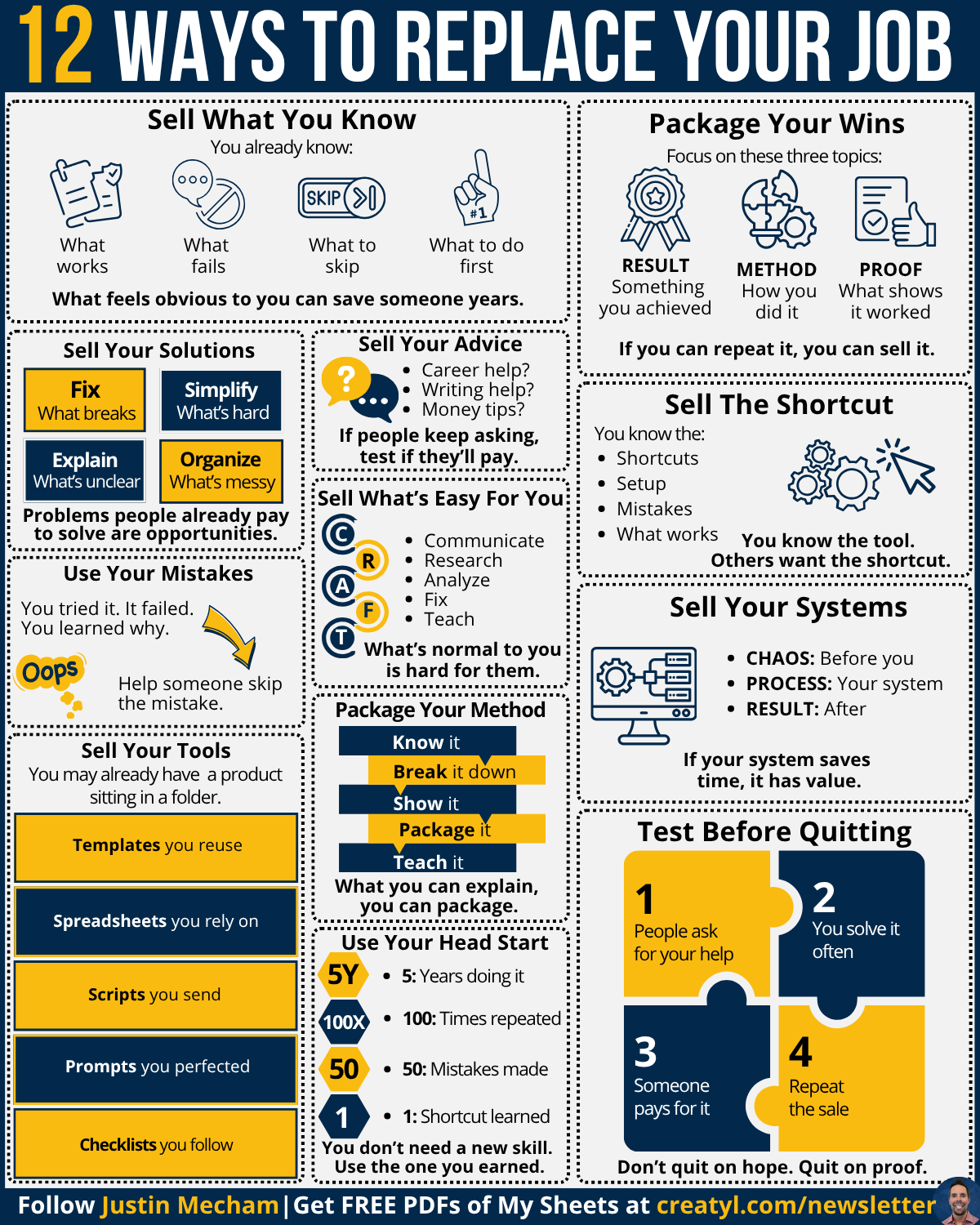
Download the 12 Ways to Replace Your Job infographic PDF. It shows twelve places to look for sellable value inside your existing experience, including what you know, the results you have achieved, the problems you solve, the advice people request, the mistakes you have learned from, the tools you already use, the shortcuts you know, and the systems you have built.
Use it as a working exercise. Go through each section, write down one possible offer, choose the strongest idea, and test it with real buyers before investing months building something larger.