

Click Here to Download the PDF.
100 Ways to Replace Your Job. But You Only Need One.
How to turn the skills you already have into income, find your first customer, and create more options for your future without quitting your job.
Here's something that took me years to understand.
You can spend your entire career getting better at your job without ever realizing how valuable those same skills could be outside your workplace.
Think about everything you've learned. The difficult conversations you've handled. The problems you've solved. The systems you've improved. The people you've helped.
You've probably become good at things you don't even consider special anymore.
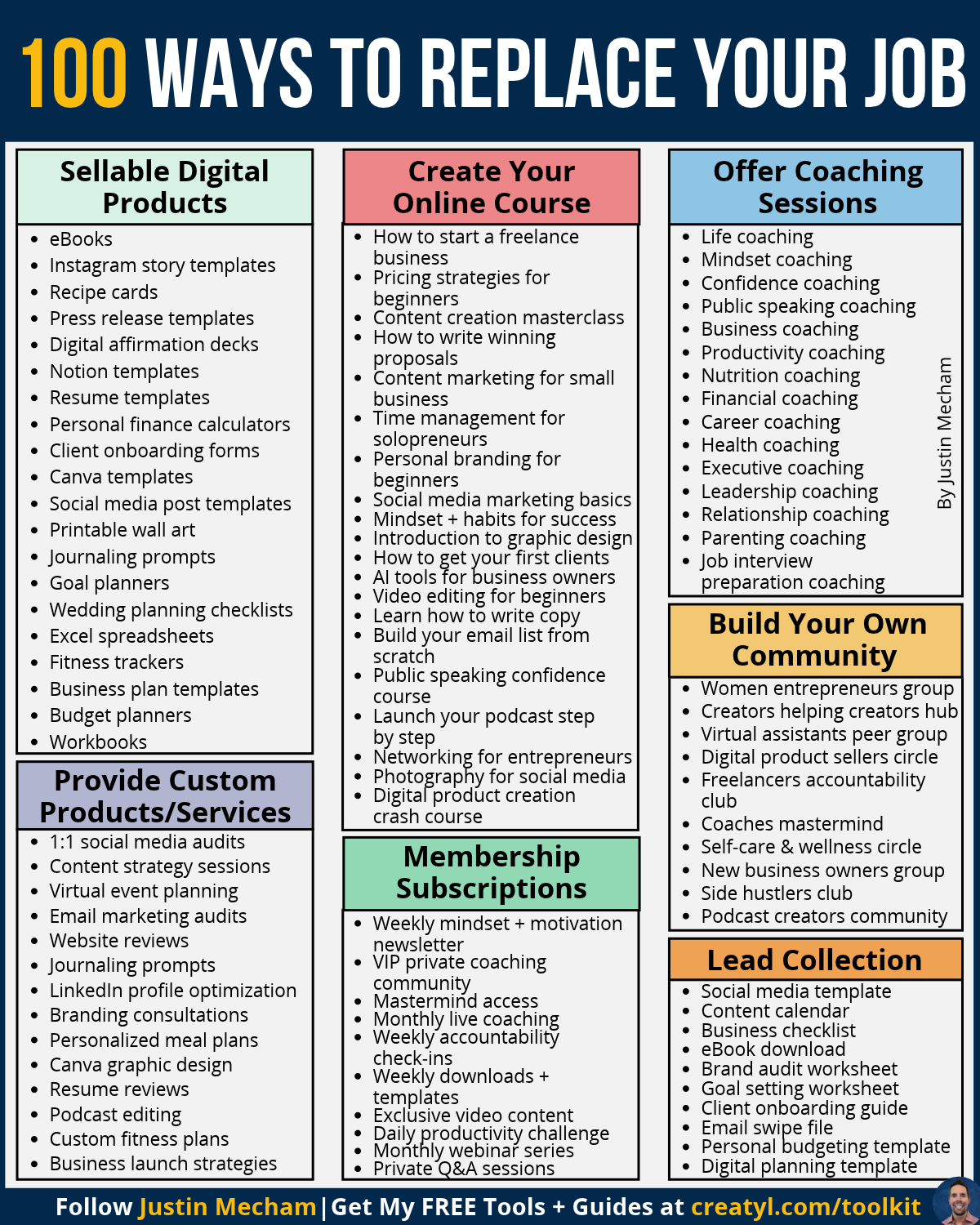
And that's exactly why I created the infographic 100 Ways to Replace Your Job.
Not because I believe everyone should quit their job. I don't.
But because I believe more people deserve to know that their employer isn't necessarily the only person willing to pay for what they know.
The problem? Having 100 ideas can be just as overwhelming as having none.
So today, I want to show you how to find one worth testing, without risking your paycheck or spending months building something nobody wants.
The Big Idea: Your First Sale Changes More Than Your Income
When people hear replace your job, they immediately think about replacing their entire salary.
That's a huge amount of pressure to put on something that hasn't earned its first dollar.
And it's why so many people spend years researching side businesses without actually starting one.
They compare an idea they've never tested with a paycheck they've spent years earning.
Of course that feels scary.
But what if the first goal wasn't replacing your salary?
What if it was earning your first $100 from something you already know how to do?
That money probably won't change your financial situation.
But something else happens.
You discover that someone outside your company values your experience enough to pay for it.
That's a pretty important discovery.
One sale doesn't mean you've built a successful business. But it gives you real evidence that your skills might create opportunities beyond your current job.
Your first business doesn't need to replace your paycheck. It needs to prove your paycheck isn't your only option.
Here's how I'd approach it.
1. Find the Skills You've Stopped Noticing
Ask someone what they're good at, and they'll usually tell you their job title.
"I'm an office manager."
"I work in customer service."
"I'm a project coordinator."
But those titles don't tell us what problems they can solve.
Take someone who's worked in customer service for ten years.
They've probably handled hundreds of complaints, dealt with frustrated customers, written difficult emails, and helped people understand confusing information.
To them, that's just Tuesday.
To a small business owner struggling with customer complaints, that experience could be incredibly useful.
They might pay for customer email templates, staff training, or help setting up a better support process.
The skill hasn't changed. The person who needs it has.
Here's what I'd do: Write down five problems people regularly ask you to solve.
Not five skills. Five actual problems.
Then write what you did and what improved afterward.
Instead of "I'm good at spreadsheets," you might discover, "I help people understand where their business money is going."
That's something a potential customer can immediately understand.
And it might be worth more than you've ever considered.
2. Stop Choosing Products Before Finding Problems
I've seen people spend weeks deciding whether to create an eBook, course, membership, or coaching program.
Meanwhile, they haven't spoken to a single potential customer.
Here's the issue.
Nobody wakes up excited because another PDF exists.
They want something in their life to become easier.
Someone struggling with money doesn't necessarily want a budgeting spreadsheet. They want to understand their spending and stop worrying about unexpected bills.
Someone starting a business doesn't necessarily want a 40-lesson course. They want to know how to find their first customer.
The product is how you deliver the help. The problem is why someone pays.
Try this: Choose three problems you could solve and score each from one to five.
Consider how painful the problem is, how often it happens, how easily you can reach people experiencing it, and how confident you are in solving it.
Start investigating the strongest option.
This doesn't prove demand. It simply helps you stop treating every interesting idea as equally important.
3. Your Friends Aren't Your Customers
Imagine telling five friends you're creating a digital product.
They all love the idea.
You spend six weeks building it.
You launch.
Nobody buys.
What happened?
Your friends were probably being supportive. And they might genuinely believe your idea sounds useful.
But saying something sounds useful and paying for it are completely different decisions.
That's why I prefer asking people about what they've already done rather than what they might do someday.
Instead of asking, "Would you buy my budgeting template?" ask, "How are you tracking your spending right now?"
Instead of asking, "Would you pay for this course?" ask, "What have you already tried to solve this problem?"
Then listen.
Have they spent money trying to fix it? Have they wasted hours dealing with it? Does the problem keep coming back?
Your next step: Speak with five potential customers before spending five weeks creating something.
If nobody cares enough about the problem to solve it, you've learned something important.
And you've learned it before investing months of your life.
4. Sell One Small Result Before Building Something Big
There's a strange thing that happens when people decide to start a business.
Suddenly, they need a logo, website, brand colors, business cards, and a complicated plan.
Weeks pass.
They feel busy.
But they still don't know whether anyone will buy.
I'd approach it differently.
Imagine you've spent years organizing projects at work.
Instead of creating a complete project management course, offer a one-hour session helping a small business owner organize their next project.
Give them a clear schedule, deadlines, and a simple way to track responsibilities.
That's a specific result.
It's also something you can test without spending months preparing.
Try this sentence:
"I help [specific person] solve [specific problem] so they can [clear result]."
Then create the smallest paid offer that delivers that result properly.
It could be a consultation, template, workshop, or short service.
You can always create something bigger later.
Right now, the question is much simpler.
Will someone pay for the result?
5. Let Customers Tell You What to Create Next
Here's something people often miss about the 100 ideas in the infographic.
They don't have to become 100 different businesses.
One useful skill can eventually become several offers.
Imagine you help small businesses organize customer follow-ups.
After working with a few clients, you notice they keep asking the same questions.
When should I follow up?
What should I say?
How do I remember who needs a reply?
You realize you're explaining the same process repeatedly.
That could become a simple template, a short workshop, or a digital guide.
But now you're creating something based on problems you've actually seen.
Not something you guessed people might want.
Keep a simple customer question log.
After every conversation, record what people struggled with, what they asked, and what helped them most.
Look for repeated patterns.
Your customers may be giving you the information you need to create your next offer.
6. More Income Doesn't Always Mean More Freedom
Let's say you earn $1,000 from your new side business.
That feels amazing.
But what if it took 60 hours to earn?
What if you also paid for software, advertising, and other expenses?
Suddenly, that $1,000 looks different.
Now compare two hypothetical offers.
One earns $500 for 25 hours of work.
Another earns $300 for five hours.
Before expenses, that's $20 per hour compared with $60 per hour.
The larger payment isn't necessarily the better opportunity.
This matters because most people aren't starting something of their own because they want to work every waking hour.
They want more choices.
Track your real numbers: Revenue, expenses, time spent finding customers, time spent delivering work, and money set aside for taxes.
Then ask whether the business fits the life you're trying to create.
An extra income stream should be evaluated by what you keep, what it costs you, and whether it's sustainable.
7. Don't Quit Because You're Excited. Quit When You're Ready.
Your first sale is exciting.
Your first $1,000 month is exciting.
But neither automatically means you're ready to leave your job.
There's a difference between earning money occasionally and earning enough consistently to support your life.
You need to understand your expenses, taxes, insurance, savings, and how reliable your customers are.
You also need to know what happens during a slow month.
I like the idea of calculating your personal freedom number.
Start with what you actually need each month after taxes. Include essential expenses, any benefits you'll need to replace, and a reasonable safety margin.
Then compare that with what your business consistently earns after expenses.
One unusually good month shouldn't determine a major career decision.
There's nothing wrong with keeping your job while you build something of your own.
In fact, having a regular paycheck can give you the time to test ideas without needing every experiment to succeed.
And that's a much better position from which to make important decisions.
A Workplace Lesson: They Had Plenty of Ideas, but No Customers
An illustrative consulting example showing how I'd apply these principles.
Imagine walking into a meeting where everyone has a different business idea.
One person wants to create a course. Another wants to sell templates. Someone else believes consulting is the answer.
Everyone has experience. Everyone has something useful to offer.
But every meeting ends with another discussion about what they should build.
Nothing gets sold.
As a consultant, the first thing I'd address isn't their lack of progress. It's how they're making decisions.
They're choosing products before understanding customers.
So I'd ask everyone to stop talking about what they want to sell.
Instead, I'd have them write down three problems they've already solved at work.
One person might have experience organizing complicated projects. Another might have created reporting systems that saved hours. Someone else might be excellent at training new employees.
We'd choose one problem and identify who experiences it regularly.
Then I'd help the team speak with five potential customers.
Not to pitch anything.
To understand what those people currently struggle with, what they've already tried, and whether solving the problem matters enough to pay for help.
From there, we'd create one small offer with a clear result and price.
No giant course. No complicated website.
Just one useful solution that can be tested with real customers.
The real improvement would be in how the team approaches new ideas.
Instead of asking, "What else could we build?" they'd start asking, "What evidence do we have that someone needs this?"
That change can prevent weeks of wasted work.
And it teaches something I wish more people understood.
Your first customer can teach you more than your next 100 ideas.
The 7-Day Plan: From an Idea to Real Evidence
You don't need to complete a business plan this week. You need to learn whether one idea deserves more of your time.
Day 1: Find your five problems. Write down five situations where you've helped someone get a better result. Focus on what you solved, not your job title.
Day 2: Choose one customer. Pick one problem and identify a specific group that experiences it. The more clearly you understand who needs help, the easier your next conversations become.
Day 3: Have five conversations. Ask people how they've handled the problem recently, what they've tried, and what hasn't worked. Don't try to sell yet.
Day 4: Create one clear offer. Describe the result, price, delivery time, and exactly what the customer receives.
Day 5: Share your offer. Speak with relevant people who might genuinely need it. Explain how you can help without pressuring anyone.
Day 6: Ask for a buying decision. Invite an interested person to purchase a small paid pilot. If they decline, try to understand why.
Day 7: Review the evidence. What problems kept coming up? Did anyone show serious interest? Did someone pay? What needs to change?
Seven days won't guarantee your first customer.
But they can give you something much more useful than another week of searching for business ideas.
A clearer understanding of what people actually need.
Worth Reading: The $100 Startup by Chris Guillebeau
If there's one book that fits this conversation, it's The $100 Startup by Chris Guillebeau.
What I appreciate about it is how ordinary many of the starting points are.
The book explores people who turned skills, interests, and practical knowledge into small businesses without needing huge amounts of money.
One of its most useful lessons is that being good at something isn't enough by itself.
You need to connect what you know with something other people genuinely want.
That distinction is important.
You might love organizing information. But customers won't necessarily pay because you enjoy it.
They may pay because your system saves them five hours every week.
That's what makes the book such a good companion to the infographic.
The 100 ideas show you what's possible. Guillebeau's examples help you understand why finding the right customer matters just as much as having the right skill.
Your Future Deserves More Than One Option
There's something I hope stays with you long after you've finished reading this.
You may have spent years working hard, learning new things, taking on responsibilities, and becoming someone others depend on.
And somewhere along the way, you may have started believing your professional value was determined by your job title, salary, or the person signing your paycheck.
But think about everything you've learned that nobody can take away from you.
The problems you now know how to solve. The judgment you've developed through experience. The confidence that comes from handling situations you once found difficult.
Those things are yours.
Your employer may pay you to use them, but your employer didn't become the owner of everything you've learned.
And there may be people outside your workplace who would find that experience incredibly valuable.
This doesn't mean you have to become an entrepreneur.
It doesn't mean you should leave a job you enjoy or turn every hobby into a business.
It simply means your future may contain more possibilities than you've allowed yourself to consider.
You can appreciate the security of your current job while knowing your abilities aren't limited to it.
You can be proud of your career and still wonder what you might create independently.
And you can begin exploring those possibilities without putting everything you've worked for at risk.
Real freedom isn't necessarily about never working for someone else again. It's about having enough confidence, skills, and financial choices that staying becomes a decision rather than something you feel powerless to change.
Maybe your first independent sale will be small.
Maybe it'll take longer than you expected.
But discovering that someone values what you know outside your regular job can change the way you see yourself.
And that realization may be worth far more than the first payment.
Because you've never been valuable only because someone hired you.
You were valuable before that job. You've become more capable through your experience. And your future can hold more than one way to earn a living.
Free Download: 100 Ways to Replace Your Job
I've put together the 100 Ways to Replace Your Job infographic as a free, easy-to-save PDF.
Inside, you'll find 100 possible ways to turn existing skills, knowledge, and experience into income, including digital products, consulting, courses, coaching, services, and more.
It's designed to help you recognize opportunities you may not have considered and revisit them whenever you're exploring what you could build.
Now that you've read this article, you'll also have a practical way to evaluate those ideas.
You don't need to pursue all 100.
You only need to find one problem you understand, one group of people who need help, and one solution worth testing.