

Click Here to Download the PDF.
I used to lie awake on Sunday nights doing math in my head.
Not the kind of math that helps you sleep.
The kind that makes you stare at the ceiling wondering how much longer you can keep doing the same thing.
How much money would I need to leave my job?
How long could I survive without a paycheck?
What if I started something of my own and nobody bought it?
What if I used up my savings and had to find another job?
And the question that kept coming back:
What if I finally left, only to discover I couldn't afford the freedom I'd been dreaming about?
I wanted out.
But wanting something and being ready for it are two very different things.
For a long time, I confused the two.
I thought the problem was that I wasn't brave enough to leave.
I watched people announce that they'd quit their jobs, started businesses, and taken enormous risks.
And part of me wondered why I couldn't just do the same.
But looking back, I wasn't missing courage.
I was missing evidence.
I didn't know exactly how much money I needed.
I didn't know how consistently I could earn outside my job.
I didn't know whether my ideas could become something people would actually pay for.
I was trying to make one of the biggest decisions of my life using guesses.
Then one night, I sat down and did something surprisingly simple.
I opened a spreadsheet.
I wrote down what actually reached my bank account each month after taxes.
Then I listed what I needed to live.
Rent. Food. Insurance. Utilities. Transportation. Everything.
Then I added a 20% planning margin.
For the first time, I had a number.
Not a dream salary.
Not some impressive amount I'd seen another entrepreneur make.
A number based on my own life.
I called it my freedom number.
And although nothing about my job had changed that night, something about how I saw my future had.
I wasn't staring at an impossible decision anymore.
I had a target I could work toward.
That became the foundation of my paycheck exit plan.
And it's the framework I want to walk you through today.
Because I've learned that the smartest way to leave a job isn't always to quit when you've finally had enough.
It's to build enough options that staying becomes a choice rather than a financial necessity.
1. The Biggest Mistake I Made Was Confusing Frustration With Readiness
I've had days when walking away sounded like the best decision in the world.
Maybe you know that feeling.
You finish another exhausting meeting.
A project you've spent weeks building gets dismissed.
Your manager asks for something unreasonable.
You realize you're spending most of your waking hours building someone else's vision while your own ideas sit untouched.
And suddenly, quitting feels like the only reasonable response.
I understand that feeling.
But I've learned to separate two questions.
Do I want to leave?
And:
Am I financially prepared to leave?
They're not the same question.
You can have an excellent reason to leave your job and still need time to prepare.
And you can be financially ready to leave without necessarily needing to resign immediately.
That distinction matters because frustration is a powerful emotion, but it isn't a financial strategy.
When you're angry or exhausted, it's easy to imagine that leaving will solve everything.
But the bills don't disappear when you resign.
Neither do your responsibilities.
And if you haven't created another source of income, you may simply exchange the pressure of an employer for the pressure of an empty bank account.
I didn't want that.
I didn't want to leave one situation where I felt trapped only to create another.
So I stopped asking myself how quickly I could escape.
I started asking how I could make leaving a responsible decision.
What I'd encourage you to do
Before making a major career decision, write down two separate lists.
List 1: Why I want to leave.
Be specific.
Is it the workload?
The culture?
The lack of growth?
The compensation?
The schedule?
The loss of control over your time?
List 2: What would need to be true for me to leave safely?
Maybe you need a financial buffer.
Maybe you need independent income.
Maybe you need health insurance arrangements.
Maybe you need to pay down debt.
Maybe you need proof that your business can attract customers consistently.
The first list explains your motivation.
The second becomes your preparation plan.
I've found that keeping those separate makes it much easier to make decisions you won't regret.
And if your workplace is unsafe or seriously damaging your health, you may need a different, more urgent plan. Financial preparation matters, but it shouldn't be used to justify remaining in immediate danger.
2. I Stopped Guessing and Calculated My Freedom Number
This was one of the most useful things I did.
For years, I had a vague idea of how much money I needed to earn.
But vague numbers aren't particularly helpful when you're trying to make a real decision.
I needed to know three things.
What I was actually earning.
What I was actually spending.
And what margin I needed to account for the unexpected.
Step 1: Find your real take-home pay
I wouldn't begin with your annual salary.
I'd begin with the money that actually reaches your bank account.
Your gross salary and your usable income are not the same.
Taxes, retirement contributions, insurance, and other deductions can create a meaningful difference.
Let's imagine someone earns $75,000 annually.
That doesn't mean they have $6,250 available to spend every month.
What matters for personal budgeting is the amount they actually receive.
Let's say that's $4,500 per month.
That's the starting point.
Step 2: Calculate your real monthly needs
Next, I'd list the expenses that continue whether I'm employed or not.
For example:
- Housing: $1,500
- Food and groceries: $550
- Utilities and internet: $250
- Insurance and healthcare: $450
- Transportation: $300
- Debt payments: $250
- Other essential expenses: $200
That gives us $3,500 in monthly essential spending.
I'd also review irregular expenses that don't appear every month.
Annual insurance payments.
Vehicle repairs.
Medical costs.
Professional fees.
Family obligations.
If something costs $1,200 once a year, I'd set aside an average of $100 per month for it rather than pretending the expense doesn't exist.
The goal is to understand what life actually costs.
Not what we wish it cost.
Step 3: Add a planning margin
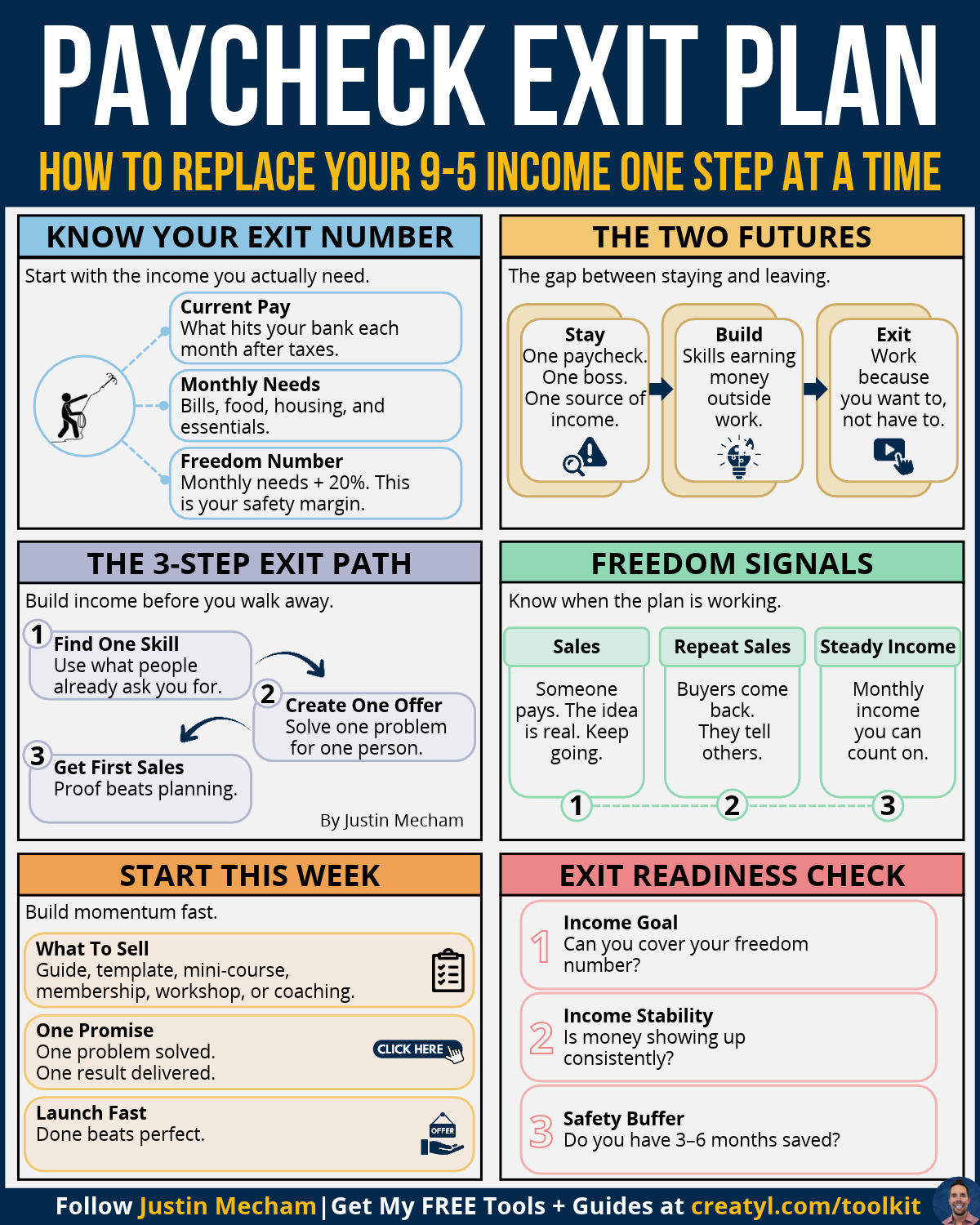
In my infographic, I use a simple 20% margin as a starting point.
Using the example above:
Monthly needs: $3,500.
20% planning margin: $700.
Freedom number: $4,200 per month.
That gives you a target based on your circumstances.
But here's an important detail.
A 20% margin is a planning shortcut, not a guarantee of financial safety.
If you're self-employed, you may need to account separately for income taxes, health coverage, retirement savings, business expenses, unpaid time off, and irregular income.
Those costs can make the actual revenue required considerably higher.
So I'd use the $4,200 as a starting personal income target, then work backward to calculate what the business needs to earn.
Why this exercise matters
Before I knew my number, leaving felt like an enormous unknown.
Afterward, I could ask a much more useful question.
"What would I need to build to reliably support this amount?"
That's something I could plan around.
Something I could measure.
Something I could work toward.
A clear number doesn't remove every risk. But it gives uncertainty a shape you can actually work with.
3. The Two Futures: Staying Dependent or Building Options
There's a section in my infographic called The Two Futures.
I included it because I believe this is one of the most important distinctions in the entire process.
Most people imagine only two possibilities.
Stay in the job.
Or quit the job.
But there's a third option that often gets overlooked.
Stay employed while building something that makes you less dependent on employment.
That's where I'd focus.
Future 1: One paycheck, one source of income
When all your income comes from one employer, your financial stability depends heavily on that relationship.
You may love your job.
You may have an excellent manager.
You may work for a wonderful company.
But you still have one primary income source.
If that income disappears, the consequences can be immediate.
That doesn't make employment bad.
It simply means concentration creates risk.
Future 2: Build income outside your job
Now imagine you keep your job while developing another source of income.
At first, it might generate almost nothing.
Then you make your first sale.
Then another.
Eventually, perhaps you have a small but meaningful amount arriving each month.
You still have your paycheck.
But you also have evidence that your skills can create value independently.
That gives you something you didn't have before.
Options.
Future 3: Work because you choose to
This is the future I find most interesting.
Not necessarily a future where everyone quits their job.
A future where your financial life gives you more freedom to decide.
Maybe you leave.
Maybe you negotiate better working conditions.
Maybe you reduce your hours.
Maybe you move into a role you enjoy more.
Maybe you continue working because you genuinely want to.
The point isn't that employment is the enemy.
The point is that having more than one option changes the way you experience work.
I don't want people building businesses simply because they hate their jobs.
I want them building skills, assets, and income streams that give them more control over their lives.
4. I Would Start With One Skill, Not Ten Business Ideas
Once I had my financial target, I needed a practical way to move toward it.
And this is where people often make the process unnecessarily complicated.
They begin searching for the perfect business.
They research e-commerce.
They explore affiliate marketing.
They look into coaching.
They investigate courses.
They consider consulting.
They watch videos about passive income.
And suddenly they're spending every evening researching opportunities without testing a single one.
I've been there.
What helped me was simplifying the question.
Instead of asking:
"What business should I start?"
I began asking:
"What do people already come to me for help with?"
That question can reveal opportunities hiding inside your existing experience.
The skill inventory I'd recommend
Write down five things.
1. Problems you've solved at work.
Maybe you've created systems, improved processes, managed projects, or helped teams communicate more effectively.
2. Questions people repeatedly ask you.
Maybe you're the person friends ask about resumes, design, finances, presentations, or technology.
3. Skills you've developed through experience.
Think about what you can do now that would have seemed difficult five years ago.
4. Tools or resources you've already created.
Spreadsheets, templates, checklists, workflows, guides, and presentations can all be starting points.
5. Results you've helped other people achieve.
What has improved because of something you taught, built, or explained?
Then I'd look for overlap.
Where does your experience meet a problem other people are actively trying to solve?
That's where I'd begin testing.
An example
Imagine you've spent years helping colleagues organize complicated projects.
You might be able to create a simple project management template for freelancers.
Or offer a short workshop for new managers.
Or provide a service that helps small teams organize their workflows.
You don't need to build all three.
I'd choose one.
The simplest offer I could explain, test, and deliver.
Because the goal at this stage isn't to build an entire company.
It's to find out whether someone will pay for a result I know how to provide.
5. My Three-Step Exit Path: Skill, Offer, First Sale
This is the heart of the framework.
I deliberately kept it simple in the infographic.
Find one skill.
Create one offer.
Get your first sales.
That's it.
Of course, building a sustainable business involves more work.
But these three steps are where the process becomes real.
Step 1: Find one skill
I'd choose something I already understand well enough to help another person.
Not something I need to spend a year learning before I can begin.
For example:
Writing better professional emails.
Creating useful spreadsheets.
Preparing for interviews.
Organizing social media content.
Building simple websites.
Teaching a language.
Creating presentations.
Helping businesses document processes.
The skill doesn't need to sound extraordinary.
It needs to be useful.
Step 2: Create one offer
A skill isn't automatically an offer.
"I know Excel" doesn't tell a potential customer what they're buying.
But this does:
"I created a ready-to-use spreadsheet that helps freelancers track invoices, expenses, and unpaid balances."
Now the result is clear.
Here's the framework I'd use:
I help [specific person] solve [specific problem] with [specific solution].
For example:
"I help first-time managers run more effective one-on-one meetings with a simple conversation toolkit."
Or:
"I help freelancers prepare professional client proposals using customizable templates."
Or:
"I help job seekers prepare stronger interview answers with a guided workbook."
I want someone to understand the offer immediately.
If they need a five-minute explanation just to understand what I'm selling, I'd simplify it.
Step 3: Get the first sale
This is where the entire process changes.
Before someone pays, you have a hypothesis.
After someone pays, you have evidence that at least one buyer values your offer.
That doesn't prove you've built a sustainable business.
But it's meaningful.
You've moved beyond your own assumptions.
Someone else has decided that what you created is worth paying for.
And that creates a new question.
Not "Could anyone ever buy this?"
But:
"How do I find another person with the same problem?"
That's a much more productive place to be.
6. The First Sale Matters More Than Most People Realize
I remember how important those early sales felt.
Not because the amounts were enormous.
They weren't.
But because they answered a question I'd been carrying for a long time.
Would someone actually pay me for something I created?
When the answer became yes, I had something more useful than encouragement.
I had proof.
And I've learned that proof is one of the most powerful things you can build.
Motivation is unpredictable.
Some mornings you feel unstoppable.
Other mornings you barely want to open your laptop.
But evidence doesn't disappear just because you're having a difficult day.
You can look back and see:
Someone bought the product.
Someone used the template.
Someone paid for the workshop.
Someone recommended your work.
Someone came back for another purchase.
Those are real events.
The proof ladder I use
I like to think about business progress in stages.
Stage 1: Interest.
Someone likes the idea.
Useful, but not enough to establish demand.
Stage 2: Engagement.
Someone asks questions or wants to know more.
A stronger signal.
Stage 3: Purchase.
Someone pays.
Now you have evidence of willingness to buy.
Stage 4: Successful delivery.
The customer gets the result you promised.
Now you know you can create value.
Stage 5: Repeat sales.
Additional customers purchase the same offer.
Now you're beginning to test whether demand is repeatable.
Stage 6: Consistent income.
Sales continue across multiple periods, and you understand the costs involved.
Now you can begin evaluating the business as a meaningful income source.
Each stage answers a different question.
And I'd be careful not to skip ahead.
One sale is worth celebrating.
But one sale isn't a financial exit plan.
Proof becomes more useful when it repeats.
7. I Would Build My First Offer Before Spending Money on a Complicated Business
I see people spend months preparing to launch something.
They choose a business name.
They buy a domain.
They design a logo.
They build a website.
They subscribe to software.
They create dozens of social media graphics.
And after all that work, they still haven't asked anyone to buy anything.
I understand the temptation.
Preparation feels productive.
And it can be much more comfortable than putting an offer in front of a real person.
But I've learned to be careful about confusing preparation with progress.
If I were starting from scratch today, I'd focus on three things.
What am I selling?
I'd create one simple product or service.
Maybe a guide.
A template.
A workshop.
A mini-course.
A coaching session.
Or a service package.
Who am I selling it to?
I'd identify a specific group of people experiencing a problem I understand.
Not everyone.
A clearly defined audience.
How can they buy it?
I'd create a simple way for interested customers to understand the offer, pay, and receive what they purchased.
That's one of the reasons I eventually built creatyl.
I wanted people who had something useful to share to have a straightforward place to turn their knowledge into a product and make it available for purchase.
You shouldn't need to become a website developer before you can test whether someone wants your guide or template.
The important part is the value you're creating.
The technology should make it easier to deliver that value.
8. The Three Freedom Signals I'd Look for Before Leaving
In my infographic, I included three signals that help show whether the plan is working.
Sales.
Repeat sales.
Steady income.
I chose these because each one represents a different level of evidence.
And I've learned not to treat them as interchangeable.
Freedom Signal 1: Sales
Someone pays you.
This confirms that your offer has at least some market value.
But I'd still have questions.
Why did they buy?
What problem were they trying to solve?
Where did they find the offer?
Did they receive the result they expected?
What would make them recommend it?
I'd use that first sale to learn as much as possible.
Freedom Signal 2: Repeat Sales
More customers purchase.
Or existing customers return for additional products or services.
This tells me something important.
The first purchase may not have been an isolated event.
But I'd still want to understand how those sales happened.
Did they come from one viral post?
A personal recommendation?
A paid advertisement?
A professional community?
A repeatable marketing process?
I don't just want to know that people bought.
I want to understand why they bought and whether I can reach similar customers again.
Freedom Signal 3: Steady Income
This is where the exit plan becomes more serious.
I'm not talking about one unusually successful month.
I'm talking about income that shows up consistently enough to support reasonable planning.
I'd review several months of results.
I'd look at profit, not just revenue.
I'd examine customer demand, costs, and how much work is required to maintain the business.
I'd also ask what happens if sales slow down.
Because a business that earns $5,000 one month and nothing the next is very different from one that produces a more predictable income pattern.
Both might be valuable.
But they carry different levels of financial risk.
I wouldn't make a major career decision based only on my best month. I'd want to understand my ordinary months too.
9. The Difference Between Revenue and Money You Can Actually Live On
This is something I would never skip when building an exit plan.
Let's say your side business generates $5,000 in a month.
That's exciting.
But it doesn't necessarily mean you have $5,000 available to pay your personal expenses.
You might have:
- Payment processing fees.
- Software subscriptions.
- Marketing expenses.
- Contractors.
- Refunds.
- Equipment costs.
- Business taxes.
- Other operating expenses.
And if you're leaving employment, you may also need to replace benefits that were previously covered by your employer.
Let's use a simple example.
Suppose your business generates $5,000 in monthly revenue.
Operating expenses total $1,000.
That leaves $4,000 before personal income taxes and any other applicable obligations.
If your freedom number is $4,200 in usable personal income, you haven't necessarily reached it yet.
Even though your business revenue is higher.
That's why I would track three separate numbers.
Revenue: How much the business brings in.
Business profit: What remains after business expenses.
Personal take-home income: What is available for your living expenses after relevant taxes and obligations.
Those numbers serve different purposes.
And confusing them can lead to expensive decisions.
The calculation I'd use
I'd begin with my required personal take-home income.
Then I'd estimate the taxes, business costs, and benefits I'd need to cover.
From there, I'd calculate the revenue the business would need to generate.
For anything involving a major employment decision, I'd consider reviewing the numbers with a qualified financial or tax professional.
Because the goal isn't to create a spreadsheet that makes leaving look possible.
The goal is to understand what leaving would actually require.
10. I'd Build a Safety Buffer Before Making the Leap
The infographic includes a simple exit readiness question:
Do you have three to six months saved?
I included that because I believe a financial buffer can make an enormous difference when income becomes less predictable.
But I also want to be clear.
Three to six months is a common starting guideline, not a universal rule.
Some people may need more.
Especially if they have dependents, significant debt, irregular business income, expensive healthcare needs, or limited ability to return to employment quickly.
How I'd calculate a buffer
Let's say my essential monthly expenses are $3,500.
Three months of expenses would be $10,500.
Six months would be $21,000.
That money would be separate from funds needed to operate the business or pay expected taxes.
I'd also think about the time it might take to find another job if the business didn't work out.
And I'd consider how much my household depends on my income.
The purpose of the buffer isn't to eliminate every possible risk.
That's impossible.
The purpose is to give yourself time to respond when things don't go according to plan.
Why a buffer matters psychologically
When you have no financial margin, every business problem becomes urgent.
A slow sales week feels catastrophic.
A delayed payment becomes a crisis.
A customer refund creates panic.
And that pressure can lead to poor decisions.
You might accept clients who aren't a good fit.
Lower your prices unnecessarily.
Spend money chasing quick results.
Or abandon a promising business because you can't afford to give it time.
A buffer doesn't guarantee success.
But it can give you room to make more thoughtful decisions.
I don't want my business to become another source of constant financial fear. I want it to create more control over my life.
11. My Exit Readiness Checklist
Before making a major decision, I'd want to answer three questions from the infographic.
Question 1: Can my independent income cover my freedom number?
Not my dream income.
Not my gross salary.
The amount I realistically need after accounting for expenses, taxes, and the costs of working independently.
If the answer is no, I'd keep building or consider other transition options.
Question 2: Is the income showing up consistently?
I'd look at several months of results.
I'd want to understand whether sales come from repeatable activities or unpredictable spikes.
I'd also examine how much time and money it takes to produce that income.
Question 3: Do I have an appropriate financial buffer?
I'd calculate my essential expenses and determine how much runway makes sense for my circumstances.
Then I'd consider what happens if revenue falls significantly.
But I wouldn't stop at those three questions.
I'd also ask:
- Do I understand where my customers come from?
- Can I continue delivering the product or service without exhausting myself?
- What happens if my largest customer disappears?
- Are there legal, contractual, insurance, or tax issues I need to address?
- Have I tested what happens during a slow month?
- Would leaving my job genuinely create enough additional capacity to improve the business?
- Am I making this decision because the evidence supports it, or because I had a terrible week?
That final question is particularly important.
I want the decision to make sense on a calm Tuesday.
Not only after a miserable Friday.
12. Here's How I'd Start Building My Exit This Week
I don't believe you need to spend six months planning before you can take your first step.
You can begin much smaller.
If I were working full-time and starting from zero, here's what I'd do over the next seven days.
Monday: Calculate the number
I'd write down my take-home pay, essential expenses, irregular costs, and an appropriate planning margin.
I'd create a realistic freedom number.
Tuesday: List my existing skills
I'd identify ten things I know how to do.
Then I'd circle the three that solve problems other people regularly experience.
Wednesday: Choose one problem
I'd identify a specific audience.
I'd choose one frustrating problem I could help them solve.
I'd write a simple product promise.
Thursday: Talk to potential customers
I'd reach out to people who experience the problem.
I'd ask what they've tried and what they find difficult.
I'd listen before building.
Friday: Create a small offer
I'd choose a format.
A guide.
A template.
A workshop.
A mini-course.
A service.
I'd define what the customer receives and the result I'm trying to help them achieve.
Saturday: Build or test the first version
Depending on what I'd learned, I'd create a small working version or test a clearly described early offer.
I'd avoid adding unnecessary features.
Sunday: Review the evidence
I'd ask:
What did I learn?
Did anyone recognize the problem?
Did anyone express meaningful buying intent?
Did I make an offer?
What should I improve?
What's the next action?
Then I'd schedule time for the following week.
Not an impossible schedule.
Something I could realistically repeat.
Maybe two evenings and one weekend block.
Because I don't believe the best exit plan is the one that demands the most hours.
It's the one you can keep following long enough to create meaningful results.
13. A Practical Example: Building Toward a $4,200 Freedom Number
Let's put the pieces together.
Imagine someone named Daniel.
Daniel works full-time in project management.
His take-home pay is $4,500 per month.
His essential monthly expenses are $3,500.
Using the 20% planning margin, his initial freedom number is $4,200.
He wants more independence, but he doesn't want to resign without another income source.
Daniel notices that small business owners regularly struggle with organizing projects and keeping clients updated.
He decides to test a simple service.
He helps small agencies set up project tracking systems.
His first customer pays $300.
That doesn't replace his paycheck.
But it proves someone is willing to pay for his expertise.
He improves the service.
His next customers pay $500.
After working with several clients, he creates reusable templates and a more structured delivery process.
Eventually, he begins selling a digital project management toolkit alongside his service.
Now he has two related offers.
One provides personalized implementation.
The other provides a lower-cost resource customers can use themselves.
Over time, Daniel tracks his revenue, expenses, customer acquisition, and delivery hours.
He also builds savings.
After several months, he can see whether the business is becoming more predictable.
Maybe he discovers that his profit is still far below the income he needs.
That's useful information.
He keeps his job and continues improving the business.
Or maybe he eventually reaches a level where his income, savings, and customer demand make a transition financially reasonable.
The important part isn't the exact timeline.
It's the process.
Daniel isn't making the decision based on frustration alone.
He's using evidence.
What this example teaches
You don't need to replace your salary in your first month.
You need to establish that someone values what you're offering.
Then learn how to make the process repeatable.
Then determine whether the economics work.
Then evaluate whether leaving makes sense.
Each stage gives you information you didn't have before.
And that's how uncertainty gradually becomes something you can manage.
14. The Real Goal Isn't to Quit. It's to Have Choices.
This is the part I care about most.
I don't believe everyone needs to become an entrepreneur.
I don't believe having a boss automatically means you lack freedom.
And I don't believe quitting a job is always the right decision.
Some people love their work.
Some people enjoy the structure of employment.
Some people have careers they find deeply meaningful.
That's wonderful.
But I do believe having more financial options can change the way you experience your career.
Imagine being able to say no to a role that doesn't fit your values.
Imagine being able to take time to find a better opportunity.
Imagine choosing to work fewer hours because your financial life allows it.
Imagine knowing that your entire income doesn't depend on one organization.
Those are meaningful possibilities.
And you don't necessarily need to quit to benefit from them.
Sometimes building outside income gives you the confidence to negotiate.
Sometimes it gives you the freedom to change careers.
Sometimes it gives you the option to leave.
And sometimes it simply makes your current job feel less like something you can't afford to lose.
For me, the goal has never been to make everyone quit their jobs. It's to help people create more control over their time, income, and decisions.
15. Recommended Books and Resources
If you're working toward greater financial independence, these are a few resources I'd recommend exploring.
The Psychology of Money by Morgan Housel
I like the way this book explores the relationship between money, behavior, risk, and personal decisions.
It's a useful reminder that financial success isn't simply about earning more.
It's also about understanding how you make decisions and what enough looks like for your life.
Company of One by Paul Jarvis
This is a useful read if you're interested in building a business without automatically assuming it needs to become large and complicated.
I believe a small, profitable business that supports the life you want can be more valuable than a larger business that consumes all your time.
The Mom Test by Rob Fitzpatrick
If you're developing your first offer, I'd recommend learning how to have better customer conversations.
This book helps explain why compliments and encouragement aren't the same as evidence that people will buy.
Profit First by Mike Michalowicz
Useful for thinking about business cash flow, expenses, and the importance of separating revenue from money you can actually keep.
I'd treat it as a framework to evaluate alongside professional financial advice rather than a substitute for it.
My Free Digital Product Toolkit
If you're still at the stage of choosing an idea, validating demand, or creating your first product, I've put together a free toolkit to help you get started.
It walks through practical steps for turning knowledge into something people can buy.
Frequently Asked Questions
How much money should I make before quitting my job?
I wouldn't use a universal number.
I'd calculate my actual monthly needs, business expenses, taxes, benefits, and an appropriate financial margin.
Then I'd look at whether independent income is reliable enough to support those needs.
The right target depends on your circumstances.
Is three to six months of savings enough?
It may be a useful starting point, but it isn't enough for everyone.
I'd consider household responsibilities, debt, health expenses, income volatility, and how long it might take to replace lost income.
Some people may need a significantly larger buffer.
Can I start building a business while working full-time?
Yes, depending on your circumstances and obligations.
That's often how I'd prefer to test an idea.
I'd use my own time and resources, respect my employer's policies and intellectual property, and begin with a manageable schedule.
What if I don't have a skill worth selling?
I'd start by questioning that assumption.
I'd look at what people ask me for help with, what problems I've solved, and what processes I've learned through experience.
Then I'd investigate whether those skills solve problems people care enough about to pay for.
Not every skill will become a profitable business, but many deserve a closer look.
Should I start with a service or a digital product?
I'd choose based on the problem and how I can deliver the result.
A service can help me learn directly from customers and potentially earn money sooner.
A digital product can make sense when the same solution can be packaged and delivered repeatedly.
Some businesses begin with services and later turn recurring work into products.
How long does it take to replace a paycheck?
There's no reliable universal timeline.
It depends on the offer, demand, customer acquisition, expenses, time available, and many other factors.
I'd focus on building and measuring repeatable results rather than promising myself a specific income by an arbitrary date.
What if my side income is inconsistent?
I'd be cautious about treating it as a dependable replacement for employment income.
I'd investigate why sales fluctuate, whether I can improve customer acquisition, and how much financial runway I need.
Consistency matters because personal expenses don't stop during slow business months.
Do I need a big social media following?
No.
I'd begin by identifying where potential customers already spend time and how I can reach them.
A relevant audience and a clear offer can matter more than a large follower count.
What is the first thing I should do if I want to leave my job?
I'd calculate my real financial needs.
Then I'd identify one skill I could use to solve a problem for someone else.
That gives me both a financial target and a practical starting point.
I Didn't Need to Hate My Job More. I Needed to Depend on It Less.
I still remember those Sunday nights.
The uncertainty.
The numbers running through my head.
The fear of leaving too early.
The frustration of wanting something different but not knowing whether I could afford it.
At the time, I believed the decision would eventually come down to courage.
That one day I'd wake up, feel brave enough, and finally walk away.
But that wasn't what made the difference.
What made the difference was getting specific.
I calculated what I needed.
I identified what I could offer.
I started building outside my job.
I made a sale.
Then I worked on making another.
I learned what customers wanted.
I improved what I created.
I paid attention to the numbers.
And gradually, the decision became less about how frustrated I felt and more about what I had actually built.
That's the lesson I want to share.
You don't need to wait until you're miserable enough to leave. You can begin creating options long before you need them.
You can start while you're still employed.
You can start with one skill.
One offer.
One customer.
One small block of time each week.
You don't need a perfect business plan.
You don't need to know exactly where the next five years will take you.
You need to understand your financial reality and begin testing whether you can create value independently.
Then you keep learning.
Keep improving.
Keep measuring.
Until you have enough evidence to make the next decision responsibly.
Maybe that decision is leaving.
Maybe it's changing jobs.
Maybe it's reducing your hours.
Maybe it's staying exactly where you are because you genuinely want to.
What matters is that you're making the decision from a position of greater choice.
And that's the kind of freedom I've always cared about.
I didn't leave when I hated my job the most. I left when I no longer needed it.
That's a very different kind of exit.
And it's one worth building toward.
Download My Free Paycheck Exit Plan Infographic and Digital Product Toolkit
If you've been wanting to build something outside your job but aren't sure where to begin, I created resources to help you take the first steps.
Get the Paycheck Exit Plan Infographic
My infographic breaks down the framework into six practical sections:
- Know Your Exit Number: Calculate your real income needs and a planning margin.
- The Two Futures: Understand the difference between relying on one paycheck and building independent income.
- The 3-Step Exit Path: Find one skill, create one offer, and get your first sales.
- Freedom Signals: Track sales, repeat sales, and income consistency.
- Start This Week: Choose what to sell, make one clear promise, and launch a small first version.
- Exit Readiness Check: Evaluate your income goal, stability, and financial buffer.
You can get free PDFs of my infographics here:
Get My Free Digital Product Toolkit
If you want help turning what you already know into a product or service people can buy, I also created a free toolkit.
It includes practical guidance for choosing an idea, validating demand, creating a digital product, pricing it, and preparing it for launch.
Download it here:
I hope these resources help you take the first step toward building more options for yourself.
Because the best time to start creating financial independence isn't necessarily the day you're ready to resign.
It's while you still have the stability to build it carefully.