

Click Here to Download the PDF
Let’s be honest: most people hate selling.
Not because they don’t believe in what they offer — but because selling feels forced.
They picture scripts, pressure, and that awful moment when the room goes quiet after a price drop.
It’s not that they don’t want to close deals; they just don’t want to sound like everyone else who’s trying too hard.
But here’s the truth: you don’t need a script.
You don’t need manipulation or clever tricks.
You need one clear win — the one result your buyer actually wants — and the courage to simplify everything else around it.
That’s what the No-Pitch Method is built on.
It’s a way to sell without pushing, lead without lecturing, and get yeses without pressure.
It’s what happens when you make your process clear, safe, and easy — and when you focus less on talking and more on understanding what people actually need.
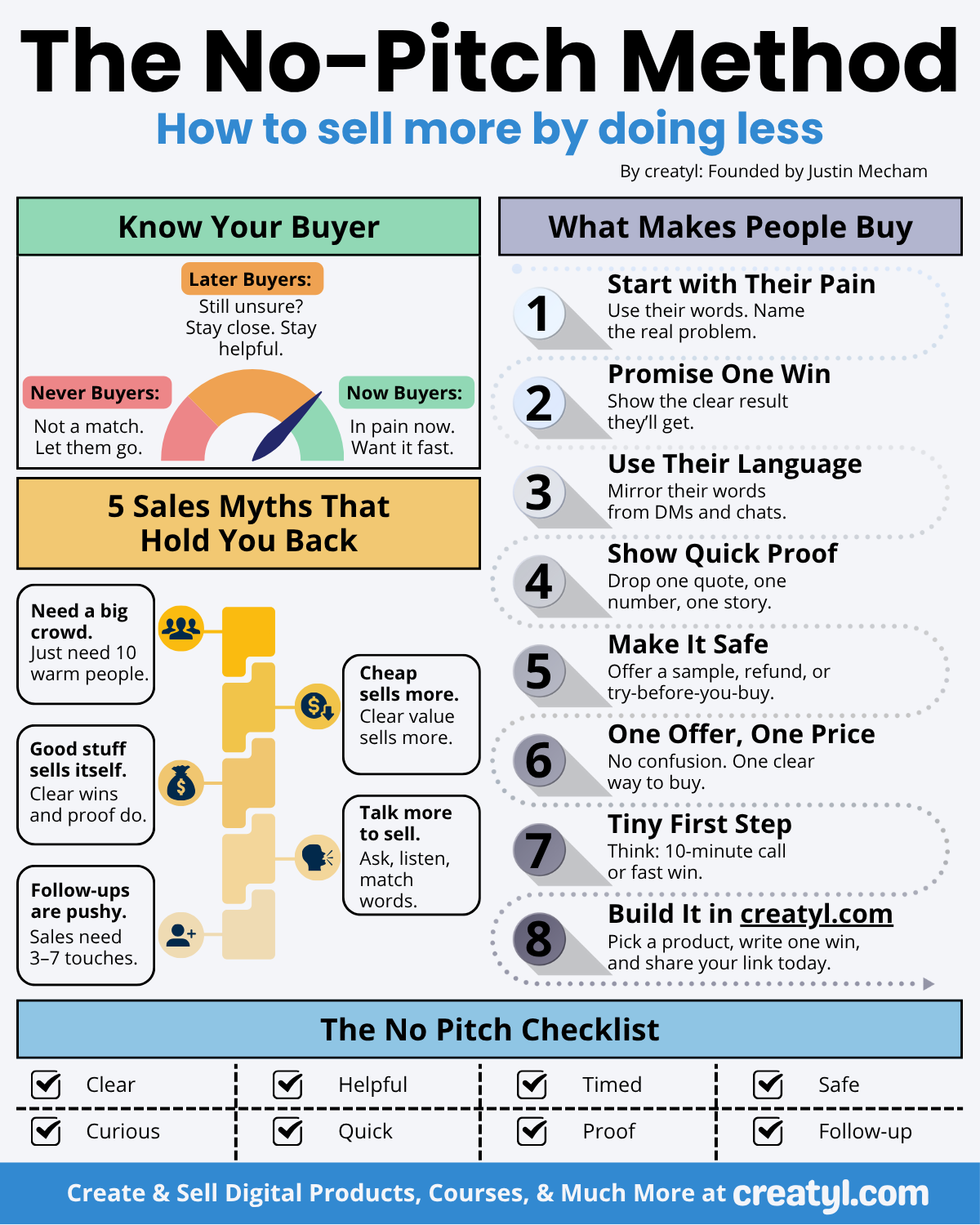
Know Your Buyer
Before you sell anything, you need to know who’s really listening.
Every audience breaks down into three groups:
- Later Buyers — They’re still unsure. They want to trust you, but they’re not there yet. Stay close. Stay helpful. Keep showing up with small, consistent value.
- Never Buyers — They’re not your people, and that’s okay. They don’t want what you offer or don’t see themselves in it. Let them go. Your energy is worth more than a forced yes.
- Now Buyers — They’re in pain right now. They know their problem and are ready for a solution. For them, clarity matters more than persuasion. They want it simple, safe, and fast.
When you start seeing buyers through this lens, selling becomes less about chasing and more about timing.
You stop trying to convert everyone and start investing in the people who actually want help now.
5 Sales Myths That Hold You Back
Most people don’t fail at selling because their product is bad.
They fail because they’re following outdated rules that sound smart but don’t match how people actually buy today.
1. “You need a big audience.”
You don’t. You just need the right ten people.
A small, warm audience who already trusts you will outperform a large, passive one every single time.
Trust scales faster than numbers.
2. “Cheap sells more.”
It doesn’t. People don’t buy because something’s cheap.
They buy because they clearly see what they’ll get.
Cheap signals uncertainty; clarity signals value.
3. “Good stuff sells itself.”
If that were true, the best creators would never need marketing.
Proof sells.
A single real-world example, a quote, or a stat builds far more confidence than your own claims ever will.
4. “Follow-ups are pushy.”
They’re not. They’re necessary.
People need 3–7 touches before making a decision.
Follow-ups are reminders of value, not pressure.
When done right, they help people feel seen — not chased.
5. “Talking less closes more.”
Listening closes more.
The best salespeople aren’t the best talkers; they’re the best listeners.
They ask smart questions, repeat key phrases back, and make people feel understood.
Each of these myths holds good people back from doing meaningful work.
The No-Pitch Method breaks them by replacing pressure with clarity, and assumption with understanding.
What Actually Makes People Buy
When you strip away the tactics and scripts, one truth remains: people buy when they feel understood and safe.
Not dazzled. Not cornered. Safe.
They buy when they recognize their own words in your message.
When they see one result that solves a real problem. When they know they won’t be trapped or tricked.
That’s why the most successful sellers today focus on:
- Starting with real pain, in the buyer’s words.
- Promising one win they can clearly picture.
- Using the language their audience already uses.
- Showing quick, simple proof that the product works.
- Making it feel safe to say yes — through refunds, samples, or trials.
- Offering one clear path with one price.
- Giving people an easy first step to build confidence.
- Following up with value, not pressure.
This isn’t psychology theory — it’s how humans work.
When something feels clear, safe, and real, people say yes faster and with less hesitation.
The 7 Tiny Moves That Transform How You Sell
Each of these moves may seem small, but together, they form the backbone of modern selling — no scripts, no pressure, just trust built step by step.
1. Write A “Pain → One Win” Line In Their Words
The fastest way to connect is to use their words, not yours.
Spend time reviewing DMs, emails, or comment threads from your buyers.
Look for the words they use to describe what’s bothering them — not how you’d describe it, but how they do.
Then, use this line:
“When you [describe their pain], you’ll get [describe their one win].”
Example:
“When your team spends half the week updating spreadsheets, you’ll get dashboards that load in 10 minutes — automatically.”
This single sentence can replace an entire sales page. It meets people where they are, shows you’ve been listening, and makes the win feel immediate.
2. Offer One Option, One Price
Nothing kills action faster than confusion.
If you give buyers three choices, they’ll pause to compare. If you give them one, they’ll act.
Strip away the tiers, bundles, and upgrades. One product. One price. One promise.
Show the contrast between “before” and “after,” not “good” and “better.”
Clarity wins because it gives people permission to move forward without overthinking.
Choice overload isn’t a theory; it’s a proven psychological barrier. The simpler your offer, the faster they buy.
3. Add A “Safety Stack”
The number-one reason people hesitate? Fear of regret.
They’re not afraid of you — they’re afraid of making the wrong decision.
Remove that fear.
Offer a refund, a sample, or a short trial.
Put it right above your button, not buried in fine print.
Example: “Try it for 14 days. If it’s not what you expected, get a full refund — no forms, no hassle.”
A safety stack isn’t generosity — it’s strategy.
It tells buyers: “You’re safe here.” That’s what gives them permission to act.
4. Ask For A Tiny First Step
Every big yes starts with a small one.
Instead of asking for a 60-minute meeting or a full commitment, give people a small, easy, two-minute step they can take right now.
Example:
“Send me one sentence about your biggest problem — I’ll reply with one fix you can use today.”
This does two things: it builds momentum, and it builds trust.
You’re showing that you can deliver value before they pay.
That’s a huge credibility builder — and it makes the eventual “yes” almost automatic.
5. Show One Proof Near The Ask
You don’t need fifty testimonials or long case studies.
One simple, believable proof point will do more than a wall of praise.
Place one proof next to your call-to-action. Example:
“Cut weekly reports from 3 hours to 15 minutes — Operations Lead, Toronto.”
That’s it. Short, specific, and real.
When people see someone like them get the result they want, the decision becomes easy.
6. Use Follow-Ups That Add Value
The idea that follow-ups are annoying is outdated.
The real problem isn’t that you follow up — it’s how you follow up.
Don’t send “just checking in” messages. Send useful, specific insights. Example:
- “Here’s a quick checklist to help you set this up.”
- “Here’s a 2-minute fix you can try today.”
- “Here’s one example of how others solved this exact problem.”
Good follow-ups teach. They don’t chase.
You’ll stop feeling like a salesperson and start feeling like a partner — and your buyers will feel it too.
7. Frame The Ask With A Quiet Loss Line
Sometimes, people need to see what waiting costs them.
Add a calm, honest line under your CTA:
“Every week you delay this change, you lose roughly 3 hours to manual work.”
No pressure. No urgency gimmicks. Just truth.
People naturally act faster when they understand what delay really costs them — in time, energy, or missed opportunity.
Real-Life Workplace Examples
These are real scenarios where the No-Pitch Method turned stuck moments into sales — without a single hard push.
The Analytics Team That Simplified Everything
A small business spent every Friday compiling data manually.
Two employees. Four hours each. Every week.
Reports were inconsistent, errors common, and morale low.
They knew automation would help but couldn’t justify the investment.
Each week felt like déjà vu. Deadlines missed. Clients waiting.
The team felt frustrated and unproductive — like they were working harder but achieving less.
They tried the No-Pitch Method:
- Message: “When your team spends 4 hours on reports, you’ll get dashboards that load in 10 minutes.”
- Offer: One product, one price — $1,499 for a full dashboard package.
- Safety Stack: “Try it for 14 days. If dashboards take longer than 10 minutes to load, get a full refund.”
- Tiny Step: “Send your top 3 data pain points — we’ll fix one for free in 24 hours.”
- Proof: “Cut report time by 75% — Senior Analyst, NYC.”
- Follow-ups: “3 formulas that fix broken sheets” and “How to schedule auto-refresh in one click.”
- Loss Line: “Every week you stay manual, you lose at least 3 hours to copy-paste.”
The first client said yes within 10 days.
The pitch didn’t feel like selling — it felt like solving.
The process was simple, fast, and real.
The Consultant Who Stopped Pitching
A consultant offered marketing strategy packages but struggled to close clients.
The pitch sounded good, but prospects couldn’t picture results.
Every call felt heavy. Too much talk, not enough clarity.
The consultant was tired of “I’ll think about it” responses.
They applied the No-Pitch Method:
- Headline: “Can’t get leads? Get a 10-day funnel you can launch this month.”
- One offer, one price: $4,999 flat.
- Safety: “If you don’t get your first lead in 30 days, we’ll work free until you do.”
- Tiny Step: “Send your offer and target audience — we’ll build a free 1-page funnel preview.”
- Proof: “Generated 125 leads for a solo business in 14 days — Consultant, London.”
- Follow-ups: Each message offered something practical — funnel templates, content tips, checklists.
- Loss Line: “Every week your funnel sits unfinished, new leads go somewhere else.”
Calls shortened by half.
Prospects felt seen and supported, not sold to.
The consultant stopped trying to convince and started converting.
Why The No-Pitch Method Works
Behind every step of this method is psychology, not luck.
- Choice Overload — Too many options paralyze buyers. One clear offer removes friction.
- Risk Reduction — Refunds and trials make action feel safe.
- Language Mirroring — Speaking your buyer’s language builds trust faster than features.
- Social Proof — People believe peers more than experts.
- Small Wins — Early micro-steps create momentum and buy-in.
- Loss Aversion — People act faster to avoid losing time or money than to gain it.
It’s not just “sales technique.”
It’s behavioral design.
You’re creating the path of least resistance between your buyer’s problem and their win — and removing everything that doesn’t belong.
Selling Without A Script Is About Trust, Not Technique
Selling without a script doesn’t mean selling without intention.
It means trading manipulation for mastery — understanding the psychology behind why people say yes, and building your process around care instead of control.
When you speak in someone’s language, you do more than sell — you connect.
When you make it safe to buy, you remove fear from the equation.
When you ask for one small step instead of a leap, you make momentum possible.
This isn’t about charm. It’s about clarity.
The best sales conversations don’t feel like sales at all — they feel like two people trying to solve the same problem from different sides.
The No-Pitch Method is how you turn that into a repeatable process: honest, simple, effective.
No tricks. No pressure. Just proof, empathy, and trust in motion.
People don’t buy because you convinced them.
They buy because you made it clear, easy, and safe to say yes.
That’s what real selling looks like — and it’s what leaves people better than you found them.
Download The Full Infographic
Want to see every step of the No-Pitch Method laid out visually?
You can download the full infographic as a high-quality, printable PDF — the same one used in this article.
It’s perfect for keeping on your desk or sharing with your team.
This one sheet captures the entire system — from knowing your buyer to building proof and safety into every offer. Keep it close. You’ll never sell the same way again.