
Click Here to Download the PDF
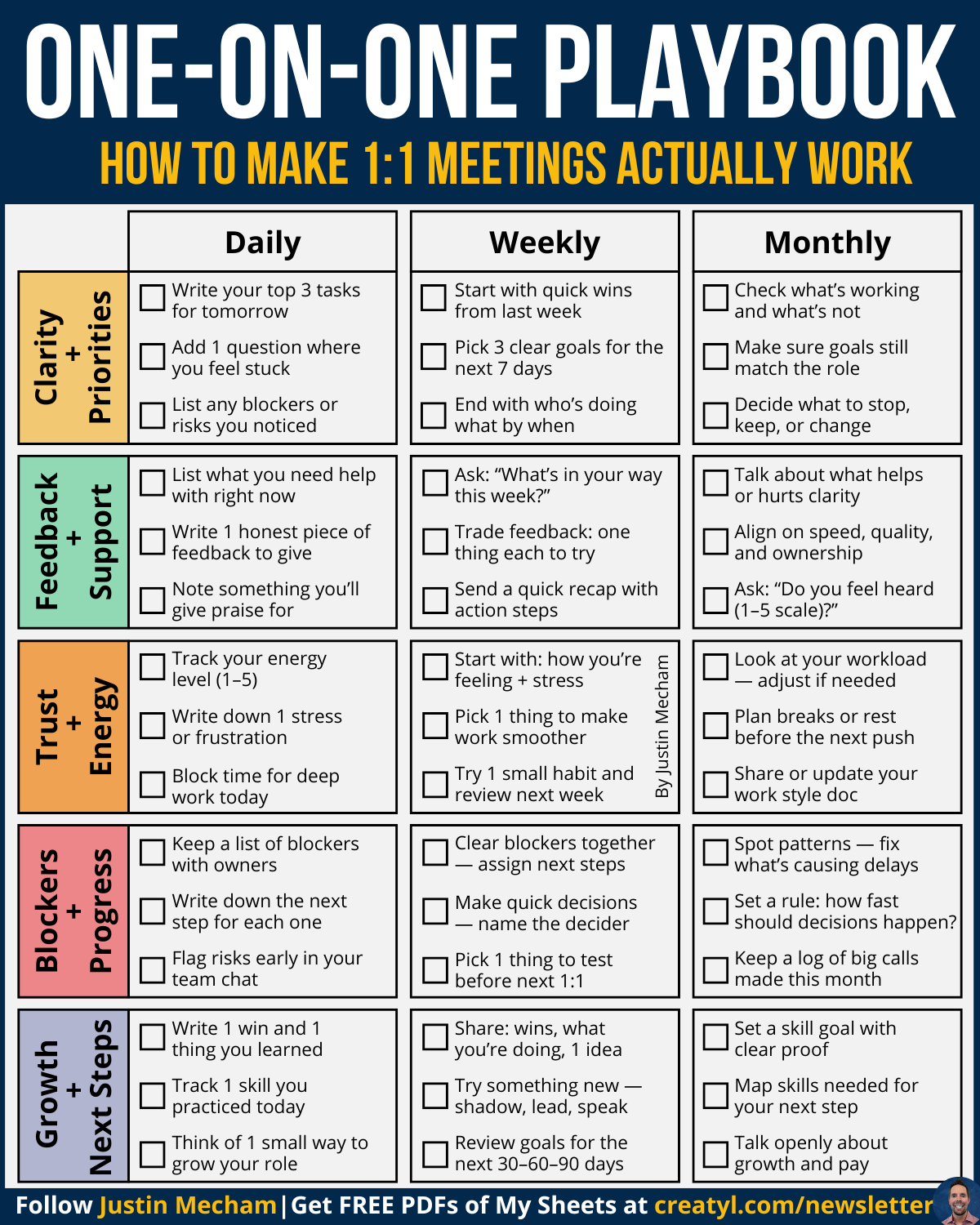
How To Make 1:1 Meetings Actually Work
Most workplaces treat 1:1s like random check-ins.
Two people meet once a week, talk through whatever comes to mind, close the call, and walk away unsure what actually changed.
No real clarity.
No real support.
No real improvement.
Then everyone wonders why the same blockers keep showing up.
Why the same frustrations repeat.
Why communication keeps slipping.
Why people feel unseen, unheard, or disconnected from their manager.
Great 1:1s are not “touchpoints.”
Great 1:1s are a system.
They build clarity.
They build trust.
They build forward movement.
Not with pressure, but with structure.
When you run 1:1s with intention, people stop guessing.
They stop bracing.
They stop hiding blockers until they become emergencies.
The work gets lighter, smoother, more predictable.
This article breaks down that system — not in theory, but in steps you can use today.
The 1:1 System That Actually Works
The right 1:1 rhythm doesn’t require more time — it requires clearer purpose.
This system is built on three layers:
Daily: Notes that keep you aligned and honest with yourself
Weekly: Fast feedback and problem-solving
Monthly: Real conversations about clarity, direction, and growth
Each layer plays a different role.
Together, they make your 1:1s one of the most useful parts of your work week.
Let’s go deeper into each one.
Daily: The Notes That Keep You Clear and Grounded
Daily prep is the quiet part of leadership that nobody sees.
But it’s where most clarity is built.
When you end each day with small reflections, your 1:1s become sharper, shorter, and smarter.
Every day, write:
Your top 3 tasks for tomorrow
This forces priority.
Not everything matters.
Not everything deserves tomorrow’s attention.
The three tasks keep you focused on what actually moves the work forward.
One blocker or question
This is how you avoid letting small issues snowball into big ones.
You capture the friction early, instead of waiting until it becomes a crisis.
Your energy level and one win
Energy tells you the story behind your performance.
Wins remind your brain that progress is happening even on messy days.
These notes don’t need to be polished.
They just need to be real.
When you show up to a 1:1 with this kind of awareness, you stop wasting time trying to remember what happened last week.
You start stepping into the meeting with clarity and direction.
Weekly: Feedback, Focus, and Fast Problem-Solving
Weekly 1:1s are where alignment happens.
They’re not therapy sessions and they’re not status meetings.
They’re the space where work becomes smoother because both people actually understand what's in the way.
Start with last week’s wins + 3 new goals
Wins build momentum.
Goals build direction.
When someone knows what they’re aiming for, their week becomes clearer.
Ask: “What’s in your way this week?”
This one question can save days of silent struggle.
People often hide blockers because they fear judgment.
But when the question is built into the system, it becomes safe to answer honestly.
Trade one piece of feedback
Just one. Not ten. Not a speech.
One specific piece of feedback each.
Giving and receiving feedback weekly prevents resentment, confusion, and misalignment.
Weekly 1:1s are the bridge between action and adjustment.
They keep the work moving without creating pressure.
Monthly: The Conversations That Build Real Growth
Monthly 1:1s are not about tasks — they’re about the human behind the work.
They’re the space where bigger patterns, deeper clarity, and long-term direction get attention.
Talk about clarity, growth, and energy
How clear does the person feel?
Where do they want to grow?
What is draining them?
What is fueling them?
People rarely say these things out loud unless someone creates space for it.
Set a small goal with a clear next step
Small goals work because they are doable.
Clear next steps work because they prevent drifting.
Review what’s working and what’s not
This is the reset button.
It keeps the team aligned.
It keeps priorities grounded in reality.
Monthly 1:1s shape the direction of the role, not the to-do list.
This is where long-term performance is built.
How This System Saved a Team
I worked with a tech team where 1:1s had become a formality.
They met every week, but nothing changed.
People brought the same problems repeatedly.
Blockers went unresolved for weeks.
Feedback piled up unspoken.
Both the manager and the team felt like they were running in place.
Morale was slipping.
Deadlines were slipping.
Trust was slipping.
Everyone felt busy, yet nothing meaningful was moving.
In private conversations, the team admitted they dreaded their 1:1s.
They never knew what the meeting was “supposed” to cover.
They were unsure what to bring, so they brought nothing.
They left the meeting with no next steps.
Everything felt vague.
They felt unseen.
They felt unsupported.
They felt unclear about expectations.
The manager felt just as frustrated — they wanted to help but didn’t know how to structure the time in a way that actually moved work forward.
I introduced this exact three-part rhythm:
Daily notes, weekly adjustments, monthly direction.
Daily:
Each person ended their day by writing their top 3 tasks, one blocker, and their energy.
This alone transformed their awareness of their own work.
Weekly:
Every 1:1 began with wins from last week and ended with three goals for the next seven days.
They traded one piece of feedback each — fast, honest, and simple.
And the manager asked, “What’s in your way this week?”
Blockers finally surfaced early.
Monthly:
Once a month, they stepped back from tasks and talked about clarity, growth, energy, and role alignment.
This uncovered deeper issues and created long-range stability.
Within six weeks, the shift was visible:
People spoke more openly.
Blockers were solved quickly instead of festering silently.
Trust increased.
Performance increased.
And the 1:1s went from dreaded interruptions to valuable strategy sessions.
The structure didn’t just make meetings better —
it made the team better.
A Top Resource To Go Deeper
Book Recommendation:
The Coaching Habit: Say Less, Ask More, and Change the Way You Lead Forever
Author: Michael Bungay Stanier
This is one of the most widely respected and highly rated books on modern leadership, coaching conversations, and effective 1:1 rhythms. It aligns directly with the approach in this article — simple questions, clear structure, and leadership built through steady habits rather than long speeches.
Clarity and Trust Are Not Accidents — They’re Built in Small Moments
Strong teams do not grow by accident.
They grow because leaders choose to create rhythms that make clarity normal, not rare.
They grow because people know where they stand, what matters, and where they’re going next.
They grow because conversations are intentional instead of rushed or reactive.
The truth is, most people don’t need more meetings.
They need better ones.
They need spaces where their work is seen, their blockers are understood, and their growth is taken seriously.
They need a system that makes communication simple enough to use daily and strong enough to change performance.
When 1:1s are done well, people stop hiding problems.
They stop guessing expectations.
They stop feeling like they’re working alone.
They start building trust.
They start making decisions with clarity.
And the team starts to move like a unit instead of a collection of individuals trying to figure things out in isolation.
This is what real leadership looks like —
not random chats, but meaningful conversations that help people do their best work.
Download the Infographic (PDF Version)
You can download the full “One-on-One Playbook: How to Make 1:1 Meetings Actually Work” infographic as a clean, print-ready PDF.