Click Here to Download the PDF.
The Danger of Assumptions: Stop Assuming, Start Understanding
Most breakdowns inside teams don’t start with big conflicts or dramatic moments.
They start with tiny moments that get misunderstood: a missed meeting, a delayed reply, a short message, a rushed tone.
These moments are harmless on their own, but the meaning we attach to them rarely is.
We often think the danger is the event itself.
But the real danger is what we decide the event means — especially when we decide too quickly.
This is where the Ladder of Inference shapes everything.
It’s a mental path we climb without knowing it.
We see something small.
We choose a detail.
We add meaning.
We assume intent.
We reach a conclusion.
We form a belief.
Then we act on that belief as if it were fact.
And we rarely notice how far we drifted from the truth.
This article breaks down why this happens, how to catch yourself before trust breaks, and how to help your team stay grounded in facts instead of spiraling into stories.
Every section is expanded to be rich, text-like, substantial, and written in a human voice that connects.
How the Ladder of Inference Pulls Us Off Course
Assumptions don’t start loudly.
They start quietly — with a detail we notice and interpret before we realize what we’re doing.
The Ladder of Inference shows how small steps lead us into full stories about people that may have no connection to the truth.
Here’s how the ladder works:
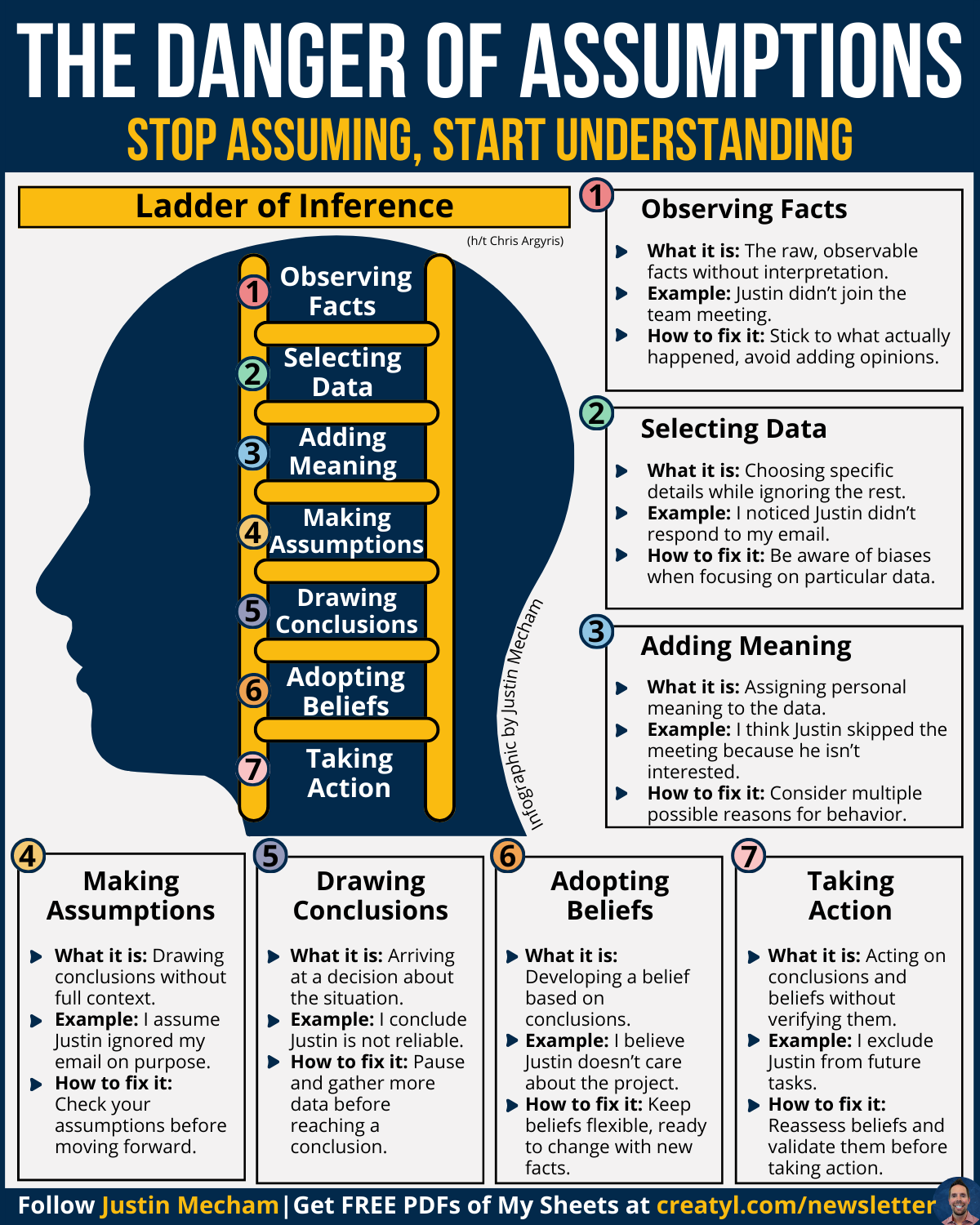
1. Observing Facts
Something happens.
A message goes unanswered.
Someone is late.
Someone misses a meeting.
These are plain facts — no meaning added.
2. Selecting Data
We choose the detail that stands out to us.
Maybe we notice they didn’t reply.
Maybe we focus on the missed meeting, not the five they attended.
Our mind narrows the view.
3. Adding Meaning
This is where trouble begins.
We assign a reason without checking if it’s real.
“He must not care.”
“She isn’t interested.”
Meaning appears before evidence exists.
4. Making Assumptions
We turn our interpretation into something that feels true.
“They ignored me on purpose.”
“They don’t respect my time.”
We don’t check it. We just believe it.
5. Drawing Conclusions
Now the story feels complete.
“They’re unreliable.”
“They’re not someone I can count on.”
This conclusion shapes our behavior.
6. Adopting Beliefs
One conclusion becomes a belief.
“They aren’t committed.”
“They don’t want to be part of the team.”
Beliefs rarely get rechecked.
7. Taking Action
This is the final step — and the most damaging.
We exclude them from future work.
We stop collaborating.
We stop trusting.
A single missed meeting turns into a broken relationship — not because of the truth, but because of the story we built.
Why Assumptions Spread Faster Than Facts
Assumptions move quickly because our minds want closure.
When something is unclear, it creates discomfort.
Assumptions help us feel steady again, even if the story we create is wrong.
We climb the ladder because:
- We want explanations.
- We want to make sense of behavior.
- We want to protect ourselves from disappointment.
- We want certainty in moments that feel unclear.
But the cost is high.
Assumptions drain trust.
They reshape relationships.
They change the way we speak to people, think about them, and choose to include or exclude them.
Most tension inside teams comes from stories that were never checked.
How to Pause the Ladder Before It Damages Trust
You can’t stop your mind from climbing the ladder — but you can learn to pause it before you act on a story that isn’t true.
Here’s how:
Stick to facts
Facts are neutral. The moment you add meaning, slow down.
Pause before assuming intent
The truth is often far simpler than the story you’re creating.
Stay open to new information
People have real reasons for delays, silence, or confusion — reasons you don’t see yet.
Check beliefs before acting
Ask yourself: “Do I know this for sure, or did I build this story myself?”
These steps protect relationships.
They prevent unnecessary conflict.
They keep teams grounded in reality instead of fear.
How One Misunderstood Moment Escalated Into a Full Team Breakdown
I worked with a company facing growing tension inside their leadership team.
Several leaders believed a key team member was becoming disengaged.
They thought this person wasn’t showing up fully, wasn’t committed, and wasn’t pulling their weight.
But none of this was based on direct conversation.
It was all based on assumptions.
It started with a few missed meetings.
Then a few delayed replies.
Then a short message that came across flat.
Little moments. Small things.
But the leaders didn’t stop at the facts.
They climbed the ladder quickly.
Each small moment gained extra meaning.
Soon, they convinced themselves that this person didn’t care about the work.
The weight of those assumptions spread through the team.
They started excluding this person from important discussions.
They shared concerns with each other rather than checking the truth.
The tension grew even though nothing was ever addressed directly.
The entire situation was built on assumptions — not evidence.
As the weeks passed, morale dropped.
The team member became confused about why they were being left out.
They sensed something was wrong but didn’t know what.
Instead of feeling supported, they felt pushed aside.
Their confidence dropped.
Their work slowed.
They became quiet during meetings, which only reinforced the leadership’s fears.
The leaders thought they were being cautious.
In reality, they were drifting further from the truth.
Their belief hardened, not because the evidence was strong, but because no one paused to question it.
This is how assumptions reshape an entire team.
They create distance, confusion, and mistrust — all without a single direct conversation.
The real issue?
Everything they believed was built on guesses, not facts.
I stepped in and brought them through the Ladder of Inference, step by step.
We broke down the exact moments that led to their belief.
We separated facts from stories.
We highlighted the meaning they added without checking.
As we worked through it, the team realized that they hadn’t verified any part of their assumption.
We replaced assumptions with clarity.
Here’s what we did:
1. We listed the facts only.
No opinions, no guesses, no interpretations.
Just the raw events.
2. We identified the added meaning.
Every assumption was written down so the team could see how far they had drifted.
3. We checked what was never confirmed.
Almost everything they believed was built on silence and imagination.
4. We had the leaders speak directly to the team member.
The truth came out: they were dealing with a private family issue.
They were overwhelmed, trying to manage it quietly, and didn’t want to burden the team.
They cared deeply — but felt stretched thin.
5. We rebuilt communication habits.
We created a simple rule: when something feels off, check the facts immediately.
No silent guessing.
No hidden conclusions.
No quiet stories that grow in the dark.
6. We repaired the relationship intentionally.
Once the truth was clear, the leaders brought this person back into key discussions, made expectations clear, and supported them through the challenges they were facing.
Trust began to heal.
The team member became more open.
The leaders became more grounded.
Most importantly, everyone learned how quickly a story can replace reality when no one pauses to check it.
The entire team now uses the Ladder of Inference as a daily tool — not a concept, but a practice.
This is the difference between assumptions and understanding: one divides teams silently, the other strengthens them openly.
The Decision That Builds or Breaks Trust
Every relationship at work rests on a simple choice: whether you act on the story you created or whether you pause long enough to understand what’s actually real.
That choice determines how people feel around you.
It shapes whether they trust you, open up to you, and feel safe showing you the truth of what they’re dealing with.
Assumptions grow in silence.
They fill gaps with fear.
They turn small moments into full stories that feel solid simply because they go unchallenged.
But the truth rarely sits where assumptions take us.
Most people are doing their best.
Most people care more than we think.
Most people have reasons we never see until we ask.
Understanding others requires patience — not perfection.
It asks you to slow down long enough to see the person, not just the moment.
It asks you to question your first reaction.
It asks you to hold your beliefs lightly enough that new facts can reshape them.
Trust is not built by always being right.
It’s built by staying open when things feel unclear.
When you stop assuming and start understanding, you create space for honesty, clarity, and connection.
You create teams where people feel safe to explain themselves instead of defend themselves.
You create relationships that last because they are built on truth, not stories.
The difference between tension and trust often comes down to one thing:
Whether you check the facts before you move.
Download the Infographic
If you want a clear, simple way to review the Ladder of Inference and catch assumptions before they create damage, you can download the full infographic as a PDF.
It includes every step, explanation, and detail from this article in one place.