Click Here to Download the PDF
There’s a moment most people hit at some point in their career when they look at their schedule, their workload, their notifications, their inbox, their unfinished tasks, and they think, “I genuinely do not know where my time goes.”
If you’ve felt that, you’re not alone.
And it’s not because you’re disorganized or lazy or easily distracted.
Most people were taught how to meet deadlines, respond to emails, show up to meetings, and keep pace with constant requests.
Almost no one was taught how to protect their attention or defend the hours that create real momentum.
That difference is everything.
Time is not something you manage like a spreadsheet.
It’s something you guard like a doorway.
And until you learn how to do that, your days will continue to fill themselves with whatever is loudest, closest, or most demanding—whether or not it matters.
This article takes you through a different way to look at your time.
It walks through eleven simple systems that help protect your day, a real workplace example of how this plays out inside a team, a set of highly rated tools to go deeper, and a powerful framework you can use to build your own “time defense system.”
Everything here is written to feel human, relatable, and honest—because time is personal, and your system needs to feel real in the world you actually live in.
What People Get Wrong About Time
Most people assume they need more hours.
More discipline. More motivation. More stamina.
But if you look closely at how people truly work, that’s not what’s missing.
What’s missing is clarity.
What’s missing is structure.
What’s missing is protection.
Without those three things, your day becomes a constant reaction: a reply here, a comment there, a quick email, a request you didn’t expect, a meeting dropped into your calendar, a small task that turns into an hour, a thought that pulls you into another task you didn’t plan for.
Then suddenly it’s 4pm and you’ve been “busy” for eight hours but can barely point to anything meaningful you actually completed.
Real productivity doesn’t come from doing more.
Real productivity comes from making fewer, better choices—and then building a system that protects those choices from all the noise around you.
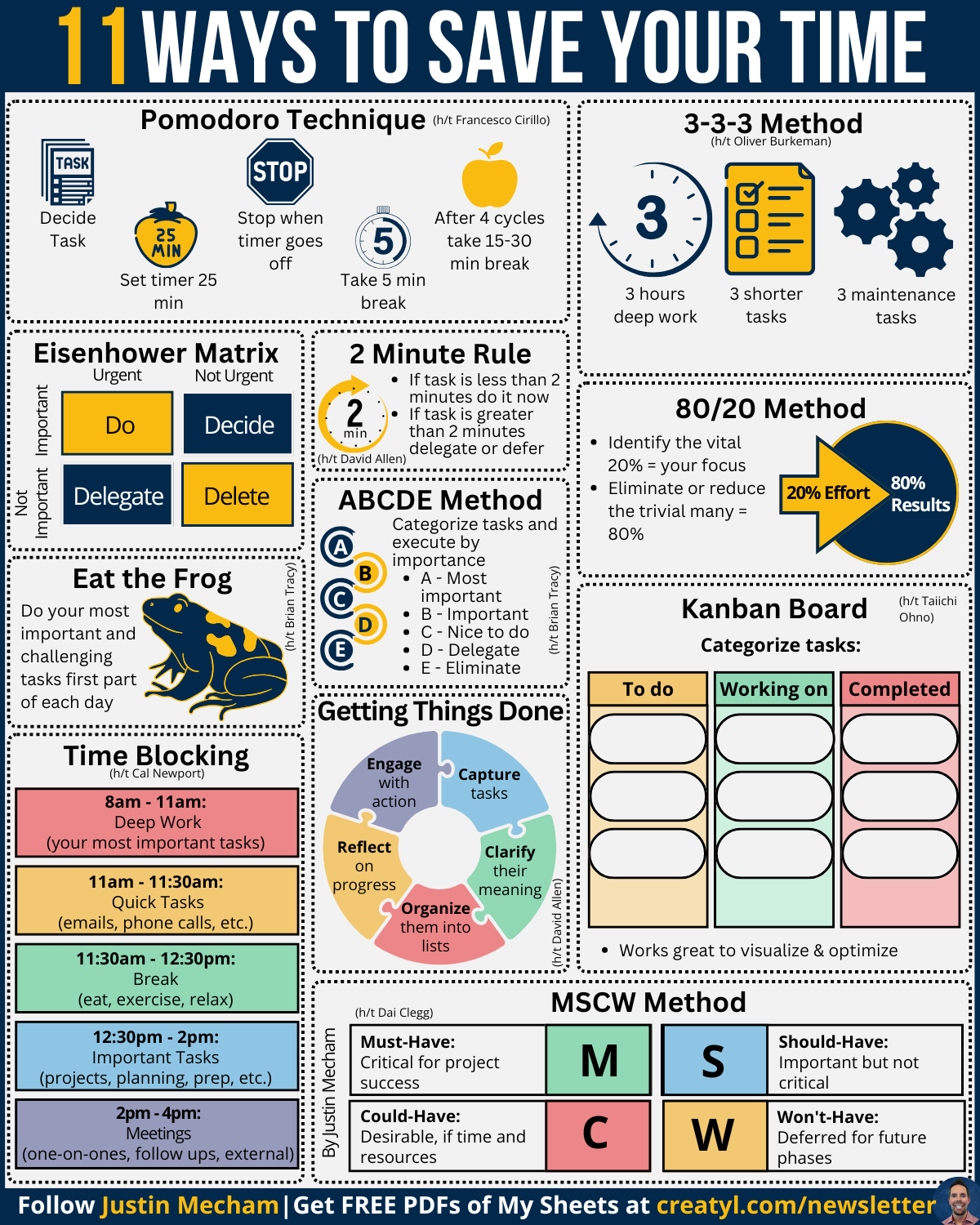
That is why the eleven systems in the infographic matter. They’re not tricks. They’re ways to take back control over the shape of your day.
A Real Workplace Example
How a Team Stopped Reacting and Started Progressing
A growing marketing team reached out because they felt buried.
Their days were packed, their projects were important, and their responsibilities were rising—yet their actual progress kept slipping.
They weren’t unskilled or unmotivated.
They were simply drowning in constant input.
By the time I stepped in, they were starting their mornings in their inboxes, bouncing between urgent messages and half-finished tasks.
Their calendars were a patchwork of meetings.
Projects were started but rarely completed.
And the important work—the work that actually mattered for revenue, clients, or strategy—kept getting pushed to late nights.
If you asked them, “Where does your time go?” they genuinely didn’t know. It slipped away in tiny pieces, one notification at a time.
As I observed their days, I realized something important: they weren’t struggling with workload.
They were struggling with design.
Their day had no backbone—nothing that protected their deep work or clarified what deserved their focus.
Everything felt urgent. Nothing felt planned.
Every task had the same weight, which meant nothing had real priority.
By midweek, I saw exhaustion creep in.
People were working hard, but the work wasn’t adding up to a sense of progress.
They were constantly in motion and rarely moving forward.
There was no structure.
No filters. No clear boundaries.
And because of that, their time leaked everywhere.
They didn’t need new software.
They needed a new approach to their day.
This is where the eleven systems came in—not as eleven new habits to force, but as parts of one simple structure.
First, we clarified what mattered using 80/20 and the Eisenhower Matrix.
We gathered every task, every project, and every responsibility and sorted them based on relevance and urgency.
The work that truly moved results forward became priority.
Everything else was downgraded, delegated, rescheduled, or removed.
Suddenly, the team’s workload looked smaller and clearer.
Nothing had changed except clarity.
Second, we rebuilt their calendar using Time Blocking and the 3-3-3 Method.
We protected their mornings for deep work.
No meetings. No calls. No Slack threads.
Just their most important work.
Then we assigned the rest of the day into manageable segments so the team always knew what type of work belonged where.
Third, we made hard tasks easier using Eat the Frog and Pomodoro.
The biggest, hardest, most strategic work went first on their schedule.
And once the day began, they used short, focused Pomodoro rounds to stay locked in.
This cut procrastination dramatically and increased their pace.
Fourth, we organized everything visually using a Kanban board and the MSCW method.
Every task lived on the board.
Every priority had a clear label.
Nothing stayed in someone’s head.
And they were only allowed three active “Doing” tasks at once.
This single rule dramatically changed completion rates.
Slowly, their days gained shape.
Their work became calmer.
Their progress became visible.
They started ending the day with fewer loose ends and more meaningful output.
They didn’t magically gain extra hours.
They simply stopped wasting the ones they already had.
The Best Tools to Support This Work
Here are the most popular and highest-rated resources for building a more intentional, more protected life with your time:
Book — Four Thousand Weeks: Time Management for Mortals by Oliver Burkeman
This bestselling book challenges the idea that you should be able to fit everything into your life. Burkeman shows you why protecting your time matters far more than trying to squeeze more into your schedule. It’s thoughtful, grounded, and widely praised for reframing how we think about time.
TED Talk — How to Gain Control of Your Free Time by Laura Vanderkam
One of TED’s most-watched talks. Vanderkam explains why people misjudge their time and how to take back control using a few simple changes in how you track and plan.
AI Tool — Motion
Motion automatically builds a realistic schedule for your day. It shifts tasks based on deadlines, blocks deep work time, and organizes your workload so you’re never staring at a long list wondering where to start. It’s considered one of the most advanced tools for modern productivity.
Tool — Trello
Simple. Visual. Highly adaptable. Trello is perfect for setting up the “To Do → Doing → Done” format and makes your workflow easier to understand at a glance.
Podcast — Deep Questions with Cal Newport
Cal Newport explores what meaningful, focused work looks like in a world full of distraction. His episodes offer thoughtful insights into how to design a calmer, more intentional day.
Movie — Groundhog Day
A classic story about repeating the same patterns over and over until someone chooses to live differently. A fitting reminder of what happens when you stop reacting and begin shaping your days.
A Practical Way to Build Your Own Time Defense System
You don’t need to carry all eleven methods. You only need a small, simple rhythm that fits your life.
Here’s how to build it:
Step 1: Identify Your Biggest Time Leak
Maybe it’s distraction.
Maybe it’s unclear priorities.
Maybe it’s a calendar that pulls you in every direction.
Maybe it’s tasks living in your mind instead of on paper.
Start there. Solve that first.
Step 2: Pick Three Core Tools
Choose one tool for focus, one for priority, one for planning. That’s it.
A few strong habits are better than eleven weak ones.
Step 3: Protect Your Deep Work Hours
Your most meaningful work should happen during the quietest part of your day.
Guard those hours. Place them on your calendar.
Treat them as commitments, not suggestions.
Step 4: Do a Weekly Time Retro
At the end of each week, reflect on what actually happened:
What pulled you off track?
What helped you move forward?
What rule did you follow well?
What needs to shift next week?
Small adjustments each week create massive clarity over time.
Owning Your Time Begins With Owning Your Choices
Most people assume their day is something they’re supposed to react to, as if life is meant to be handled moment by moment, interruption by interruption.
But the deeper truth is that your life becomes a reflection of whatever you allow to shape your attention.
If you don’t decide where your best hours go, something else will gladly decide for you.
You only get a limited number of weeks in your life.
You don’t get to pause them.
You don’t get to store them.
You don’t get to trade them back if you’re not happy with how they were used.
You only get to choose how you will spend them right now, with the day you’re living and the responsibilities you carry.
Protecting your time isn’t about control.
It’s about direction.
It’s about the quiet confidence that comes from spending your hours on the work that matters, the relationships that matter, and the goals that matter.
It’s about ending your day knowing that your choices—not your distractions—shaped the day you just lived.
The moment you begin defending your time, everything feels different.
Your work stops scattering in a hundred directions.
Your mind feels clearer.
Your progress becomes steady.
You gain a sense of ownership over your life again.
Not because you suddenly became more productive.
But because you finally decided your time was worth protecting.
Download the Infographic as a PDF
If you want a clean, printable version of the “11 Ways To Save Your Time” infographic featured in this article, you can download the PDF here: