Click Here to Download The PDF
For decades, people have been told to get their emotions under control.
To be rational. To stay level-headed. To keep it together.
But anyone who has lived through real life—love, loss, deadlines, pressure, change, relationships, ambition, mistakes—knows that emotions do not move in a straight line.
They don’t arrive one at a time.
They don’t wait their turn.
They don’t offer explanations or context before they show up.
Emotions come layered.
They overlap.
They collide.
And sometimes they contradict each other in ways that can be confusing, uncomfortable, or overwhelming.
Most people assume this means something is wrong with them.
They think they’re unstable or dramatic or too sensitive.
But the truth is much simpler:
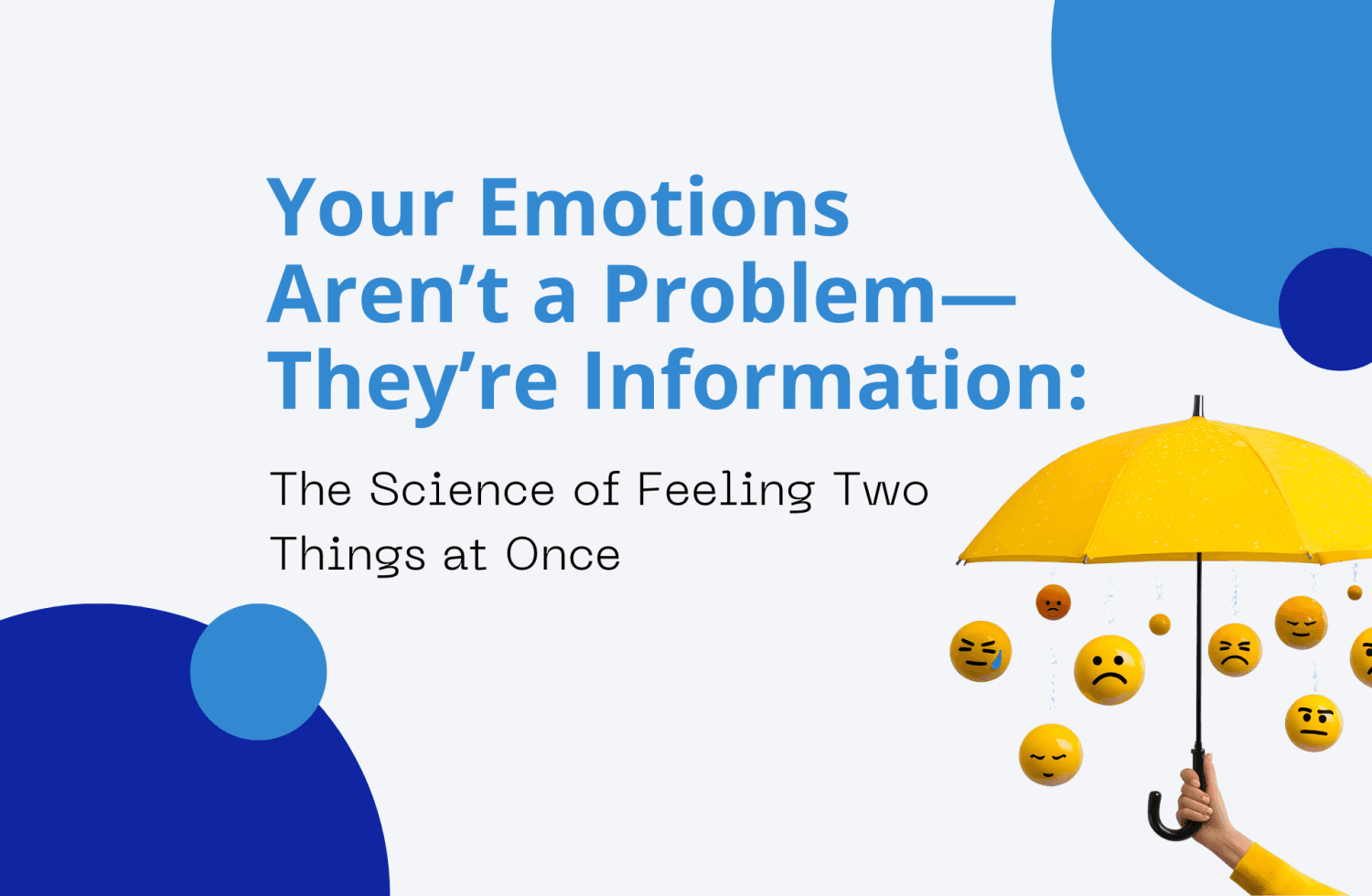
You’re not too emotional. You’re carrying two realities at once.
Your emotions are not flaws.
They’re signals.
They’re data.
They’re your internal system trying to tell you the truth before your mind can put words to it.
And the more you learn to listen, the more your emotions become a source of wisdom rather than something you’re trying to control or outrun.
The Real Nature of Emotions: They’re Mixed, Not Single
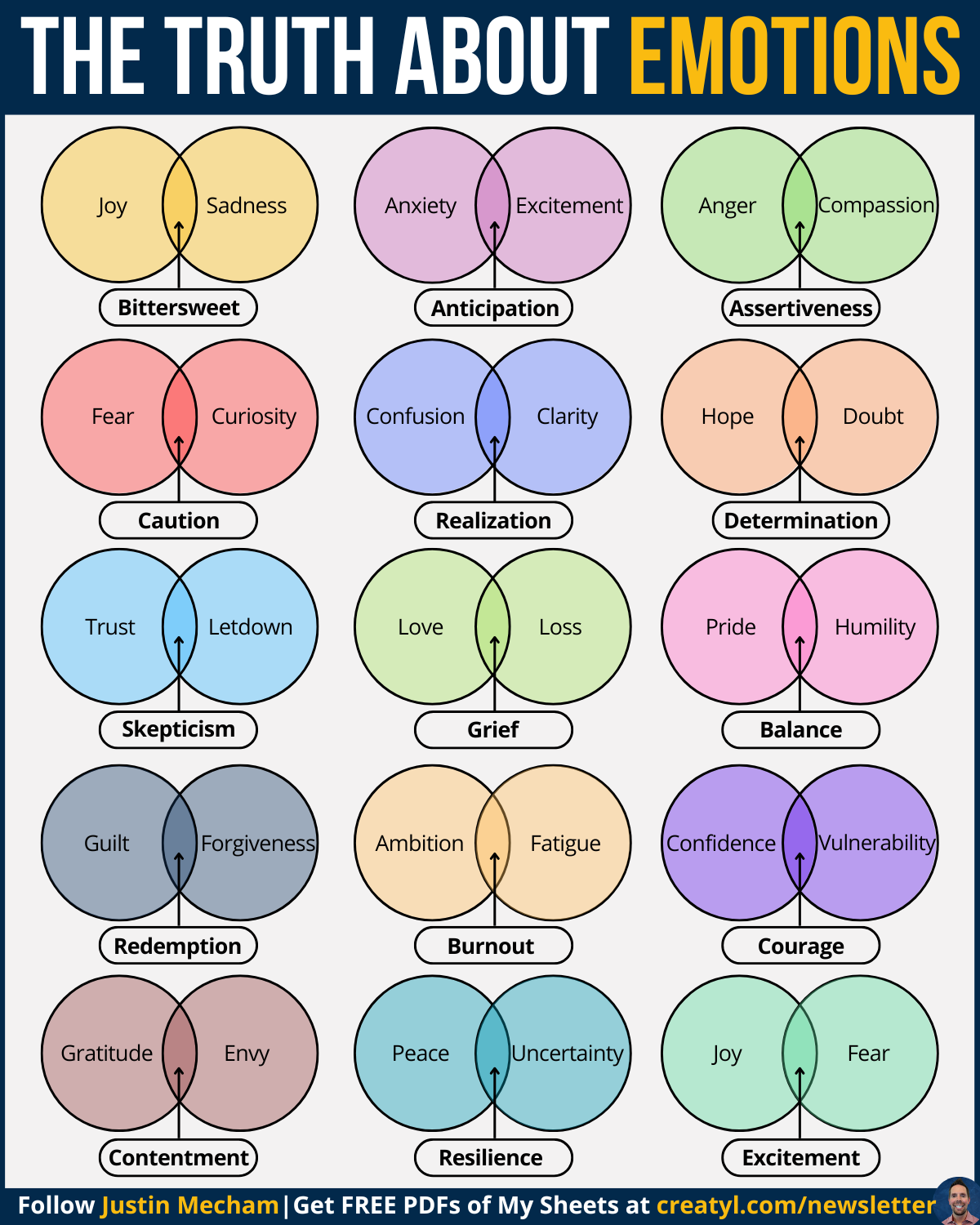
The infographic you saw earlier breaks this down beautifully.
It shows how core emotional pairs blend to create deeper, more complex experiences:
- Joy + Sadness = Bittersweet
- Anger + Compassion = Assertiveness
- Hope + Doubt = Determination
- Confidence + Vulnerability = Courage
- Peace + Uncertainty = Resilience
These combinations aren’t accidents.
They’re your body and brain doing their job—collecting information from your life and forming meaning in real time.
The mistake most people make is assuming they should “pick one.”
But biology does not work that way.
Your emotional system is designed to read multiple signals at once, because life rarely gives you clean, simple moments.
You can love someone and be hurt by them.
You can be excited about an opportunity and terrified of failing.
You can be grateful for your life and still long for change.
You can feel joy while carrying loss.
You can feel peace and uncertainty at the exact same time.
This does not make you confused.
This makes you human.
The Four Emotional Truths Most People Overlook
To understand your emotions more clearly, it helps to recognize four universal truths.
These apply to nearly everyone—even high performers, leaders, and people who appear calm on the outside.
1. Emotions are not commands. They are information.
Emotions show up to signal something, not to control you.
But when you see emotions as threats or weaknesses, you cut yourself off from the data they’re trying to reveal.
2. You can hold two conflicting emotions and still be healthy.
The presence of mixed emotions is not instability—it is complexity.
Authentic growth always includes contradictory feelings.
3. Emotional judgment blocks emotional clarity.
The moment you label a feeling as wrong or unacceptable, you stop listening.
Judgment replaces curiosity, and clarity disappears.
4. The emotion you resist is often the one you need to understand the most.
Resistance usually means the truth is getting close.
Listening instead of fighting is how you learn what needs to change.
A Real Workplace Example
How Emotional Awareness Helped a Team Member Break a Pattern
A senior account manager at a design firm reached out because they were struggling with their performance.
On paper, they were strong—talented, experienced, reliable.
But their interactions with clients had become tense.
They avoided difficult conversations.
They took feedback personally.
They carried stress home and replayed conversations long after work hours.
They worried they were “too emotional.”
They blamed themselves for reacting too strongly.
They tried to shut their emotions down, which only made things worse.
They were stuck in a loop of suppressing, overthinking, and judging themselves for feeling anything at all.
As we talked, a pattern surfaced: they weren’t experiencing one emotion at a time.
They were experiencing emotional combinations, but because they saw emotions as something to control, they never recognized what was actually happening.
For example:
They felt anger when a client dismissed their work—but they also felt compassion because the client was under pressure.
This mix created discomfort and hesitation.
They felt confident in their skills—but vulnerable because a new project was high-stakes.
This mix created anxiety.
They felt hopeful about their career—but doubtful they were meeting expectations.
This mix created tension.
Each combination confused them because they believed they should only feel one emotion at a time.
The more they fought these mixed signals, the more overwhelmed they became.
We began with one simple shift:
Emotions are not problems to control.
They are information to understand.
Once they embraced that, everything changed.
Step 1: We named each emotional mix clearly.
Instead of telling themselves “I shouldn’t feel this,” they started saying, “I feel frustrated and compassionate. Both are true, and both matter.”
This gave their mind language for what their body already knew.
Step 2: We identified what each mixed emotion was trying to reveal.
- Frustration + compassion → a boundary was needed, but empathy was still present.
- Confidence + vulnerability → the challenge mattered, and they cared about doing well.
- Hope + doubt → growth was happening, but clarity was still forming.
Naming these combinations gave the emotion purpose rather than shame.
Step 3: We worked with the emotions instead of against them.
When they felt emotional tension during client calls, they paused before responding.
They asked one clarifying question.
They spoke honestly about scope, deadlines, and boundaries.
And for the first time in months, they felt steady.
The emotions didn’t disappear.
They simply became a source of direction instead of a source of chaos.
Two months later, their interactions improved dramatically.
They handled difficult conversations with calm assertiveness.
They communicated with clarity and empathy.
They no longer feared being “too emotional.”
Because they finally understood that feeling two things at once doesn’t weaken you.
It deepens you.
The Best Tools to Support Emotional Awareness
Book — Emotional Agility by Susan David
A powerful, research-backed guide that teaches people how to understand emotions as signals, not judgments.
One of the most respected books on emotional health.
TED Talk — The Gift and Power of Emotional Courage by Susan David
A widely viewed TED Talk that breaks down why emotional suppression harms clarity and how embracing emotions leads to better decisions and deeper resilience.
AI Tool — Moodnotes
Co-created by clinical psychologists, Moodnotes helps users understand emotional patterns, reframe negative thinking, and identify emotional combinations with clarity.
Podcast — Unlocking Us with Brené Brown
This podcast digs deeply into emotional complexity, vulnerability, and human behavior.
Many episodes explore emotional blends and the wisdom they hold.
Movie — Inside Out
A powerful exploration of how emotions intertwine, influence each other, and work together to form human experience.
Insightful for adults as much as children.
A Framework for Turning Emotion Into Wisdom
Step 1: Feel first.
Before analyzing, naming, or explaining, give yourself permission to feel without resistance.
Emotional honesty is the entry point to emotional clarity.
Step 2: Name the combination, not the single emotion.
Ask yourself:
“What two emotions are showing up right now?”
This is often the key to unlocking what your system is trying to tell you.
Step 3: Ask what information the emotion holds.
Every emotion has a message.
Anger reveals boundaries.
Sadness reveals meaning.
Hope reveals desire.
Fear reveals risk.
Compassion reveals connection.
Step 4: Use the emotional data, not the emotional impulse.
Emotion gives insight.
You choose the action.
This is where emotional intelligence becomes emotional wisdom.
Where Emotional Judgment Ends, Emotional Growth Begins
There comes a moment in every person’s life when they realize that the goal was never to shut emotions down.
It was never to rise above them or control them or pretend they don’t exist.
The real goal is to understand them, because emotions are the language your inner world uses when words are too small.
Your emotions are not obstacles.
They are invitations.
They are signals that something inside you is shifting, expanding, or asking to be seen more clearly.
Once you stop judging your emotions and start listening to them, you begin to understand yourself with a level of honesty that changes everything.
You learn what you value.
You learn where you need boundaries.
You learn who matters to you.
You learn what hurts and what heals.
You learn what is calling you forward.
And as you learn, your emotional reactions become less confusing.
They become maps.
Every time you name a blended emotion—joy and sadness, confidence and vulnerability, peace and uncertainty—you get closer to understanding who you are becoming.
And the more you understand, the more deeply you trust yourself.
Emotion turns into wisdom the moment you stop trying to fix it and start trying to learn from it.
Download the Infographic as a PDF
You can download the full “Truth About Emotions” infographic in a clean, printable PDF format here: