Click Here to Download The PDF
Most people think metrics are about spreadsheets, charts, and reporting.
But in real leadership, metrics do something much more personal.
They reveal what you care about.
They reveal your bias, your blind spots, and your priorities.
They reveal the kind of leader you are becoming long before you notice it yourself.
If you track only revenue, your team learns that money is the main focus.
If you track engagement, retention, workload, and new ideas, your team learns that people, progress, and long-term health matter just as much as performance.
That is the quiet power of measurement.
It shapes how people act without a single speech.
Great leaders do not guess.
They build clarity.
And clarity becomes the force that makes the whole team better.
This article breaks down a simple system for using metrics as a form of leadership instead of a form of paperwork.
If you use it well, you will not only track better results — you will lead better people.
Numbers Don’t Lead. You Do.
Most teams do not fail from lack of talent.
They fail from lack of clarity.
Leaders often assume the team understands what matters.
They assume everyone knows what impact looks like.
They assume people can tell the difference between activity and progress.
But when you ask team members privately what success looks like, their answers rarely match.
That gap creates confusion, pressure, and misaligned effort.
Metrics fix this only when the leader uses them with intention.
A metric is not a scoreboard. It is a spotlight.
When you choose the right spotlights, the whole team can finally see the work the same way.
The shift begins when leaders stop asking, “What should we track?” and instead ask, “What do we want our team to understand, act on, and repeat?”
Metrics that answer those questions will always move the organization forward.
Metrics that do not will sit in dashboards, untouched and ignored.
Once you see that every metric shapes behavior, you start choosing them differently.
Pick Your Leader Five: The Five Metrics That Actually Match Your Values
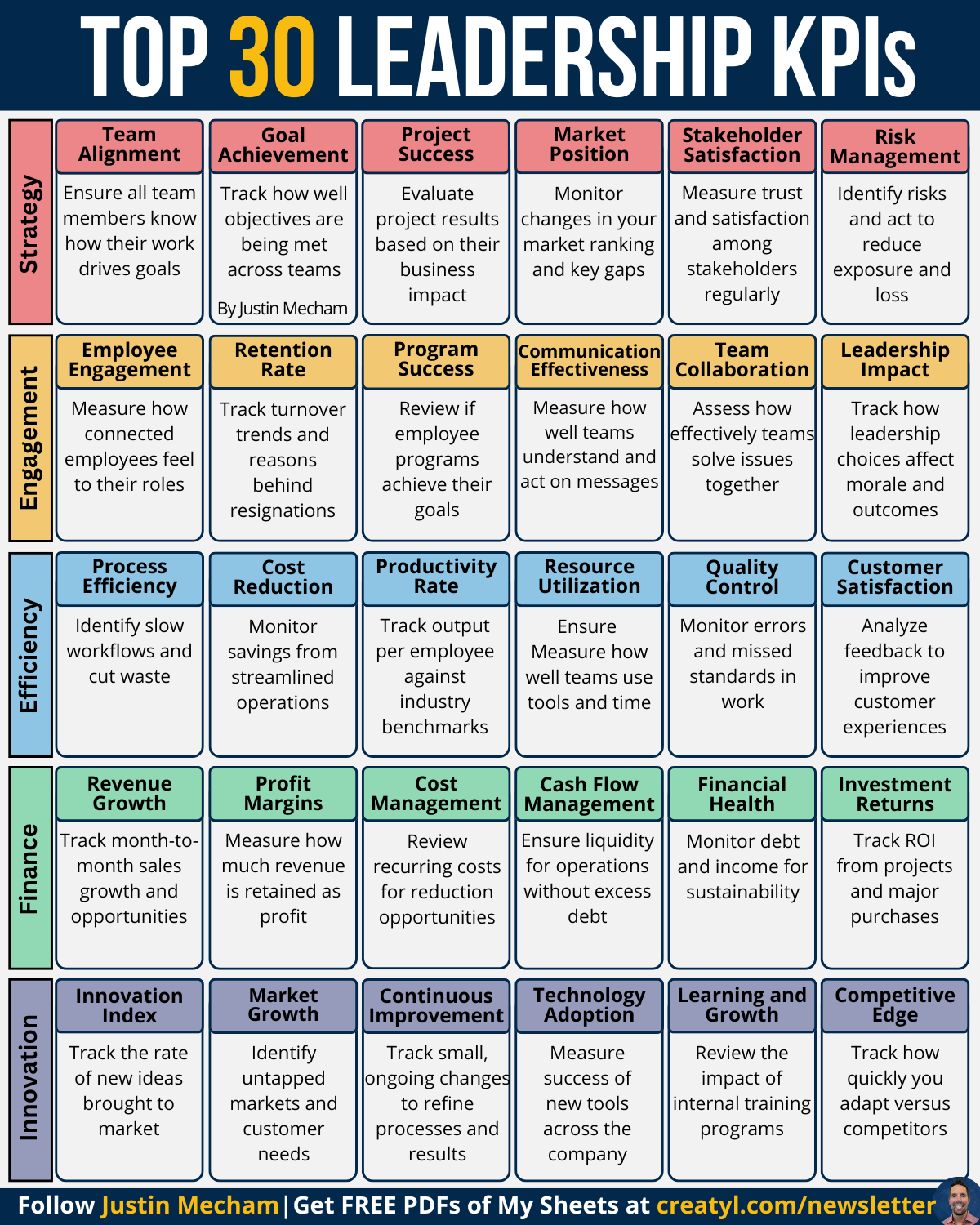
The chart you began with shows thirty different leadership KPIs across Strategy, Engagement, Efficiency, Finance, and Innovation.
It is a rich list, but no leader should track all of them.
If everything is important, nothing is.
To build a leadership system you can actually use, choose one metric per category — your Leader Five.
Each one should reflect what you want your team to value and repeat.
Here is a simple way to choose:
Strategy
Ask yourself:
Do I care more about impact or activity?
If impact matters most, choose Project Success or Market Position.
If clarity matters most, choose Team Alignment.
Engagement
Ask yourself:
Do I want to understand how people feel or why they stay?
If connection matters, choose Employee Engagement.
If patterns matter, choose Retention Rate.
Efficiency
Ask yourself:
Is our problem speed or workload friction?
If speed matters, choose Cycle Time or Productivity Rate.
If friction matters, choose Process Efficiency.
Finance
Ask yourself:
Do I want to understand stability or growth quality?
If stability matters, choose Financial Health.
If quality of growth matters, choose Profit Margins.
Innovation
Ask yourself:
Do we need new ideas or better testing?
If ideas matter, choose Innovation Index.
If testing matters, choose Technology Adoption.
Once you have your Leader Five, write a one-sentence intention under each one:
“We track this because we want ______.”
When your metrics and your values match, leadership becomes easier for everyone around you.
Turn Each KPI Into Weekly Behavior, Not Yearly Reflection
A metric does nothing until you attach a behavior to it.
For each of your five KPIs, define:
- One action you want to see every week.
- One action you personally will do every week.
- One clear response for when the number rises or falls.
This prevents the common leadership trap of using metrics as review tools instead of improvement tools.
The goal is not to admire numbers.
The goal is to act on them.
Here is a simple example:
Retention Rate
Team behavior: Managers ask one meaningful question each week in their check-ins.
Your action: Review one pattern every Friday and write one insight.
If the number drops: Hold three listening sessions within two weeks.
When every metric leads to movement, your leadership becomes more predictable, more stable, and more reassuring for your team.
People do not need perfection.
They need consistency.
Behaviors create that consistency.
The Leadership Scoreboard Huddle
Once your metrics are set, you need a weekly rhythm that brings them to life.
This is where most leaders lose momentum.
They track, but they do not talk about what the numbers mean.
Or they talk, but they do not link the conversation back to action.
The solution is a simple thirty-minute meeting each week.
Five minutes: The headlines
Do not open with a report. Open with clarity.
One sentence per metric:
Here is what changed and why it matters.
Ten minutes: Two questions for each metric
Ask:
“What did we do last week that likely moved this?”
“What will we try next week?”
This turns every number into a story and a decision.
Ten minutes: One real example from the team
Choose one metric that moved.
Ask a team member to share what they saw in the real work.
This keeps the team grounded in reality instead of abstract reporting.
Five minutes: One change
End with three decisions:
Stop.
Start.
Keep.
This is how maturity grows inside the team.
Not through complicated frameworks, but through steady, predictable attention.
Let Your Team Edit the Scoreboard
The most overlooked part of metrics is that they shape the team’s experience more than the leader realizes.
When people feel ownership over what is measured, they feel ownership over the work.
Once a quarter, ask the team two questions:
“What metric feels unhelpful or unclear?”
“What metric is missing that would help you do better work?”
A small shift in definition, a stronger description, or a cleaned-up tracking method can completely change how people interact with the numbers.
You do not need a perfect scoreboard.
You need a shared scoreboard.
Guardrails: How To Keep Metrics From Hurting Trust
Metrics can either build trust or damage it.
The difference comes from how the leader uses them.
Here are the most common traps and how to avoid them:
Tracking too many numbers
Solution: Choose five. Nothing more.
Using vanity metrics
Solution: Ask, “What decision will change if this moves?”
No ownership
Solution: Assign one person to explain each metric every quarter.
Using numbers to pressure instead of guide
Solution: Replace “Who dropped this?” with “What changed here?”
Your team will follow data when data feels fair and honest.
Trust grows when numbers are handled with care.
A Real Workplace Example: When Metrics Revealed the Real Problem
A team once brought me in because they felt stuck.
They were working long hours, but their results were flat.
They tracked only revenue, project count, and meeting volume.
No one could explain why the team felt tired even though the numbers looked stable.
The team’s metrics focused entirely on output, not outcomes.
They had no way to measure engagement, project quality, idea flow, or workload friction.
People felt invisible and overwhelmed, but the dashboard never showed it.
Because the wrong metrics were being measured:
Strategy was unclear.
Engagement was hidden.
Efficiency problems were ignored.
Profit per project was shrinking despite rising revenue.
Innovation was sporadic and untracked.
The team assumed they had a performance problem.
They actually had a clarity problem.
I helped them rebuild their scoreboard using the Leader Five system:
Strategy: Project Success Rate
Engagement: Quarterly Stay Score
Efficiency: Cycle Time
Finance: Profit Per Project
Innovation: Ideas Tested Per Month
We added weekly actions to each metric.
We ran a consistent scoreboard huddle.
We removed three slow approval steps.
We held listening sessions for low engagement scores.
We priced projects more accurately.
We tested small ideas every month.
Within three months, their performance changed.
Not because they worked harder, but because their attention shifted to the right places.
What you track becomes how you lead.
And how you lead becomes how the team works.
Tools That Match This Theme
If readers want to go deeper, these four resources align perfectly with the idea that leadership is revealed through the goals and metrics you choose.
Best Book
Measure What Matters by John Doerr
A clear look at how OKRs bring focus, accountability, and alignment into leadership.
Best TED Talk
Why the Secret to Success Is Setting the Right Goals by John Doerr
A practical explanation of how goals and metrics shape success.
Best AI / Dashboard Tool
Microsoft Power BI
One of the strongest tools for building simple, readable KPI dashboards.
Best Film
Moneyball
A powerful example of how tracking the right metrics changes decisions, team culture, and results.
The Measures You Choose Become the Leader You Become
Leadership is not revealed in speeches or plans.
It is revealed in what you decide to watch every week.
When you choose your metrics with intention, you reshape your culture without forcing it.
You tell your team what matters without raising your voice.
You show them what good leadership looks like through the consistency of your attention.
People perform differently when the measures feel honest and meaningful.
They speak up more.
They take smarter risks.
They share problems sooner.
They make decisions with more care because they understand the direction.
This is how momentum builds in real life — not through grand gestures, but through the steady weight of clarity.
When your scoreboard reflects what you truly care about, the team begins to move in the same direction.
When your actions match your measures, trust becomes natural.
And when you choose a small set of metrics that reflect your values, you turn leadership from something you talk about into something you practice.
Clarity is not loud, but it lasts.
It shapes the way your team sees their work, their goals, and themselves.
And over time, those small choices about what you track will become the story of the leader you are becoming.
Download the Full Framework
If you want the complete visual as a pdf, download it here!