

Click Here to Download the PDF
Negativity almost never shows up the way we expect it to.
It doesn’t arrive as a loud voice telling you to quit or give up.
It doesn’t announce itself as fear or insecurity.
Instead, it slips in quietly.
It sounds reasonable.
It sounds thoughtful.
It sounds like logic.
“Why rush this?”
“Let’s think it through one more time.”
“Now might not be the right moment.”
Because these thoughts sound responsible, most people don’t challenge them.
They assume they’re being careful, strategic, or mature.
And that’s how negativity works best.
By the time you realize something is wrong, your energy is already gone.
Why the Thoughts That Hold You Back Feel So Normal
The most limiting thoughts rarely feel harsh.
They feel familiar.
They show up as hesitation instead of refusal.
As delay instead of doubt.
As overthinking instead of fear.
In my work with teams, leaders, and individuals, I’ve seen this pattern repeat again and again: people don’t stop because they think they can’t succeed.
They stop because they convince themselves that waiting is wise.
They tell themselves they’ll start once things are clearer.
Once confidence is higher.
Once conditions feel safer.
But that moment rarely comes.
And over time, delay turns into habit.
The Real Cost Isn’t Missed Goals. It’s Lost Trust in Yourself
When people talk about negativity, they often focus on outcomes.
Projects that stall.
Ideas that never ship.
Opportunities that quietly pass by.
But those are just surface symptoms.
The deeper cost is internal.
Each time someone talks themselves out of starting, they weaken their trust in their own ability to move.
Each time they overthink a simple decision, they teach themselves that action is risky.
Each time they compare instead of progress, they lose sight of their own momentum.
Eventually, the question shifts.
Not “What’s my next step?”
But “What’s wrong with me?”
The truth is simple: nothing is wrong with them.
They’re just stuck in a loop they were never taught how to interrupt.
How Negativity Becomes a Team Problem Without Anyone Noticing
Negativity rarely stays contained to one person.
It spreads quietly through teams.
One person hesitates to share an idea.
Another softens feedback to avoid tension.
Meetings drift toward “Let’s revisit this later.”
No one is trying to slow things down.
Everyone is trying to stay safe.
But safety without movement turns into stagnation.
Decisions take longer than they should.
Clarity fades.
Progress becomes harder to measure.
By the time leaders notice a performance issue, the real problem has often been there for months.
What Actually Changes Things (And What Doesn’t)
Motivational talks don’t fix this.
Neither do slogans, posters, or reminders to “stay positive.”
What actually helps is teaching people how to deal with these thoughts in real time, while they’re happening.
Not afterward.
Not in hindsight.
In the moment.
That requires a different skill set—one most people were never taught.
Shift One: Stop Treating Every Thought as a Fact
The first meaningful change happens when someone realizes this:
A thought can feel urgent without being true.
Negativity works because it speaks quickly and confidently.
It doesn’t wait for evidence. It jumps straight to conclusions.
Instead of arguing with the thought, the more effective move is to name what’s happening.
“This is fear.”
“This is perfectionism.”
“This is me assuming the worst.”
That simple act creates distance.
And distance creates choice.
Shift Two: Trade Mental Spin for Specifics
Negativity thrives on vague statements.
“This isn’t good enough.”
“I always mess this up.”
“They’re probably going to hate it.”
These thoughts feel heavy because they’re unclear.
The way forward is to replace judgment with precision.
What exactly isn’t working?
Which part needs improvement?
What would make this one step better?
Specific questions turn emotion into information.
Information makes movement possible.
Shift Three: Shrink Action Until It’s Hard to Avoid
Most people wait to feel confident before they act.
That’s backwards.
Confidence comes after action, not before it.
One of the most reliable ways to break a negative loop is to shrink the task until starting feels manageable.
Not finishing the project.
Not solving the whole problem.
Just beginning.
Ten minutes is often enough.
Once movement starts, the whisper loses strength.
A Real Moment from Consulting Work
I once worked with a team that looked productive on paper but struggled to ship anything meaningful.
Every idea had a reason to wait.
Every draft needed one more pass.
Every decision required one more opinion.
They believed they had a process problem.
What they actually had was a thinking problem.
We didn’t overhaul their strategy.
We didn’t add new tools.
We changed how they handled hesitation.
We practiced naming patterns out loud instead of internalizing them.
We ended discussions with one clear next step, not endless debate.
We made it normal to ship small and learn quickly.
Nothing about the team changed on paper.
Everything changed in motion.
What Most Advice Leaves Out
Negativity doesn’t disappear forever.
It comes back during busy seasons.
Before big decisions.
Right before something matters.
The goal isn’t to eliminate it.
The goal is to recognize it faster and respond more clearly.
That’s what real progress looks like in daily life.
Final Thought: You’re Not Stuck. You’re Paused.
And Pauses Can Be Released
If negativity has been quietly shaping your days, that doesn’t mean you’re weak or behind.
It means you learned a way to protect yourself that no longer fits where you’re going.
You don’t need a new personality.
You don’t need endless motivation.
You need a better relationship with your own thoughts.
When you learn to pause, name the pattern, and take one small step forward, something shifts.
Not all at once.
But enough to feel like yourself again.
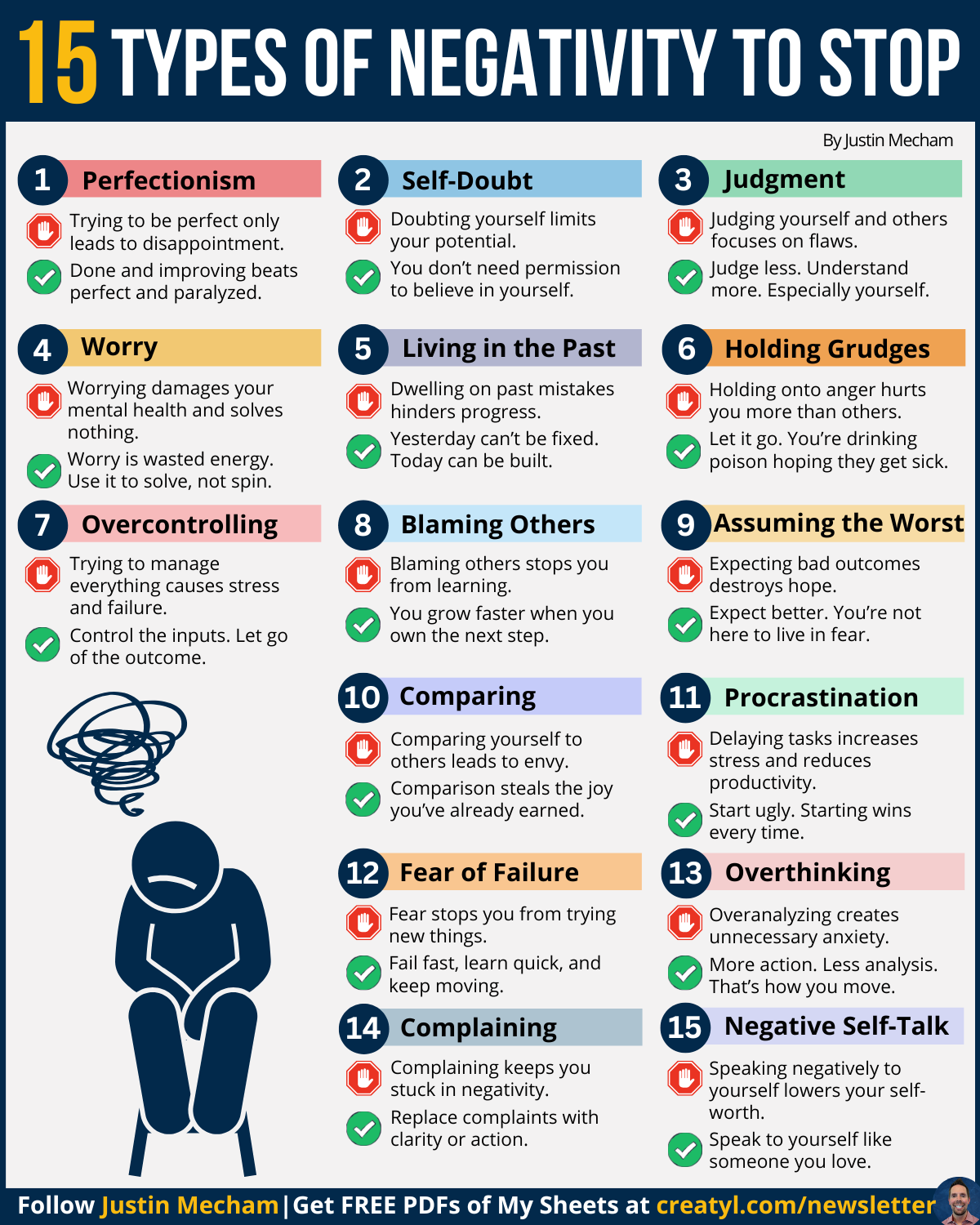
Download the Infographic That Inspired This Article (PDF)
The visual guide that inspired this article is available as a one-page PDF.
Many readers use it as a quick reference when they feel stuck or notice the same thought loop repeating.
You can download it here:
Sometimes, seeing the pattern is all it takes to change the next step.