

Most People Aren’t Overwhelmed by Work. They’re Overwhelmed by Decisions.
When people say they’re overwhelmed, they usually blame the workload.
- Too many tasks.
- Too many messages.
- Too many responsibilities.
But if you look closely at how days actually fall apart, the problem is rarely the amount of work.
It’s the number of decisions required to get through the day.
- What should I start with?
- Is this more important than that?
- Should I respond now or later?
- Am I doing the right thing, or just the urgent thing?
Each choice seems small on its own.
But over the course of a day, those choices quietly drain energy.
The issue isn’t effort.
It’s decision load.
That’s why the most productive people don’t rely on motivation or willpower.
They rely on structure that removes unnecessary decisions before the day even begins.
Why Fewer Decisions Matter More Than More Discipline
Energy doesn’t disappear all at once.
It drains one decision at a time.
When every task requires a fresh judgment call, focus erodes quickly.
By midday, even simple work feels heavier than it should.
The goal isn’t to do more.
It’s to decide less about things that don’t deserve constant attention.
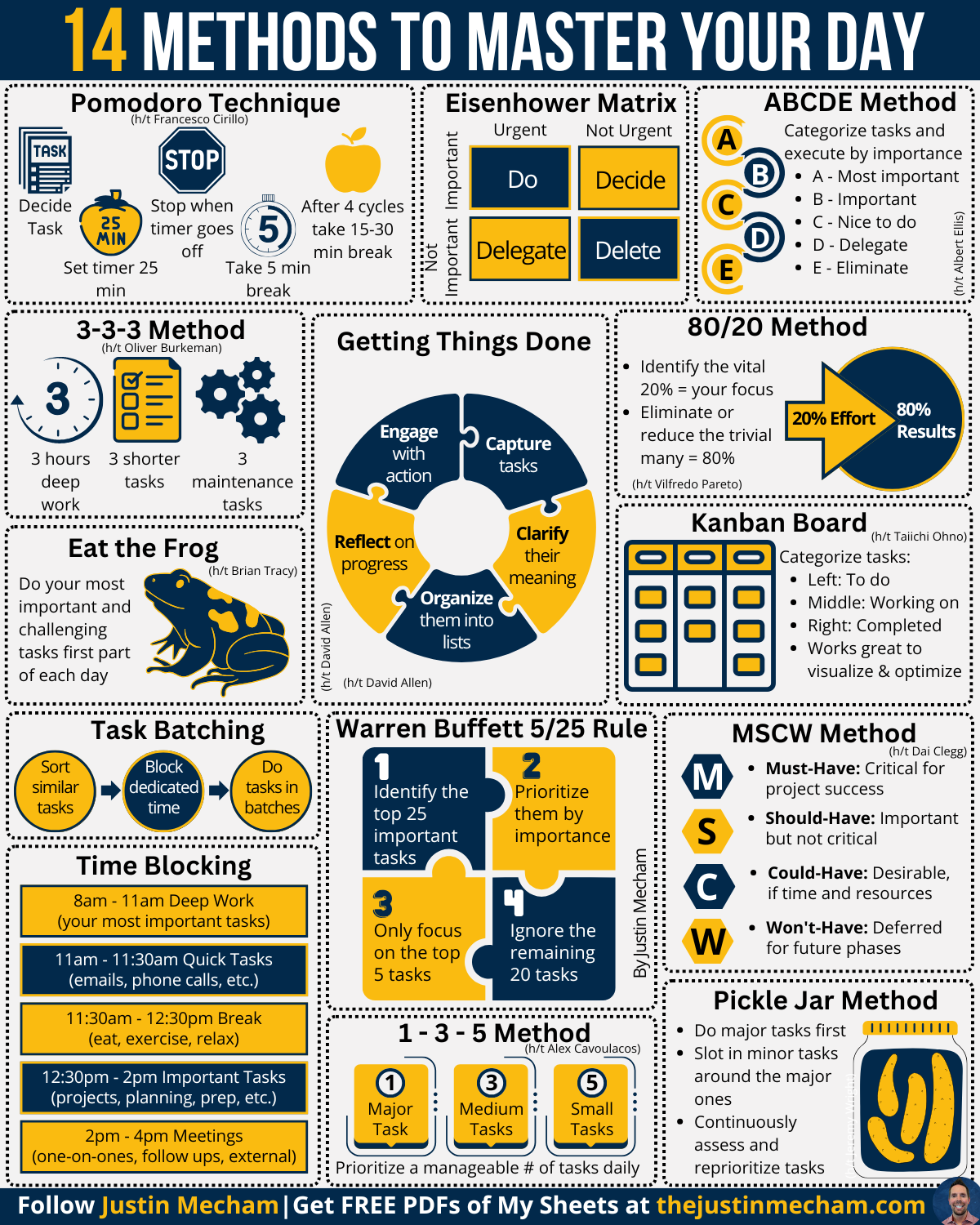
The 14 methods below all work for the same reason.
They reduce decision-making by creating rules ahead of time.
Once the rule exists, you don’t need to think.
You just follow it.
That’s how work gets finished without burning out.
1. Pomodoro Technique: Limit How Long You Decide to Focus
The Pomodoro method removes the question of how long to work.
- You work for a short, fixed block.
- You stop when the timer ends.
- You take a planned break.
This structure matters because it prevents overthinking how long something “should” take.
You work with the time you have instead of negotiating with yourself.
Use this when starting feels harder than continuing.
2. Eisenhower Matrix: Separate Urgency from Importance
Many days collapse because urgent tasks crowd out meaningful ones.
The Eisenhower Matrix forces a clear distinction:
Urgent and important
Important but not urgent
Urgent but not important
Neither
Once tasks are sorted, decisions become obvious.
You stop reacting and start choosing intentionally.
3. ABCDE Method: Rank Before You Begin
This method removes decision-making during work by ranking tasks first.
- A tasks matter most.
- B tasks matter, but less.
- C tasks are optional.
- D tasks are delegated.
- E tasks are removed.
Once ranked, you don’t debate what comes next.
You follow the list.
4. 3-3-3 Method: Create a Daily Ceiling
The 3-3-3 method limits how much you expect from yourself in a day:
Three hours of deep work
Three short tasks
Three upkeep items
This boundary prevents overload caused by unrealistic planning.
It makes the day feel contained instead of endless.
5. Getting Things Done: Get Tasks Out of Your Head
Unwritten tasks create constant mental noise.
The GTD approach captures everything so nothing has to be remembered.
Once tasks are written down and organized, the brain stops trying to track them.
That mental relief alone restores focus.
6. 80/20 Method: Reduce What Deserves Attention
Not all tasks create equal results.
The 80/20 method helps identify the few actions that matter most and reduce time spent on the rest.
This isn’t about ignoring work.
It’s about protecting attention.
7. Eat the Frog: Remove the Hardest Decision First
Difficult tasks create background stress when delayed.
Doing the hardest task first removes that weight early in the day.
Everything else feels lighter once it’s done.
This method works because it removes avoidance from the equation.
8. Kanban Board: Make Work Visible
Seeing work clearly reduces mental juggling.
A simple board with:
- To do
- Doing
- Done
Removes the need to constantly remember what’s in progress.
Progress becomes visible, which lowers anxiety.
9. Task Batching: Stop Switching Contexts
Switching between task types drains focus.
Batching similar tasks together removes repeated setup decisions.
You stay in one mode longer, which reduces fatigue.
10. Time Blocking: Decide Once, Not All Day
Time blocking assigns work to specific time slots.
Once the calendar is set, you no longer decide what to work on in the moment.
You follow the plan.
This protects focus and prevents reactive work from taking over.
11. Warren Buffett 5/25 Rule: Say No on Purpose
This method limits priorities intentionally.
- You identify your top 25 goals.
- You focus on the top five.
- You ignore the rest.
This protects attention by reducing the number of things competing for focus.
12. MSCW Method: Clarify What Matters Now
Tasks are sorted into:
- Must
- Should
- Could
- Won’t
This prevents optional work from pretending to be urgent.
Clarity here reduces guilt and indecision.
13. 1-3-5 Method: Set a Daily Decision Limit
Each day includes:
One major task
Three medium tasks
Five small tasks
This creates a realistic workload and removes the need to constantly reassess what’s possible.
14. Pickle Jar Method: Place Big Priorities First
If small tasks fill the day early, big priorities never fit.
This method forces major work to be scheduled first so it actually happens.
The order alone changes outcomes.
A Real Workplace Example: When Decisions, Not Work, Were the Real Problem
Problem
They were a cross-functional team inside a growing business, responsible for shipping projects, responding to requests, and keeping initiatives moving.
On paper, the workload was reasonable.
In practice, days felt chaotic.
Every morning started with deciding what to work on.
Messages interrupted focus constantly.
Meetings added new tasks without removing old ones.
By the end of the day, effort was high—but progress felt unclear.
Agitation
Over time, energy dropped.
People felt busy but unsatisfied.
Important work kept getting postponed by urgent requests.
Focus fractured as tasks were constantly re-evaluated.
The team blamed time management, but the real issue was decision overload.
Too many choices were being made in real time.
Solution
Instead of pushing harder, they reduced decisions.
- They used time blocking to assign work before the day started.
- They applied the Eisenhower Matrix weekly to filter urgent noise.
- They limited daily tasks using the 1-3-5 method.
- They batched communication into set windows.
- They used a simple board to track what was being worked on.
Within weeks:
Focus improved
Work finished earlier
Stress dropped
The workload didn’t change.
The decision load did.
Tools That Support Fewer Decisions
Getting Things Done by David Allen provides a clear system for capturing and organizing tasks.
Essentialism by Greg McKeown reinforces saying no to non-essential work.
Notion helps structure tasks, time blocks, and boards in one place.
Creatyl supports building and sharing work without complex setup.
Final Thought: Structure Protects Energy Better Than Motivation
Why Better Days Start Before the Day Begins
Most people don’t need more discipline.
They need fewer decisions competing for attention.
- When structure exists, energy is protected.
- When priorities are clear, focus follows.
- When rules are set early, work moves without resistance.
Motivation fades.
Willpower fluctuates.
But structure stays.
Better days aren’t built by trying harder.
They’re built by deciding less—about the things that don’t matter—and protecting space for the ones that do.
Download the “14 Methods to Master Your Day” Infographic (PDF)
Some systems are easier to apply when you can see them all at once.
This infographic lays out all 14 methods in a clear visual so you can quickly choose the one that fits your day and remove decisions before they drain your energy.
It’s a simple reference you can return to whenever your day starts feeling heavier than it needs to be.