

Click Here to Download The PDF.
Choosing Calm Is a Form of Strength Most People Never Practice
For a long time, I thought strength meant having the perfect reply.
The sharp comeback.
The airtight argument.
The sentence that made the other person pause and think,
“Wow. They really got me.”
But over time, I realized something uncomfortable.
Winning arguments rarely improves your life.
It usually just keeps you stuck inside the moment.
The truth is, most conflict isn’t about the words being said.
It’s about the emotion underneath them.
And once emotions spike, the conversation stops being about facts.
It becomes about nervous systems.
About pride.
About old triggers.
About the need to feel safe.
That is why the biggest shift is not learning how to respond faster.
It is learning how to respond calmer.
Because most reactions feel urgent.
Very few are important.
Choosing calm is not passive.
It is one of the most powerful forms of control you can practice.
Why “Taking It Personally” Feels Automatic
When someone speaks sharply…
When a message feels cold…
When feedback lands the wrong way…
Your brain does something instantly.
It creates a story.
They disrespected me.
They don’t value me.
I need to defend myself right now.
This is normal.
The brain is wired to detect threat quickly.
Psychologists describe this as an emotional hijack,
where the reactive part of the brain takes over
before the thoughtful part catches up.
That is why the pause matters so much.
Because the pause gives your thinking mind time to return.
The moment you slow down, you regain choice.
That is the real goal.
Not silence.
Choice.
The Core Shift: Stop Trying to Win, Start Protecting Your Peace
One change did more for my life
than any clever reply ever did:
I stopped trying to win arguments
and started choosing calm instead.
Winning feels satisfying for a second.
But peace feels satisfying for years.
Calm is not about letting things slide.
It is about deciding what deserves your energy.
Energy is expensive.
And most people spend it on moments
that do not matter next week.
Protecting your peace is not avoidance.
It is wisdom.
The Reset Method: A Simple Sequence That Slows the Moment Down
When emotions spike, you do not need a perfect response.
You need a reset.
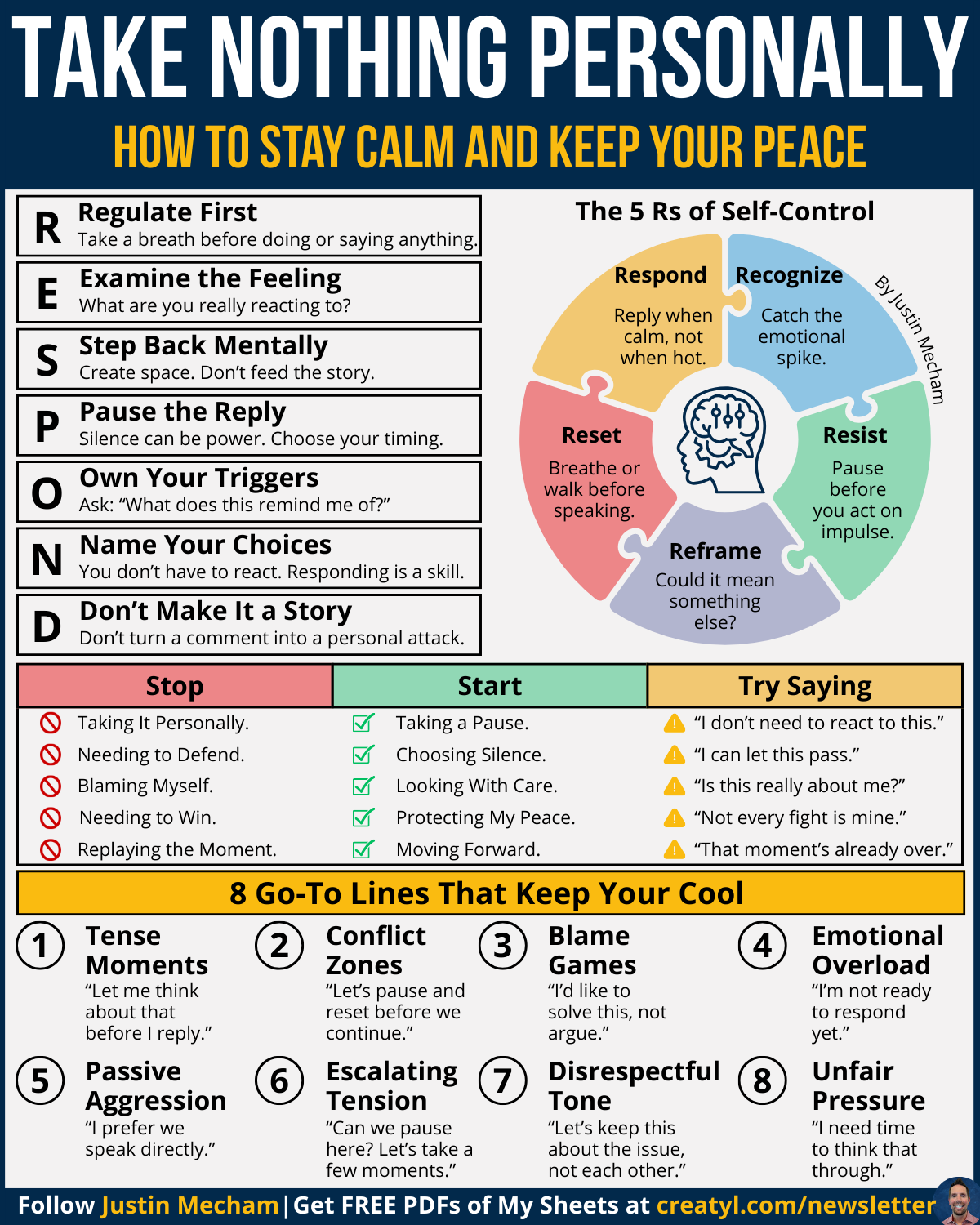
That is what the infographic teaches with the RESPOND steps:
Regulate First
Take one breath before doing or saying anything.
Not to be dramatic.
Just to interrupt the reflex.
Breathing slows the body.
And when the body slows, the mind follows.
Examine the Feeling
Ask: What am I really reacting to?
Is it the words?
Or is it the meaning I’m attaching to them?
This question is a door out of the story.
Step Back Mentally
Create space.
Do not feed the story with more thoughts.
Space weakens emotion.
Emotion grows when it is rehearsed.
Pause the Reply
Silence can be power.
Timing matters more than speed.
You do not owe an instant answer.
Own Your Triggers
Ask: What does this remind me of?
Sometimes the reaction is old.
The moment is new, but the feeling is familiar.
Name Your Choices
You don’t have to react.
Responding is a skill.
Not a reflex.
Don’t Make It a Story
A comment is not always an attack.
A tone is not always a verdict.
Most things are smaller than your mind makes them.
The 5 Rs of Self-Control (A Practice, Not a Personality Trait)
Self-control is not something you either have or don’t.
It is something you practice in real time.
The 5 Rs make it simple:
Recognize
Catch the emotional spike early.
The sooner you notice it, the easier it is to slow down.
Resist
Pause before acting on impulse.
Impulse feels like truth.
It is usually just heat.
Reframe
Ask: Could this mean something else?
Maybe they are stressed.
Maybe they misunderstood.
Maybe it is not about you.
Reset
Breathe or walk before speaking.
Movement helps emotion move through.
Respond
Reply when calm, not when hot.
A calm response carries weight.
A reactive response carries regret.
What to Stop vs What to Start (The Real Life Difference)
A lot of people think calm is about doing less.
It is not.
It is about doing different.
Stop
Taking it personally
Needing to defend
Blaming yourself
Needing to win
Replaying the moment
These habits keep you stuck in the emotional loop.
Start
Taking a pause
Choosing silence
Looking with care
Protecting your peace
Moving forward
The goal is not to become numb.
The goal is to become steady.
Eight Go-To Lines That Keep You Cool (Words That Lower the Temperature)
Most people escalate because they don’t know what to say.
So they fill the space with reaction.
Having a few calm lines ready changes everything.
Here are the kinds of phrases that work because they buy space:
- “Let me think about that before I reply.”
- “Let’s pause here for a moment.”
- “I want to solve this, not argue.”
- “I’m not ready to respond yet.”
- “Can we slow this down?”
- “I prefer we speak directly.”
- “Let’s focus on the issue, not each other.”
- “I need time to think that through.”
Simple words.
Clear tone.
No drama.
These lines are not weak.
They are controlled.
The Same Moment Kept Escalating Until I Chose Calm
I worked with a team where small tensions kept turning into big ones.
A message would be misread.
A meeting would get sharp.
Someone would feel dismissed.
And suddenly, the real issue was gone.
All that remained was tone.
People weren’t fighting about the work anymore.
They were fighting about how the work was discussed.
The team was talented.
But emotional friction was draining energy every week.
What made it worse was the replay.
After the meeting, people carried it home.
They rewrote the conversation in their head.
They drafted responses they never sent.
They showed up the next day already tense.
And once that cycle starts, everything feels personal.
Even neutral feedback feels loaded.
Even small requests feel like criticism.
The workplace becomes heavier than it needs to be.
The shift wasn’t a new policy.
It was a new practice.
We started using pauses as a team norm.
Instead of reacting fast, people began saying:
“I need a moment.”
“Let’s pause here.”
“Let’s focus on the issue.”
We trained ourselves to separate:
What was said
From the story about what it meant
We encouraged one calm breath before replying.
We normalized delayed responses.
And slowly, something changed.
The temperature dropped.
People felt safer.
The work became clearer because emotions weren’t running the room.
The team didn’t become softer.
They became steadier.
That is what calm does.
The Ship Rule of Calm: One Choice at a Time
Here is what makes this real.
You do not need to master calm overnight.
You need one choice.
One delayed reply.
One moment of silence.
One clarifying question instead of a defense.
Calm is built the same way trust is built.
In small moments.
Repeated.
Peace Is Not Passive. It Is Power.
Most people think strength looks like reaction.
Quick words.
Sharp clarity.
The last line.
But real strength is often quiet.
It is the ability to feel the spike…
And still choose your response.
That choice changes everything.
Because you cannot control other people’s tone.
You cannot control their stress.
You cannot control what they carry into the room.
But you can control what you carry back.
You can decide not to turn every moment into a battle.
You can decide that your peace is worth more than being right.
And when you practice that, life gets lighter.
Not because problems disappear.
But because you stop letting them live inside you longer than they need to.
That is real power.
Download the Infographic (PDF)
If you want to keep this “Take Nothing Personally” sheet
in front of you as a reminder, the full infographic is available as a PDF.