



Click Here to Download the PDF.
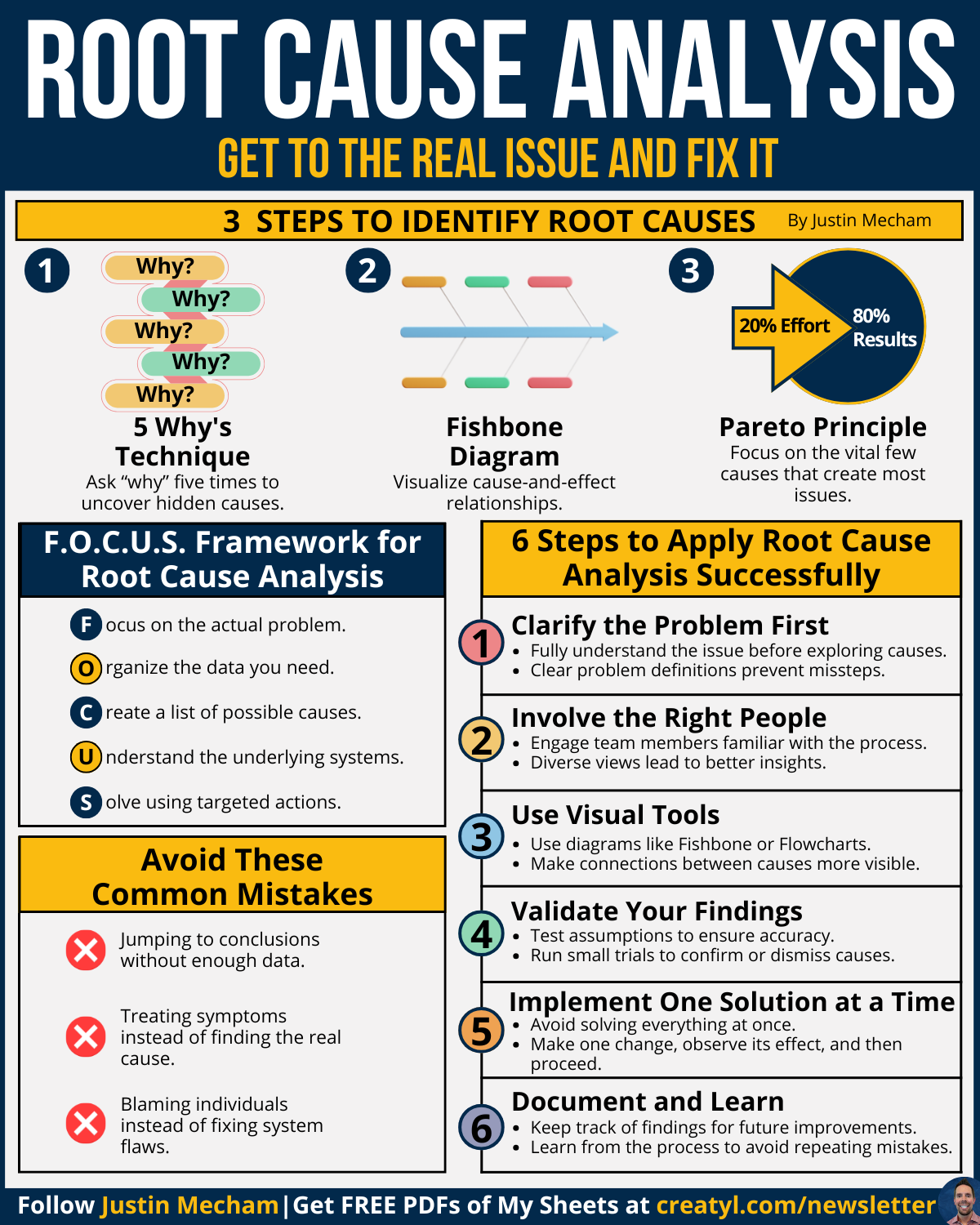
Busy Teams Love Quick Answers. Strong Teams Slow Down and Ask Why.
Most teams are not lazy.
Most teams are not careless.
Most teams are doing their best.
They are moving fast.
They are solving problems all day.
They are jumping from one fire to the next.
And from the outside, it can look like progress.
But then something strange happens.
The same issue comes back.
Again.
And again.
Different fix.
Same result.
A new tool gets added.
A new process gets rolled out.
A new meeting gets scheduled.
And still, the problem keeps showing up
in a slightly different outfit.
This is where most teams get exhausted.
Not because the work is hard.
Because the work is wrong.
Root cause work is not about moving slower.
It is about stopping the wrong work early.
It is the difference between being busy
and being effective.
Why Smart Teams Keep Fixing the Same Problem
Here is the trap.
When something breaks, your brain wants relief fast.
You want the fix that makes the noise stop.
So you patch the surface.
You solve what is loud.
You solve what is urgent.
You solve what is right in front of you.
That is normal.
But most workplace problems are not single problems.
They are systems.
And systems do not break once.
They repeat.
That is why rushing is dangerous.
When you rush to solve,
you usually solve the wrong thing.
The shift is simple:
Stop guessing.
Start asking why.
Not once.
Not twice.
Until the answer stops changing.
That is where the real issue lives.
The Core Skill: Root Cause Thinking
Root cause analysis sounds technical.
But it is deeply human.
It is the practice of saying:
“Let’s not just fix what hurts today.”
“Let’s fix what keeps creating the hurt.”
Strong teams do not have fewer problems.
They just get better at finding
the one cause underneath the noise.
That is why root cause work creates calm.
Fix the cause, and the chaos quiets itself.
Step 1: The 5 Whys (The Fastest Way to Get Honest)
One of the simplest tools is the 5 Whys.
You ask why five times.
Not as a script.
As a way to peel back layers.
Example:
The project missed the deadline.
Why? The handoff was late.
Why was the handoff late?
Because requirements changed midstream.
Why did they change midstream?
Because the customer goal was unclear.
Why was the goal unclear?
Because nobody owned the decision early.
Now you are not fixing deadlines.
You are fixing ownership and clarity.
The first why gives you a symptom.
The fifth why gives you leverage.
That is where change starts.
Step 2: Get It Out of Your Head (Messy Problems Stay Messy Inside)
Here is something I learned the hard way.
If the problem only lives in your head,
it will stay messy.
Because your mind blends everything together.
People. Process. Tools. Systems.
It feels like one big fog.
That is why visual tools matter.
The Fishbone Diagram is powerful
because it forces separation.
You lay causes out side by side:
People
Process
Tools
Systems
Patterns show up when you can see them.
The issue becomes less emotional.
Less personal.
More clear.
That is when real problem-solving begins.
Step 3: The Pareto Filter (Fix the One Cause Doing Most of the Damage)
This is the hard choice.
Do not fix everything.
Fix the one cause doing most of the damage.
Most results come from very few drivers.
The rest is noise.
Strong teams are not the teams
that do the most work.
They are the teams
that choose the right work.
This is what the Pareto Principle teaches.
A small number of causes
create most of the impact.
Root cause work is focus.
Not effort.
The F.O.C.U.S. Framework (A Simple Way to Stay Grounded)
This is the filter I come back to
when everything feels tangled.
Focus on the actual problem
Not the loudest symptom.
Organize the data you need
Facts first. Stories second.
Create a list of possible causes
Do not lock onto the first explanation.
Understand the underlying system
Ask what keeps producing this outcome.
Solve using targeted actions
One clear move. Then observe.
This framework removes drama.
It replaces panic with process.
The 6 Steps to Apply Root Cause Analysis Successfully
Root cause work fails
when teams treat it like theory.
Here is how to make it real.
1. Clarify the problem first
If you cannot define it clearly,
you cannot solve it cleanly.
A fuzzy problem creates fuzzy fixes.
2. Involve the right people
The people closest to the work
often see what leaders miss.
Different views create better insight.
3. Use visual tools
A messy issue becomes clearer
when it is mapped.
4. Validate what you find
Test assumptions.
Run small trials.
Do not guess.
5. Implement one solution at a time
If you change five things at once,
you learn nothing.
One change. One signal.
6. Document and learn
The goal is not one fix.
The goal is fewer repeats.
Avoid These Common Mistakes (Where Teams Lose Trust)
Most root cause efforts fail
because of three habits.
Jumping to conclusions
Speed feels productive.
But speed without clarity is waste.
Treating symptoms instead of causes
If the same issue returns,
you did not solve the problem.
You silenced it.
Blaming individuals instead of fixing systems
Blame kills honesty.
Systems create outcomes.
Fix systems.
That is how strong teams stay healthy.
The Same Problem Kept Coming Back Until We Asked One Better Question
A team brought me in
because they felt stuck in constant rework.
Every week, the same complaint surfaced:
Projects were late.
Customers were frustrated.
The team was tired.
They kept trying new fixes.
More check-ins.
More tracking.
More urgency.
But nothing changed.
Different fixes. Same results.
The pressure started to build.
People began pointing fingers quietly.
One group blamed another.
Leaders felt like they had to push harder.
Meetings got longer.
And the work got heavier.
The team was not failing because of effort.
They were failing because they were solving
the wrong level of the problem.
They were fixing what was visible.
Not what was true.
I slowed the room down
and asked one question:
Why is this happening?
We asked it until the answer stopped changing.
We mapped causes across:
People
Process
Tools
Systems
The pattern was obvious once visible.
The real issue was not speed.
It was unclear ownership at the start.
Work entered the system half-defined,
so everything downstream became rework.
We made one change:
A single decision owner
had to lock scope before execution.
Not five changes.
One.
Within weeks, deadlines stabilized.
Not because the team worked harder.
Because the cause was finally addressed.
Fix the cause, and the chaos quiets itself.
The Ship Rule of Root Cause Work: One Change at a Time
Here is the rule that keeps this practical.
Do not fix everything.
Fix one cause.
Then watch.
If you change ten things at once,
you cannot learn.
Root cause work is not about intensity.
It is about precision.
Clarity Is What Calm Teams Have in Common
Most teams do not need more effort.
They need fewer repeated problems.
The real cost of workplace chaos
is not the issue itself.
It is the cycle.
Fix. Repeat. Fix again. Repeat again.
That cycle drains trust.
Root cause thinking breaks the cycle.
It replaces panic with questions.
It replaces noise with patterns.
It replaces endless motion
with one clear action.
The strongest teams are not the fastest teams.
They are the teams
who know what to stop doing.
When you fix the cause,
work becomes lighter.
People become calmer.
And progress finally sticks.
Download the Infographic (PDF)
If you want to keep this Root Cause Analysis sheet
in front of you as a reference,
the full infographic is available as a PDF.