

Click Here to Download The PDF.
I Stopped Trying To Be Liked At Work.
It Changed Everything.
There was a season in my career where I cared deeply about being liked.
I wanted smooth meetings.
Quick laughs.
Nods of agreement.
Positive feedback.
I avoided tension. I softened my words. I agreed when I wasn’t fully convinced. I told myself I was being collaborative.
But something subtle was happening.
The more I chased approval, the less weight my words carried.
People liked me.
They did not always trust me.
And trust is what moves work forward.
Approval feels good in the moment.
It keeps the room comfortable.
It keeps the mood light.
But respect is different. Respect is slower.
It is built in friction, not ease.
Being nice feels safe.
Being kind takes courage.
Nice protects comfort.
Kind protects values.
And once I saw the difference, I couldn’t unsee it.
If you lead a team, raise kids, build a business, or simply want to grow as a professional, this difference matters more than you think.
Let’s break it down in a way that makes it practical, not just inspirational.
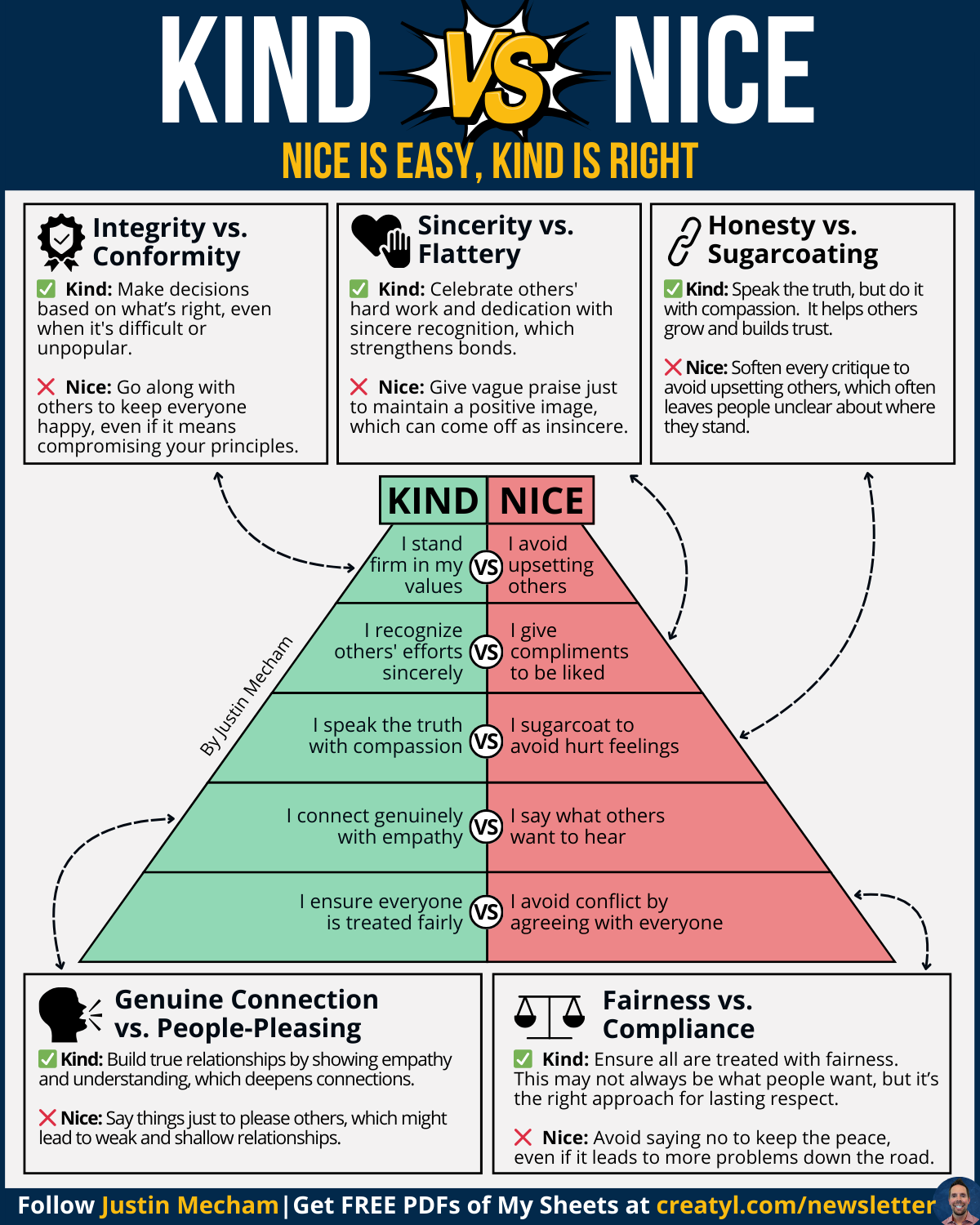
Integrity vs Conformity
Choosing What’s Right Over What’s Comfortable
Kind leadership chooses what is right, even when it costs comfort.
Nice leadership goes along to keep peace, even when it costs integrity.
There is a big difference between harmony and avoidance.
Conformity looks polite. You nod. You agree. You move on. The meeting ends quickly.
Integrity sometimes slows the room down. It asks, “Are we sure this is the best move?” It risks being the dissenting voice.
Teachable Moment:
When you conform to protect the mood, you may be quietly compromising standards. Over time, people notice.
Integrity builds long-term trust because people know you won’t bend your principles for short-term ease.
Action Strategy:
- In your next meeting, if you disagree, say so calmly and clearly.
- Frame disagreement around outcomes, not ego.
- Ask, “What are we not considering here?”
Kindness sometimes means discomfort in the moment to prevent damage later.
Sincerity vs Flattery
Praise That Builds Versus Praise That Soothes
Kind leaders name real effort with care. They highlight specific behaviors and growth.
Nice leaders give easy praise to be liked. “Great job.” “Amazing work.” “Love it.”
Generic praise feels good, but it teaches nothing.
Sincere praise sounds different.
“I appreciate how you handled that client pushback. You stayed calm and clear.”
“You improved your presentation structure this time. It was easier to follow.”
Teachable Moment:
Specific recognition builds capability. Vague praise builds dependency.
Flattery often avoids hard conversations. It keeps relationships smooth but shallow.
Action Strategy:
- Replace generic praise with behavior-based feedback.
- Pair recognition with growth.
- When something needs improvement, say it respectfully instead of hiding it.
Kindness helps people grow. Niceness keeps them comfortable.
Honesty vs Sugarcoating
Truth With Care Changes People
Kind leaders tell the truth with compassion. They believe clarity is a form of respect.
Nice leaders soften truth to avoid tension. They wrap feedback so carefully that the message disappears.
The result?
People leave unsure of where they stand.
Sugarcoating often sounds like this:
“You’re doing great overall. Maybe just tweak a few things.”
Honest kindness sounds like this:
“Your effort is strong. The structure needs work. Let’s fix that together.”
Teachable Moment:
People cannot improve what they cannot see clearly.
When truth is delayed to avoid discomfort, problems grow quietly.
Action Strategy:
- Deliver feedback in private.
- Be specific about what needs to change.
- Offer support alongside critique.
Kindness does not avoid tension. It handles it responsibly.
Genuine Connection vs People-Pleasing
Empathy That Holds Up Under Stress
Kindness builds connection through empathy.
It listens deeply. It understands context. It cares about the person beyond the task.
Nice behavior often says what people want to hear. It smooths conversations. It avoids friction.
But when stress hits, people-pleasing collapses.
Genuine connection is stable because it is rooted in truth.
Teachable Moment:
People trust leaders who are consistent under pressure. If your tone shifts when conflict appears, people feel it.
People-pleasing feels generous, but it often hides fear of disapproval.
Action Strategy:
- Practice active listening without interrupting.
- Repeat back what you heard before responding.
- When you disagree, stay steady instead of retreating.
Kind connection withstands stress. Nice connection dissolves when things get hard.
Fairness vs Compliance
Treating People Right Even When It’s Unpopular
Kind leaders ensure fairness, even when the room disagrees.
Nice leaders avoid conflict by agreeing, even when it harms the work.
Fairness is not about being liked. It is about applying standards consistently.
Compliance can feel easier. It keeps tension low. But it often creates hidden resentment.
Teachable Moment:
Teams respect leaders who apply standards evenly, even when it is inconvenient.
Compliance protects short-term peace. Fairness protects long-term culture.
Action Strategy:
- Apply the same expectations to everyone.
- Address performance gaps early.
- Say no when necessary, even if it disappoints someone.
Kindness sometimes means disappointing someone to protect the team.
A Real Workplace Example
From Approval-Seeking To Trust-Based Leadership
I worked with a team leader who was widely liked.
Their team enjoyed working with them. Meetings were smooth. Feedback was soft. Conflict was rare.
But performance was slipping.
Deadlines were missed. Standards lowered quietly. High performers felt unnoticed. Low performers felt unchallenged.
The leader was confused. “Everyone likes me,” they said.
They were right.
But the team didn’t fully trust their direction.
When mistakes happened, feedback was vague. Underperformance was gently brushed aside.
Disagreements were softened to avoid friction.
High performers felt unsupported because mediocrity went unaddressed. Lower performers lacked clarity on how to improve.
The room was calm.
The work was not strong.
Over time, respect faded. People complied. They did not commit.
We shifted from being nice to being kind.
First, we clarified standards publicly. Everyone knew what good performance looked like.
Second, feedback became specific and direct, but respectful.
Third, credit was distributed clearly and consistently.
Fourth, difficult conversations were handled early, not delayed.
The tone stayed calm. The warmth remained. But the avoidance stopped.
Within months, performance improved. The team felt clearer. High performers felt valued. Lower performers knew exactly how to grow.
The leader was still liked.
But now they were trusted.
Nothing about their personality changed.
Their courage did.
What Made It Work
Small Behavioral Changes That Shifted Culture
- Clear expectations replaced vague encouragement.
- Direct feedback replaced softened hints.
- Fair standards replaced uneven compliance.
- Calm courage replaced conflict avoidance.
These were not dramatic changes.
They were consistent ones.
Trust does not require intensity. It requires integrity.
The Deeper Shift That Matters
Most professionals believe being liked will protect them.
It feels safe.
But safety without trust is fragile.
Trust is built when people know where you stand.
When your words align with your values.
When you choose what is right over what is easy.
Being nice often avoids discomfort.
Being kind manages it.
Nice gets applause in the moment.
Kind earns loyalty over time.
When your team trusts you, they bring their real thoughts.
They take responsibility. They stretch. They improve.
When they only like you, they protect you from tension.
Leadership is not about controlling the room.
It is about strengthening the room.
The Courage To Be Kind
There is a quiet strength in choosing kindness over niceness.
It requires self-awareness. It requires emotional control. It requires the willingness to sit in discomfort without retreating.
But it creates something powerful.
When people walk away from working with you and think, “I feel clearer,” you are leading.
When they think, “I feel respected,” you are leading.
When they think, “I can trust this person to tell me the truth,” you are leading.
Being nice can make you popular.
Being kind makes you reliable.
And reliability builds trust that lasts longer than applause ever will.
If you want influence that holds up under pressure, choose courage over comfort.
Choose clarity over approval.
Choose kindness over niceness.
Because nice gets applause.
Kind earns trust.
Best Resources For This Topic
Book: Radical Candor — Kim Scott
Why It Fits: Explains how to care personally while challenging directly.
Book: The Speed of Trust — Stephen M. R. Covey
Why It Fits: A clear exploration of how trust accelerates performance.
Podcast: Coaching for Leaders — Dave Stachowiak
Why It Fits: Practical conversations around modern leadership challenges.
TED Talk: Dare to Disagree — Margaret Heffernan
Why It Fits: Highlights the importance of constructive conflict.
Tool: 15Five — Founded by David Hassell
Why It Fits: Encourages consistent feedback and clarity within teams.
AI Tool: ChatGPT — OpenAI
Why It Fits: Helps refine feedback language and improve communication clarity.
Download The “Kind vs Nice” Infographic (PDF)
If you want a visual reference of the differences between kind and nice, download the PDF version of the infographic.
Use it as a reminder while practicing one courageous leadership skill at a time.