


Click Here to Download the PDF.
The Thought You Keep Believing (That Is Not True)
Most people trust their thoughts more than they should.
If a thought shows up often, it feels real.
If it feels real, it feels true.
But that is not how your brain works.
Your brain is not a truth machine.
It is a repetition machine.
It gives you more of what it hears most.
So if you repeat doubt, it gives you more doubt.
If you repeat pressure, it gives you more pressure.
And over time, that becomes your default state.
This is why so many people feel stuck.
Not because they lack ability.
Because they are listening to a pattern they trained without realizing it.
Why Your Brain Keeps You Stuck (Even When You Want Change)
Your brain is built to keep things familiar.
Not better. Not smarter. Just familiar.
So if your inner voice says:
“I’m behind.”
“I’m not ready.”
“I always mess this up.”
Your brain does not question it.
It protects it.
It repeats it.
That is why effort alone does not fix it.
You can work harder.
You can push more.
But if the input stays the same, the output stays the same.
Teachable Moment:
You do not change your life by forcing new results.
You change it by changing what your brain repeats.
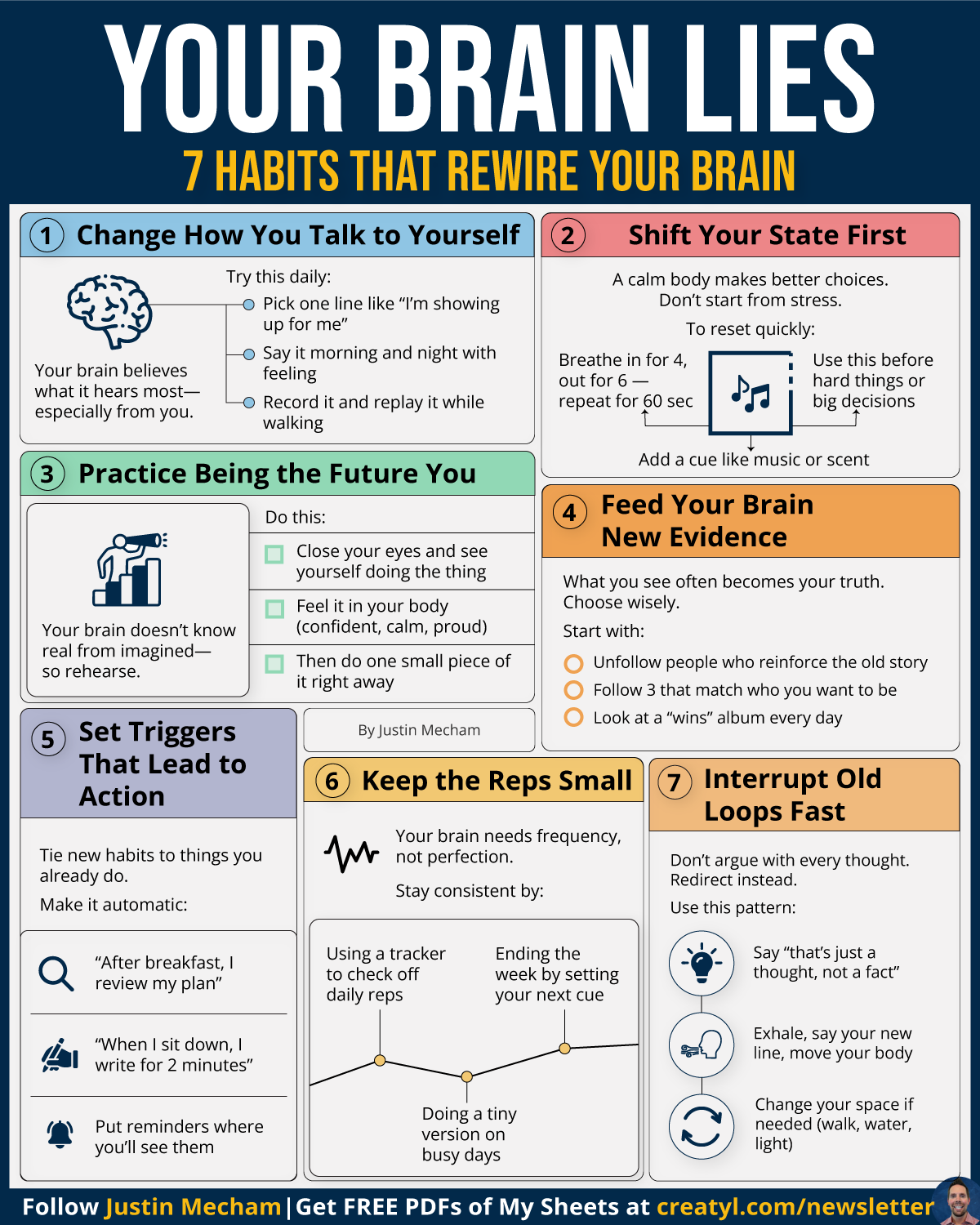
Step 1: Change How You Talk to Yourself (Because Your Brain Is
Listening)
The most powerful voice in your life is your own.
Not your boss.
Not your team.
Not your environment.
Yours.
Most people leave it unchecked.
And it becomes harsh, rushed, and reactive.
The fix is simple, but not easy.
Pick one sentence that supports you.
Not something vague.
Something you can believe and repeat.
Examples:
“I follow through.”
“I can handle this step.”
“I move even when it feels uncomfortable.”
Say it in the morning.
Say it at night.
Record it and play it back while walking or driving.
This is not about motivation.
It is about repetition.
Teachable Moment:
Your brain believes what it hears often, not what is true.
Step 2: Fix Your State Before You Fix Your Decisions
Most bad decisions come from bad states.
Stress.
Rushed thinking.
Tension.
When your body is tight, your thinking narrows.
So before you try to think better, slow your body down.
Try this:
Breathe in for 4 seconds.
Breathe out for 6 seconds.
Repeat for 60 seconds.
Do this before:
Sending a message
Making a decision
Responding in a tough moment
You will notice something shift.
More space.
Less reaction.
Teachable Moment:
Clear thinking does not start in your head.
It starts in your body.
Step 3: Act Like the Future Version of You (Before You Feel Like It)
Most people wait to feel ready.
Confident.
Clear.
Certain.
But those feelings come after action.
Not before.
So instead of waiting, borrow the behavior.
Ask:
“What would the next version of me do right now?”
Then do a small version of that.
Not everything.
Just one piece.
Send the message.
Start the draft.
Take the first step.
Teachable Moment:
You do not become someone new by thinking like them.
You become them by acting like them in small ways.
Step 4: Control What You Feed Your Brain
Your brain builds beliefs from repetition.
So what you see daily matters more than you think.
If your inputs are:
Negative news
Doubt-driven content
People who complain
Your brain learns that pattern.
Instead, choose your inputs.
Unfollow what pulls you down.
Follow people who reflect where you want to go.
Track small wins daily.
Even tiny ones.
This builds evidence.
And evidence changes belief faster than motivation ever will.
Teachable Moment:
Your environment shapes your thinking more than your intentions do.
Step 5: Make Habits Easier to Start
Most people fail at habits because they try to add new effort.
But the easier path is to attach new actions to existing ones.
This is how you make things stick.
After coffee → review your plan
After sitting down → write for 2 minutes
After work → take a short walk
You are not creating something new.
You are linking it to something that already happens.
Teachable Moment:
The best habits do not require more energy.
They require better timing.
Step 6: Keep the Reps Small (So You Actually Stay Consistent)
Big changes feel exciting.
But they rarely last.
Small actions feel almost too simple.
But they repeat.
And repetition is what rewires your brain.
Write for 2 minutes.
Reflect for 60 seconds.
Take one small step.
Even on busy days.
Especially on busy days.
Teachable Moment:
Consistency is built on actions you can repeat when you do not feel like it.
Step 7: Interrupt Old Thought Loops Fast
Old thoughts will show up.
That is normal.
The goal is not to eliminate them.
It is to redirect them.
When a negative thought appears:
Do not argue with it.
Label it.
“That is a thought, not a fact.”
Then shift.
Exhale slowly.
Move your body.
Change your environment.
This breaks the loop.
Teachable Moment:
You do not win by fighting every thought.
You win by choosing what to do next.
A Real Workplace Example
From Self-Doubt to Clear Action in High Pressure Work
A team member was strong in their role but kept second-guessing everything.
They would delay decisions, over-edit their work, and ask for constant reassurance.
It slowed projects and affected team trust.
The issue was not skill.
It was internal dialogue.
Every task came with doubt.
“What if this is wrong?”
“What if I missed something?”
That loop created hesitation.
And hesitation created delays.
The more it happened, the more it reinforced itself.
I worked with them to reset their approach.
We started with one clear sentence they repeated daily.
Then added a simple breathing reset before key decisions.
Next, we defined one small “future version” action per day.
Instead of overthinking everything, they focused on one step.
We also tracked small wins each week.
Not big outcomes.
Just progress.
Within weeks, their pace improved.
Not because they became more skilled.
Because they stopped feeding the doubt loop.
Why Most People Never Break the Loop
Because they try to fix everything at once.
They look for a big shift.
A full reset.
A complete change.
But your brain does not work that way.
It changes through repetition.
Small inputs.
Repeated daily.
That is what creates new patterns.
You Are Not Stuck—You Are Repeating
Most people think they are stuck.
But what is really happening is simpler than that.
They are repeating a pattern.
The same thoughts.
The same reactions.
The same inputs.
Day after day.
And over time, that repetition feels like identity.
It feels like truth.
But it is not fixed.
It is trained.
And anything trained can be changed.
Not in one big moment.
But in small, quiet choices.
The sentence you repeat.
The breath you take before reacting.
The action you choose when it feels easier to wait.
These are the moments that reshape how you think.
And once your thinking shifts, everything else starts to move with it.
Not because life got easier.
But because your mind stopped working against you.
Best Resources To Rewire Thinking and Build Better Mental Patterns
Book: Atomic Habits — James Clear
Why It Fits: Shows how small repeated actions reshape behavior and thinking over time.
Book: Think Again — Adam Grant
Why It Fits: Teaches how to question your own thinking and update beliefs.
Podcast: The Tim Ferriss Show — Tim Ferriss
Why It Fits: Breaks down habits, mental patterns, and performance from top performers.
TED Talk: The Power of Vulnerability — Brené Brown
Why It Fits: Explains how awareness and honesty reshape internal patterns.
Tool: Notion — Ivan Zhao
Why It Fits: Helps track habits, thoughts, and small wins in a simple system.
AI Tool: ChatGPT — OpenAI
Why It Fits: Helps reframe thoughts, write better self-talk, and clarify thinking fast.
Download the “Your Brain Lies” Infographic (PDF)
If you want a simple visual guide to reset your thinking and build better habits, download the infographic as a PDF.
Use it daily as a reminder of what to do when your thoughts start to spiral.