

Click Here to Download the PDF.
The Hardest Career Lesson Most People Learn Too Late
There is a belief that quietly follows many hardworking professionals throughout their careers.
It sounds reasonable.
It sounds fair.
It sounds like something that should be true.
"Just work hard and people will notice."
Unfortunately, that is not how most organizations work.
Across industries, countries, and companies, talented people regularly find themselves watching others move ahead while they stay exactly where they are.
They are smart.
They are dependable.
They consistently deliver.
They solve problems.
They hit deadlines.
They help teammates.
Yet promotion cycles come and go, and someone else gets the opportunity.
The immediate reaction is often frustration.
Sometimes resentment.
Occasionally even disengagement.
The assumption becomes:
"They must be playing politics."
"Management only notices favorites."
"Hard work doesn't matter."
While those situations certainly exist, they are not usually the primary reason.
The real reason is often much simpler.
The promoted employee was visible.
Not louder.
Not more talented.
Not more intelligent.
Visible.
And visibility is one of the most misunderstood career skills in modern work.
The Myth That Hard Work Speaks for Itself
Many people are taught that good work naturally gets recognized.
That belief works reasonably well in school.
You complete the assignment.
The teacher sees it.
You get the grade.
Workplaces are different.
Managers oversee:
- multiple projects
- competing priorities
- changing business goals
- numerous team members
- constant meetings
Even exceptional work can become invisible if nobody understands its impact.
This is not because leaders are careless.
It is because attention is limited.
The reality is uncomfortable but important:
Hard work creates value.
Visibility creates opportunity.
The strongest careers combine both.
Without value, visibility becomes empty self-promotion.
Without visibility, value often stays hidden.
The goal is not choosing one or the other.
The goal is learning how to make meaningful work visible.
Why So Many High Performers Get Overlooked
The irony is that many of the people most likely to be overlooked are also the people doing excellent work.
High performers often believe:
"My results should be enough."
"I don't want to brag."
"I don't want attention."
"I'll let my work speak for itself."
These beliefs usually come from humility.
But humility becomes costly when it prevents people from communicating their contributions.
Being visible is not the same thing as being arrogant.
It is simply making sure the people making decisions understand the value being created.
If leaders cannot see your impact, they cannot reward it.
Mistake #1: Staying Quiet in Meetings
One of the fastest ways to become invisible is remaining silent in important conversations.
Many employees attend meetings like spectators.
They listen.
Take notes.
Nod along.
Then leave.
Their manager may walk away thinking:
"They seem engaged."
But nobody remembers them afterward.
Meetings are not only places where decisions happen.
They are places where visibility happens.
The people who stand out are not always the people who speak the most.
Often they are the people who contribute the most useful thought.
A thoughtful question.
A helpful insight.
A practical solution.
A unique perspective.
One meaningful contribution often creates more impact than ten minutes of unnecessary talking.
Mistake #2: Waiting for Recognition
Many professionals assume managers notice everything.
They do not.
Managers are busy.
Even great managers miss things.
Not because they do not care.
Because they are human.
If you complete a major project, improve a process, solve a customer issue, or create measurable results, communicate it.
This does not require bragging.
It requires clarity.
For example:
Instead of saying:
"The project is done."
Try:
"The project is complete. We reduced turnaround time by 20% and eliminated two recurring customer complaints."
Now the impact becomes visible.
Results become memorable when attached to outcomes.
Mistake #3: Blending Into Every Meeting
Many professionals attend meetings without ever influencing them.
They listen but rarely contribute.
The issue is not a lack of intelligence.
It is often a lack of confidence.
People worry:
"What if my idea is wrong?"
"What if nobody agrees?"
"What if I sound inexperienced?"
Meanwhile, less qualified people share ideas regularly and become associated with leadership potential.
Visibility often comes from participation.
Not perfection.
A useful question can create enormous credibility.
A practical observation can shape an entire discussion.
Influence rarely belongs to the smartest person in the room.
It often belongs to the person willing to contribute.
Mistake #4: Hoarding Knowledge
Some employees believe knowledge equals job security.
So they keep valuable information to themselves.
They become the only person who knows:
- certain processes
- systems
- workflows
- customer relationships
Initially, this can feel powerful.
In reality, it often limits growth.
Organizations promote people who increase the capability of others.
The most valuable professionals do not create dependency.
They create leverage.
They share:
- lessons
- insights
- shortcuts
- best practices
Helping others succeed increases your influence far more than protecting information ever will.
Mistake #5: Avoiding Challenging Work
Comfort is often the enemy of visibility.
Many employees become extremely reliable in familiar work.
But promotions rarely come from doing only what is comfortable.
Growth becomes visible when people step into:
- difficult projects
- cross-functional initiatives
- process improvements
- new responsibilities
These opportunities carry risk.
But they also create exposure.
Leadership teams notice people willing to solve important problems.
Not just complete routine tasks.
Mistake #6: Ignoring Relationships Across the Organization
One of the biggest career mistakes is believing your reputation exists only within your team.
Modern organizations operate through collaboration.
Your opportunities often come from people who:
- know your work
- trust your judgment
- enjoy working with you
That requires relationships.
Not networking in the superficial sense.
Genuine collaboration.
Helping people.
Sharing knowledge.
Supporting projects.
Being someone others want to work with.
Careers often accelerate through relationships long before they accelerate through titles.
Mistake #7: Waiting to Be Asked
Many employees operate reactively.
They wait for assignments.
Wait for direction.
Wait for permission.
Wait for instructions.
Initiative changes everything.
Leaders notice people who:
- identify problems
- suggest improvements
- anticipate needs
- create solutions
Initiative communicates ownership.
Ownership communicates leadership potential.
And leadership potential often determines promotion decisions.
Mistake #8: Bringing Problems Without Solutions
Every workplace has challenges.
Every team encounters obstacles.
Pointing them out is easy.
Offering solutions is harder.
The employees who gain trust are usually the ones who arrive with both.
Instead of:
"This process is broken."
Try:
"This process is creating delays. Here are two possible ways we could improve it."
You do not need perfect answers.
You simply need to demonstrate solution-oriented thinking.
That mindset separates contributors from future leaders.
Mistake #9: Disappearing in Remote Work
Remote work creates tremendous flexibility.
It also creates visibility challenges.
In physical offices, people see:
- your presence
- your effort
- your interactions
Remote environments remove many of those signals.
That means communication becomes even more important.
Employees who excel remotely often:
- provide progress updates
- communicate proactively
- stay engaged in discussions
- participate visibly
Not because they need attention.
Because visibility requires intentional communication.
Silence often gets interpreted as inactivity, even when excellent work is happening behind the scenes.
Mistake #10: Stopping Your Learning Too Soon
One of the quickest ways to become less visible is becoming stagnant.
The workplace changes constantly.
Technology evolves.
Industries shift.
Skills age.
The professionals who continue growing stand out because they bring fresh thinking.
Learning creates:
- confidence
- adaptability
- innovation
- relevance
The most valuable employees never assume they have arrived.
They remain curious.
And curiosity keeps them valuable.
A Real Workplace Example
Marcus was one of the most dependable employees on his team.
He consistently delivered projects on time.
He worked hard.
He stayed late when needed.
His manager trusted him completely.
Yet after four years, he had not received a significant promotion.
Meanwhile, several colleagues moved ahead.
The situation became increasingly frustrating.
Marcus felt overlooked.
He began questioning whether his efforts mattered.
His motivation started slipping because he believed the company simply failed to recognize talent.
The more frustrated he became, the quieter he got.
The quieter he became, the less visible he became.
The cycle continued.
Eventually, Marcus changed his approach.
He began:
- sharing weekly progress updates
- speaking once in every meeting
- volunteering for cross-functional projects
- documenting business impact
- building relationships outside his department
His work quality did not suddenly improve.
It was already excellent.
What changed was visibility.
Within twelve months, leadership viewed him differently.
Not because he became louder.
Because they finally understood the value he had been creating all along.
The Five-Day Visibility Challenge
If you want to become more visible without feeling self-promotional, try this simple challenge.
Day 1
Share one meaningful accomplishment with your manager.
Day 2
Ask one thoughtful question during a meeting.
Day 3
Help someone outside your immediate team.
Day 4
Suggest one improvement to a process.
Day 5
Share a lesson you recently learned.
These actions seem small.
But repeated consistently, they create a reputation.
And reputations create opportunities.
Tools to Help You Increase Your Visibility and Impact
Book Recommendation
The First 90 Days by Michael Watkins
One of the strongest books available on building influence, credibility, and momentum inside organizations.
TED Talk Recommendation
Your Body Language May Shape Who You Are – Amy Cuddy
An insightful discussion on confidence, presence, and showing up effectively in professional environments.
Podcast Recommendation
Coaching for Leaders
Excellent conversations on leadership, communication, influence, and career growth.
Professional Development Tool
LinkedIn Learning
A practical platform for continuously developing skills that improve both competence and visibility.
The Goal Is Not Attention. The Goal Is Impact.
Many people hear the word visibility and immediately think of self-promotion.
That misses the point entirely.
Visibility is not about becoming the loudest person in the room.
It is about ensuring your value is understood.
The best professionals are not remembered because they demanded attention.
They are remembered because they consistently created value and communicated it clearly.
If nobody knows what you contribute, they cannot advocate for you.
If nobody understands your impact, they cannot reward it.
You were hired because your work matters.
Do not let that work remain invisible.
Share your progress.
Contribute your ideas.
Build relationships.
Help others succeed.
Speak up when it matters.
Not because you are chasing recognition.
Because the people making decisions deserve to see the value you bring.
And because your career should not be limited by silence.
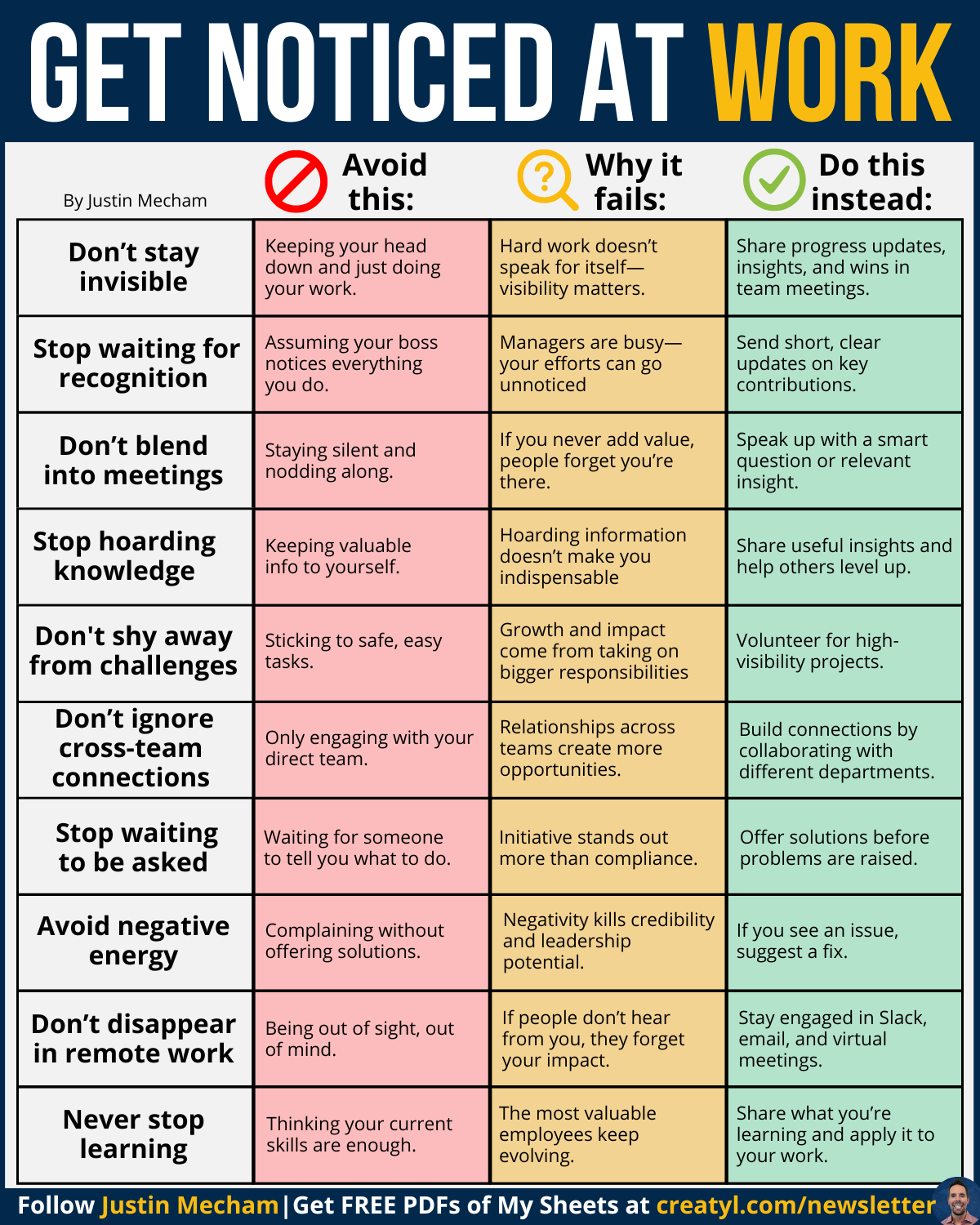
Download the Related Infographic
Want a visual version of these principles?
Download the Get Noticed at Work infographic PDF and use it as a practical guide for increasing your visibility, influence, and career growth.