


Click Here to Download the PDF.
The Career Advice Most People Never Hear
Ask most people what it takes to succeed at work and you'll hear familiar answers.
Work hard.
Stay busy.
Meet deadlines.
Put in extra hours.
Be reliable.
Those things matter.
But after years of working with high performers, managers, leaders, and teams, one pattern becomes impossible to ignore:
The people who create the most value are rarely the people doing the most work.
They are the people making work easier for everyone else.
That sounds simple.
But it changes everything.
Think about the people everyone wants on their team.
The ones who get pulled into important projects.
The ones whose opinions carry weight.
The ones who seem to create opportunities wherever they go.
The ones who continue growing while others remain stuck.
They usually share one defining characteristic.
When they show up, things become clearer.
Problems get solved faster.
Communication improves.
Workflows become smoother.
Collaboration becomes easier.
Stress decreases.
Results improve.
They are not simply completing tasks.
They are improving the system around them.
That is what makes them valuable.
And the good news is that this skill has very little to do with job titles, years of experience, or natural talent.
It can be learned.
It can be practiced.
And it can transform almost any career.
Why Being Busy Is Not the Same as Being Valuable
Many professionals spend years confusing activity with impact.
They answer emails all day.
Attend back-to-back meetings.
Respond to messages instantly.
Keep long task lists.
Work late.
Stay overwhelmed.
Yet despite all that effort, their influence remains limited.
Why?
Because organizations do not reward motion.
They reward outcomes.
Being busy often means reacting.
Being valuable means improving.
The distinction matters.
Imagine two employees.
The first completes fifty tasks every week.
The second identifies one recurring issue that wastes ten hours for the entire team and eliminates it.
Who created more value?
The answer is obvious.
Yet many professionals spend their careers focused entirely on the first approach.
The people who advance learn how to focus on the second.
Habit #1: Spot Problems Before They Become Expensive
One of the fastest ways to become indispensable is developing the ability to identify issues early.
Most organizations spend enormous amounts of time reacting.
A deadline gets missed.
A customer complains.
A process breaks.
A project goes off track.
Then everyone scrambles.
The employee who notices these problems before they become emergencies immediately becomes more valuable.
This requires curiosity.
Instead of asking:
"What am I supposed to do?"
Ask:
"What isn't working right now?"
"What keeps slowing us down?"
"What causes frustration repeatedly?"
"What could become a bigger issue later?"
These questions reveal opportunities that many people overlook.
The best part is that you do not need to solve massive problems.
Small improvements create enormous results over time.
A shorter meeting agenda.
A better document template.
A clearer workflow.
A simpler onboarding process.
Tiny fixes compound.
Organizations are often transformed through hundreds of small improvements rather than one giant breakthrough.
The Hidden Power of Small Wins
Many people wait until they can solve something significant before taking action.
That is a mistake.
Small wins create momentum.
They build credibility.
They create trust.
They demonstrate initiative.
Imagine fixing one small inefficiency every week.
That equals more than fifty improvements in a year.
Very few employees operate with that level of intentionality.
And that is exactly why they stand out.
Habit #2: Make Work Easier for Other People
The most respected professionals rarely ask:
"How can I make my job easier?"
Instead, they ask:
"How can I make everyone's job easier?"
This mindset creates enormous influence.
People naturally gravitate toward individuals who reduce friction.
Consider a few examples:
Instead of repeatedly answering the same questions, create a checklist.
Instead of endless email threads, build a shared document.
Instead of confusing meetings, send an agenda beforehand.
Instead of scattered updates, create one centralized source of truth.
These actions seem small.
But they create leverage.
Every minute you save for ten people becomes ten minutes of value.
Every process you simplify creates recurring benefits.
The most valuable employees often think like system designers.
They improve the environment rather than simply surviving inside it.
Habit #3: Speak Up Clearly
Many talented professionals remain invisible because they assume everyone understands what they mean.
Clarity is one of the most underrated career skills.
When communication becomes vague:
Projects slow down.
Expectations become unclear.
Mistakes increase.
Frustration grows.
Strong professionals communicate with precision.
They ask:
"What does success look like?"
"What outcome are we trying to achieve?"
"What are the priorities?"
"What is expected of me?"
They do not rely on assumptions.
They create clarity.
This skill becomes even more valuable as careers advance.
Leadership is often less about having answers and more about helping people understand where they are going.
Clear communication creates confidence.
And confidence builds trust.
Feedback: The Skill Most People Avoid
Many professionals want feedback.
Few actively seek it.
Even fewer use it immediately.
The highest performers treat feedback differently.
They understand that feedback is information.
Not judgment.
Not criticism.
Not rejection.
Information.
Instead of defending themselves, they become curious.
Instead of explaining why something happened, they ask how to improve it.
Growth accelerates when defensiveness disappears.
The professionals who improve fastest are usually the ones willing to learn publicly.
Habit #4: Learn Faster Than Your Environment Changes
One of the biggest career risks today is standing still.
Industries evolve.
Technology changes.
Customer expectations shift.
New tools emerge.
The people who remain valuable are the people who continue learning.
But there is an important distinction.
Learning alone is not enough.
Application matters.
Many people consume information endlessly.
Books.
Podcasts.
Courses.
Videos.
Yet little changes.
The professionals who stand out learn something and immediately apply it.
Then they teach others.
That final step is powerful.
Teaching reinforces understanding.
Sharing knowledge increases visibility.
Helping others learn creates influence.
Learning becomes exponentially more valuable when it improves the people around you.
Habit #5: Bring New Ideas Consistently
Organizations need fresh thinking.
Yet many employees stop sharing ideas because they fear being wrong.
What if nobody likes it?
What if it fails?
What if it sounds foolish?
The reality is that most great ideas begin as imperfect ideas.
Innovation rarely arrives fully formed.
It evolves through discussion, testing, and refinement.
The employees who contribute ideas consistently become associated with creativity and initiative.
Not every idea succeeds.
That is not the point.
The point is developing the habit of contributing.
Many organizations have no shortage of people identifying problems.
They have a shortage of people suggesting possibilities.
Be one of those people.
Why "Weird" Ideas Matter
Some of the best improvements begin as suggestions nobody initially takes seriously.
An unusual process.
A different workflow.
A new meeting structure.
A fresh approach to customer communication.
Creative thinking often looks strange before it looks obvious.
That is why valuable contributors write down ideas rather than dismissing them.
Curiosity often creates opportunities that logic alone cannot see.
Habit #6: Become a Connector
One of the fastest ways to increase your value is helping other people succeed.
Not through formal authority.
Through connection.
Every organization contains hidden expertise.
Someone knows the answer.
Someone solved the problem before.
Someone has the right experience.
Yet people often struggle to find each other.
Connectors solve that issue.
They introduce people.
Share resources.
Build bridges between departments.
Encourage collaboration.
When you become known as someone who helps people find solutions, your influence expands dramatically.
Opportunities move through relationships.
And relationships often grow through generosity.
The Career Advantage Nobody Measures
Many performance reviews focus on individual output.
But some of the most valuable contributions never appear in metrics.
Helping two teams collaborate.
Connecting a new employee with a mentor.
Introducing people who solve problems together.
Removing communication barriers.
These actions create value that ripples throughout an organization.
The best professionals understand that success is rarely a solo achievement.
Habit #7: Own Outcomes, Not Just Tasks
Perhaps the most powerful habit of all is ownership.
Many employees focus narrowly on their responsibilities.
They complete assigned tasks.
Then move on.
High-value professionals think differently.
They care about the result.
Not just the assignment.
If something goes wrong, they do not immediately look for someone to blame.
They look for solutions.
If expectations are unclear, they seek clarity.
If a project struggles, they step in.
Ownership communicates leadership long before someone receives a leadership title.
People trust individuals who care about outcomes.
And trust creates opportunities.
A Real Workplace Example
Daniel was a skilled analyst at a growing company.
His reports were accurate.
His work was reliable.
His managers respected his technical ability.
Yet year after year, his career moved slowly.
Meanwhile, other colleagues received larger projects, leadership opportunities, and promotions.
Daniel became frustrated.
From his perspective, he was working harder than many of the people moving ahead.
He focused intensely on his assigned tasks and consistently delivered quality work.
But he rarely contributed ideas.
He stayed quiet in meetings.
He seldom collaborated outside his team.
And he viewed problems as management's responsibility.
His performance was strong.
His influence was limited.
Eventually, Daniel changed his approach.
Every week he identified one small process improvement.
He began sharing concise updates about business impact.
He started helping colleagues solve problems outside his immediate responsibilities.
He introduced people who could help each other.
He volunteered for cross-functional initiatives.
Within a year, leaders stopped viewing him as simply an analyst.
They began seeing him as someone who improved the organization.
His technical skills had not changed dramatically.
His value had.
The Seven-Day Value Challenge
If you want to become more valuable immediately, try this challenge.
Day 1
Identify one recurring frustration on your team.
Day 2
Suggest one practical improvement.
Day 3
Send a clear update highlighting progress or impact.
Day 4
Ask for feedback from someone you trust.
Day 5
Learn one new skill for thirty minutes.
Day 6
Introduce two people who could benefit from knowing each other.
Day 7
Reflect on one outcome you improved, not just one task you completed.
Small actions repeated consistently create extraordinary career growth.
Recommended Resources
Book
Give and Take by Adam Grant
A powerful exploration of how helping others creates long-term success and influence.
TED Talk
Everyday Leadership by Drew Dudley
A compelling reminder that leadership often appears in small moments rather than big titles.
Podcast
Coaching for Leaders
Excellent conversations about leadership, communication, influence, and professional growth.
AI Tool
ChatGPT
Use it to brainstorm ideas, improve communication, create systems, summarize learning, and accelerate skill development.
The People We Remember Make Things Better
When people reflect on the most valuable colleague they ever worked with, they rarely describe the busiest person.
They do not usually talk about the person who answered the most emails.
Or attended the most meetings.
Or worked the longest hours.
Instead, they remember someone who made work easier.
Someone who solved problems.
Someone who brought clarity during confusion.
Someone who connected people.
Someone who improved systems.
Someone who cared about outcomes.
Someone who made difficult situations feel manageable.
That kind of value is unforgettable.
The workplace is full of talented people.
Talent matters.
Skill matters.
Experience matters.
But the people who create the greatest impact are often the ones who focus beyond themselves.
They look for ways to improve the environment around them.
They remove friction.
They create momentum.
They help others succeed.
And in doing so, they become the people everyone wants on their team.
If you want to stand out, stop asking how to do more.
Start asking how to make things easier, clearer, and better for the people around you.
Because at the end of the day, the most valuable person in the room is rarely the busiest.
It is the person who makes hard things feel lighter for everyone else.
Download the Infographic
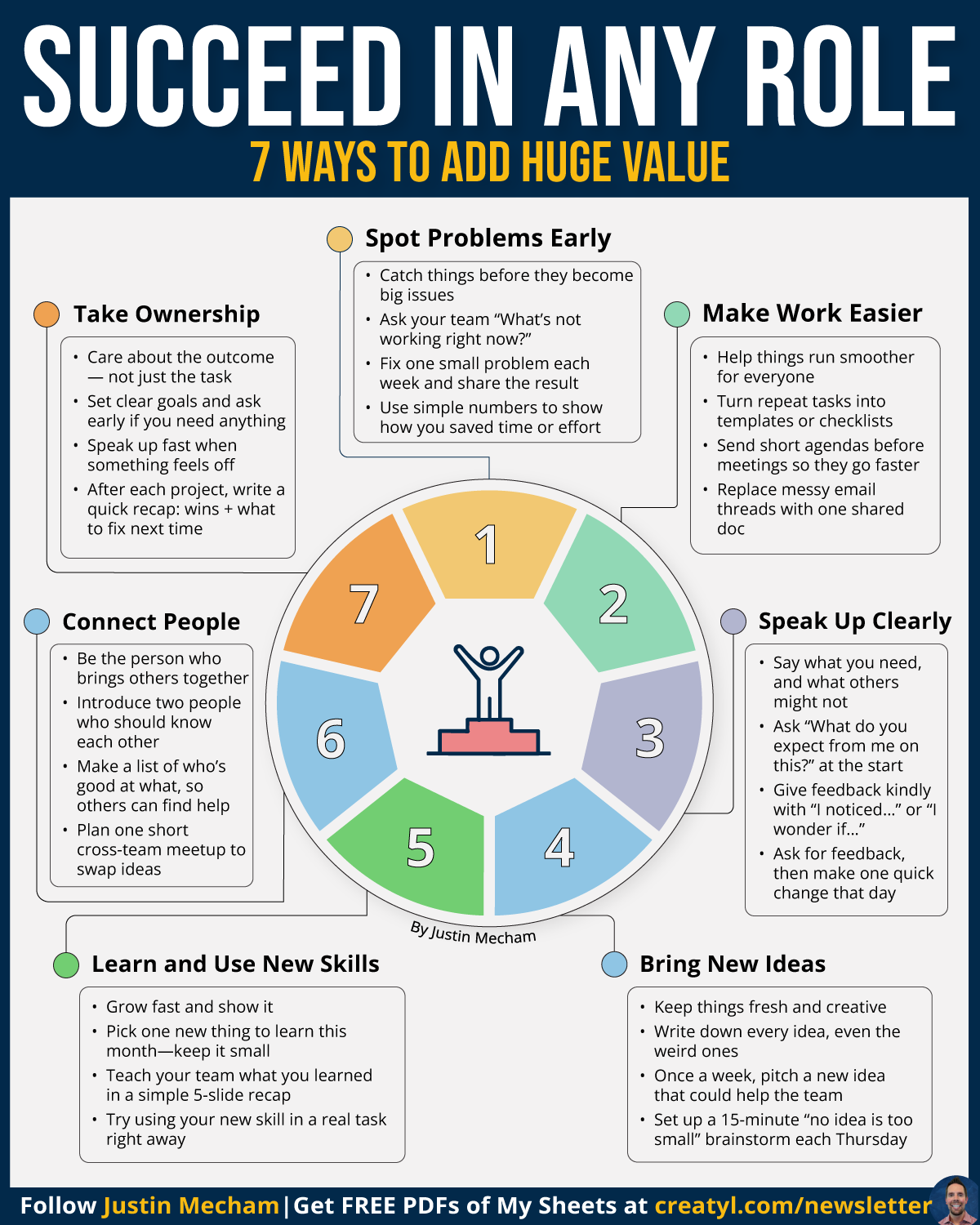
Want a practical visual guide to these seven value-building habits?
Download the Succeed in Any Role: 7 Ways to Add Huge Value infographic PDF and use it as a weekly reminder of the habits that create trust, influence, and long-term career growth.