Click Here to Download the PDF.
Communication Is Not About Talking More
Most people believe communication problems happen because people do not explain enough.
So they add more information.
More context.
More details.
More slides.
More meetings.
More emails.
More messages.
More words.
Yet despite all that communication, misunderstandings continue.
Projects stall.
Teams become frustrated.
Relationships become strained.
People leave meetings with different interpretations of the same conversation.
Managers think expectations were clear.
Employees think expectations were vague.
Partners think they explained themselves.
The other person feels unheard.
Parents believe they communicated a lesson.
Children walk away with a completely different message.
The problem is rarely a lack of communication.
The problem is ineffective communication.
There is a significant difference between speaking and being understood.
One creates noise.
The other creates clarity.
And in a world overflowing with information, clarity has become one of the most valuable leadership skills, relationship skills, and career skills a person can develop.
That is why the 7 Cs of Communication remain one of the most practical frameworks ever created.
Not because they help people sound smarter.
Because they help people become easier to understand.
And when understanding improves, almost everything else improves with it.
Why Communication Breakdowns Cost More Than We Think
Communication problems rarely appear as communication problems.
They disguise themselves as other issues.
A missed deadline.
A frustrated customer.
A disengaged employee.
A team conflict.
A failed project.
A damaged relationship.
A lost opportunity.
An unhappy client.
A poor performance review.
A business that struggles to grow.
Look beneath the surface of many of these situations and a common pattern appears.
Someone assumed.
Someone misunderstood.
Someone interpreted a message differently.
Someone lacked information.
Someone was unclear.
Someone never asked for clarification.
The consequences can be surprisingly expensive.
A poorly written email can delay a project for weeks.
A vague expectation can create months of frustration.
An unclear conversation can damage trust that took years to build.
Communication is not just a soft skill.
It is often the foundation upon which every other skill depends.
The better people communicate, the fewer problems they need to solve later.
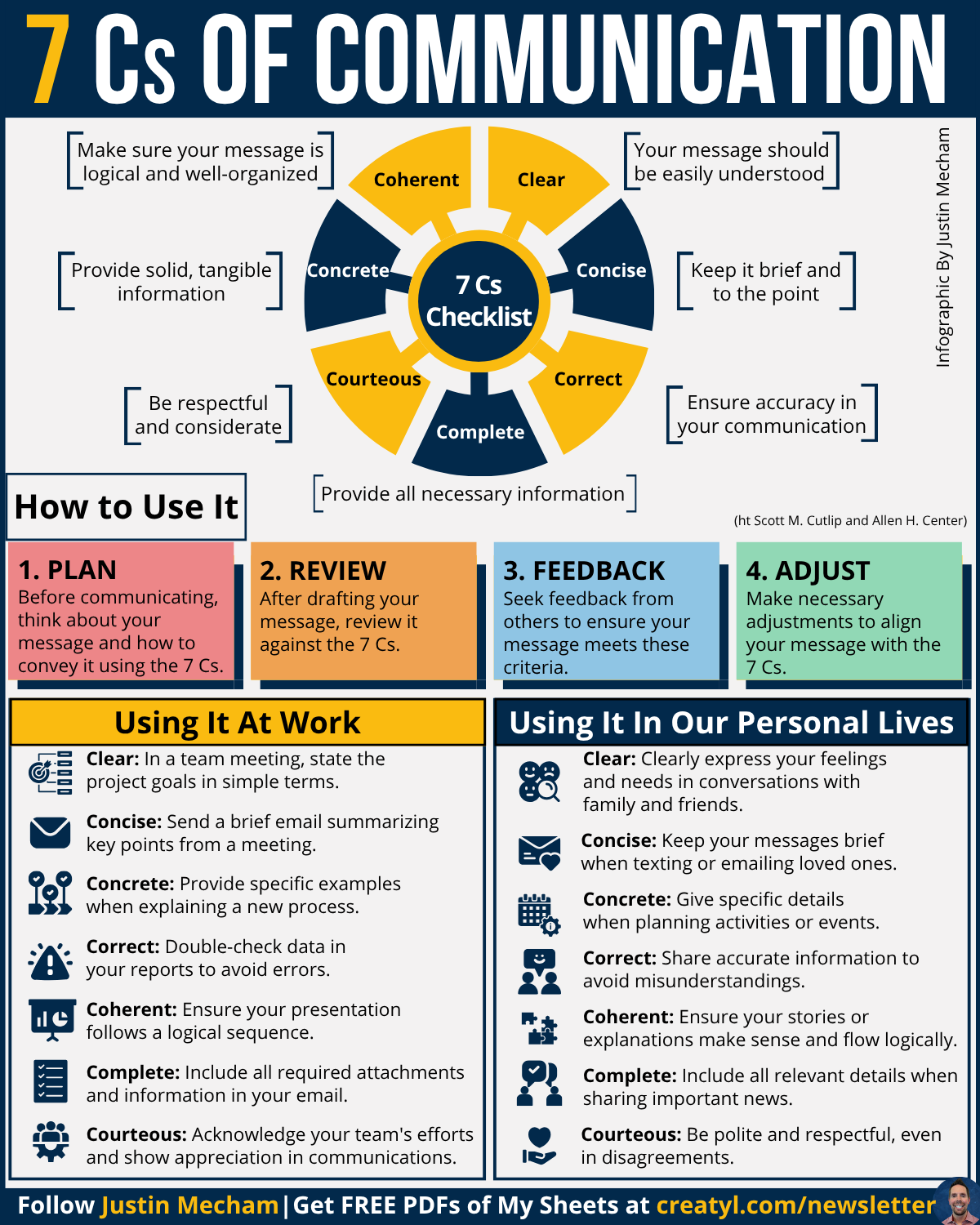
The 7 Cs of Communication Framework
The 7 Cs were developed as a simple way to evaluate whether a message is likely to be effective.
Think of them as filters.
Before sending an email, giving feedback, presenting an idea, leading a meeting, or having a difficult conversation, run your message through each one.
If it passes all seven, understanding becomes far more likely.
Let's explore each one in depth.
1. Clear: Can People Understand It Quickly?
Clarity is the foundation of communication.
Without clarity, everything else becomes irrelevant.
A message that is polite, detailed, and accurate still fails if people cannot understand what it means.
One of the biggest mistakes professionals make is assuming clarity because something makes sense in their own head.
The problem is that people hear messages through the filter of their own experiences, priorities, and assumptions.
What seems obvious to you may be completely unclear to someone else.
Consider these two examples:
Unclear:
"We should improve performance on this initiative moving forward."
Clear:
"Let's reduce customer response times from 24 hours to 8 hours within the next 60 days."
One creates interpretation.
The other creates action.
Clear communication answers questions before people need to ask them.
What exactly needs to happen?
Who is responsible?
What does success look like?
When is it due?
If your audience has to guess, clarity is missing.
2. Concise: Remove the Noise
Many people confuse thoroughness with effectiveness.
They are not the same thing.
Communication becomes stronger when unnecessary information disappears.
Being concise does not mean being short.
It means being intentional.
Every sentence should serve a purpose.
Every paragraph should move the message forward.
Every word should earn its place.
Think about the emails you actually respond to.
Most are probably brief, direct, and easy to scan.
Now think about the emails you avoid.
They are often long, repetitive, and difficult to follow.
People are overwhelmed.
Attention is limited.
Concise communication respects both.
The goal is not saying less.
The goal is saying exactly what needs to be said and nothing more.
3. Correct: Accuracy Builds Credibility
Trust is fragile.
Accuracy protects it.
People often underestimate how quickly credibility can disappear when information is wrong.
One incorrect figure.
One inaccurate statement.
One misleading claim.
One overlooked detail.
Suddenly everything else becomes questionable.
Correct communication requires verification.
Check your facts.
Confirm your numbers.
Review your assumptions.
Ensure dates, names, and details are accurate.
This matters in professional settings.
It matters in leadership.
It matters in relationships.
People trust communicators who demonstrate care with information.
Accuracy communicates respect.
4. Complete: Eliminate Guesswork
Incomplete communication creates confusion.
When important information is missing, people fill the gaps themselves.
And those assumptions are often wrong.
Imagine receiving an email that says:
"Let's discuss this tomorrow."
Questions immediately appear.
What time?
Where?
For how long?
What are we discussing?
Do I need to prepare anything?
A complete message removes uncertainty.
It anticipates questions before they are asked.
Complete communication saves time because it reduces back-and-forth clarification.
People should leave your message with fewer questions, not more.
5. Courteous: Respect Creates Receptiveness
People rarely remember every word of a conversation.
But they often remember how the conversation made them feel.
Courteous communication is not about avoiding difficult messages.
It is about delivering them respectfully.
A leader can give direct feedback while maintaining dignity.
A colleague can disagree without being dismissive.
A parent can correct behavior without damaging confidence.
A partner can express frustration without attacking character.
Courtesy increases the likelihood that people will actually hear the message.
Defensiveness decreases understanding.
Respect increases it.
Communication works best when people feel valued, even during disagreement.
6. Concrete: Make It Real
Abstract communication often creates uncertainty.
Concrete communication creates understanding.
Specific examples help people visualize what you mean.
Compare these examples:
Abstract:
"Customer service needs improvement."
Concrete:
"Customers currently wait an average of three days for a reply. Our goal is to respond within one business day."
The second example creates clarity because it provides tangible information.
Concrete communication includes:
- Examples
- Data
- Stories
- Demonstrations
- Specific observations
The more real the message becomes, the easier it is to understand and act upon.
7. Coherent: Does It Flow Logically?
Even great information loses impact when it feels disorganized.
Coherent communication follows a logical structure.
Ideas connect naturally.
Points build upon one another.
The audience can easily follow the journey.
Think about presentations that lose your attention.
Often the issue is not the content.
It is the flow.
Your brain works harder when information feels scattered.
Coherent communication reduces cognitive effort.
People should never have to work hard to follow your thinking.
When communication flows naturally, understanding follows naturally.
Using the 7 Cs at Work
The workplace is full of communication opportunities.
Every interaction either creates clarity or creates confusion.
Let's explore how the 7 Cs improve professional effectiveness.
Clear Goals
Many projects fail because expectations were never clearly defined.
People cannot achieve targets they do not understand.
Clear goals create alignment.
Concise Emails
Long emails often create delays.
Short, direct emails receive faster responses and reduce misunderstandings.
Concrete Feedback
Specific feedback leads to improvement.
Vague feedback creates frustration.
Instead of saying:
"Your presentation needs work."
Say:
"The recommendations were strong, but adding data to support the conclusions would make them more
persuasive."
Courteous Conversations
Professional respect creates healthier cultures.
People contribute more openly when they feel respected.
Using the 7 Cs in Personal Relationships
Communication is not just a workplace skill.
It shapes every relationship in life.
Clear Conversations
Many conflicts occur because people expect others to read their minds.
Clear communication eliminates unnecessary guessing.
Concise Discussions
Overexplaining often creates more confusion.
Simple honesty creates understanding.
Complete Sharing
When discussing important topics, include the details people need.
Missing information often leads to assumptions.
Courteous Disagreement
Healthy relationships are not built by avoiding disagreement.
They are built by navigating disagreement respectfully.
A Real-Life Workplace Example
Michael managed a talented team that consistently missed deadlines.
Everyone worked hard.
Everyone seemed committed.
Yet projects frequently ran late.
Team members felt frustrated.
Leadership felt disappointed.
Nobody understood why.
After several project reviews, a pattern emerged.
The problem was not effort.
The problem was communication.
Goals were unclear.
Instructions were inconsistent.
Meetings generated discussions but rarely ended with concrete next steps.
Team members interpreted expectations differently.
Everyone believed they were aligned.
They were not.
The resulting confusion created delays, rework, and frustration.
Michael introduced a simple rule.
Every important communication had to pass through the 7 Cs.
Project goals became clearer.
Meetings ended with documented actions.
Feedback became more specific.
Updates became concise.
Within months, project completion rates improved significantly.
Nothing about the team's talent changed.
The communication did.
And that changed everything.
Five Practical Habits to Improve Communication Immediately
1. Pause Before Sending
Review important messages before hitting send.
Ask whether they pass the 7 Cs.
2. Define Success Clearly
Never assume people know what success looks like.
State it explicitly.
3. Use Specific Examples
Examples create understanding faster than explanations.
4. Ask for Feedback
The best communicators actively check whether their message was understood.
5. Simplify Relentlessly
If a message can be simpler without losing meaning, simplify it.
Recommended Resources
Book
Crucial Conversations by Kerry Patterson, Joseph Grenny, Ron McMillan, and Al Switzler
One of the most practical books ever written on navigating difficult conversations with clarity and respect.
TED Talk
How to Speak So That People Want to Listen by Julian Treasure
A powerful presentation on communication habits that increase influence and understanding.
AI Tool
Claude
Excellent for rewriting emails, simplifying complex communication, and improving clarity while maintaining your tone.
Podcast
Think Fast, Talk Smart
Hosted by Stanford Graduate School of Business communication expert Matt Abrahams, this podcast provides practical communication strategies for leadership, presentations, and everyday conversations.
People Rarely Need More Information. They Need More Clarity
Most communication problems are not intelligence problems.
They are clarity problems.
People are not confused because they lack capability.
They are confused because the message was difficult to understand.
The best communicators are not necessarily the smartest people in the room.
They are often the clearest.
They respect people's attention.
They remove unnecessary complexity.
They organize their thoughts.
They provide specifics.
They communicate with care.
And they make understanding feel effortless.
That is why great communication creates influence.
Not because it sounds impressive.
Because it removes friction.
Every conversation, meeting, presentation, email, and message creates a choice.
You can add complexity.
Or you can add clarity.
The people who consistently choose clarity become trusted leaders, respected colleagues, stronger partners, and better problem-solvers.
Because at the end of the day, communication is not about proving how much you know.
It is about helping other people understand what matters.
And when understanding improves, relationships improve.
Teams improve.
Results improve.
Everything improves.
Download the Related Infographic
Want a visual version of the 7 Cs framework to use before your next email, meeting, presentation, or difficult conversation?
Download the 7 Cs of Communication infographic PDF and keep it as a practical communication checklist.