

Click Here to Download the PDF.
The Day “Job Security” Stopped Feeling Secure
For years, I thought a steady paycheck meant I was safe. As long as I worked hard, stayed useful, met expectations, and kept getting paid every two weeks, I assumed I had built something stable.
Then I watched dozens of people lose their jobs in a single day.
They did not suddenly become less talented on Wednesday morning. Their work ethic had not disappeared. Their skills had not stopped being useful. A financial decision had simply been made somewhere above them, and the income they had structured their entire lives around disappeared with it.
The next day, everyone who remained was told to keep doing great work.
That moment changed the way I thought about security.
I realized I had been treating employment as if it were something I controlled. In reality, I controlled my effort, the quality of my work, the skills I developed, and the value I created. I did not control whether the company restructured, whether a budget disappeared, whether leadership changed direction, or whether my role continued to exist.
There is nothing wrong with having a job. A good job can provide stability, friendships, professional growth, meaningful work, benefits, and opportunities that would be difficult to create alone.
The problem is not the paycheck.
The problem is having only one.
When one employer controls one hundred percent of your income, one decision you do not make can change almost everything about your financial life.
That is not a reason to panic.
It is a reason to build options.
The best time to start creating those options is not after the meeting where someone tells you your role is gone. It is while the paycheck is still arriving, the bills are still covered, and you still have the luxury of learning without every experiment needing to succeed immediately.
That is what building your exit really means.
Not quitting tomorrow.
Building enough skill, proof, savings, income, and repeatability that your career no longer has only one door.
Dependence Can Look Exactly Like Security
A reliable salary creates a powerful sense of safety because it makes life predictable.
You know roughly what will hit the bank account.
You know when rent or the mortgage gets paid.
You know what you can spend.
You know what you can save.
Predictability matters.
But predictability and control are not identical.
Your paycheck may be reliable right now while still depending on a company, customer base, industry, leadership team, and budget you do not fully control.
That distinction becomes easier to see when something changes.
A reorganization.
A merger.
A lost client.
A leadership transition.
A new strategy.
A difficult quarter.
A department being centralized.
A role being automated or outsourced.
Suddenly the income you considered secure looks much more conditional.
That does not mean traditional employment is inherently unstable. It means it should not be mistaken for complete financial control.
A stronger version of security is having more than one way to create value.
If your role disappeared tomorrow, could you use your skills somewhere else?
Could you freelance?
Consult?
Teach?
Build a small digital product?
Run a workshop?
Create a paid resource?
Sell a service?
Help a specific person solve a specific problem?
You do not need all of those paths.
You need evidence that at least one exists.
The First Goal Is Not to Replace Your Salary
This is where many people make the process unnecessarily intimidating.
They earn $6,000, $8,000, or $10,000 a month from employment and assume anything they build on the side is meaningless until it produces the same amount.
That mindset makes the starting line feel impossibly far away.
Your first goal is not salary replacement.
Your first goal is proof.
Can someone outside your employer pay you because of something you know how to do?
That first sale may be $25.
It may be $100.
It may be $500.
Financially, it may barely change the month.
Psychologically, it can change something much bigger.
It proves your ability to create value is not confined to one organization.
Before that transaction, independent income is theoretical.
After it, you have evidence.
Then the question changes.
Instead of asking, “Could I ever earn outside my job?” you can ask, “How do I make this happen again?”
That is a much easier problem to work on.
The BUILDING Framework: How to Create an Exit Without Creating Chaos
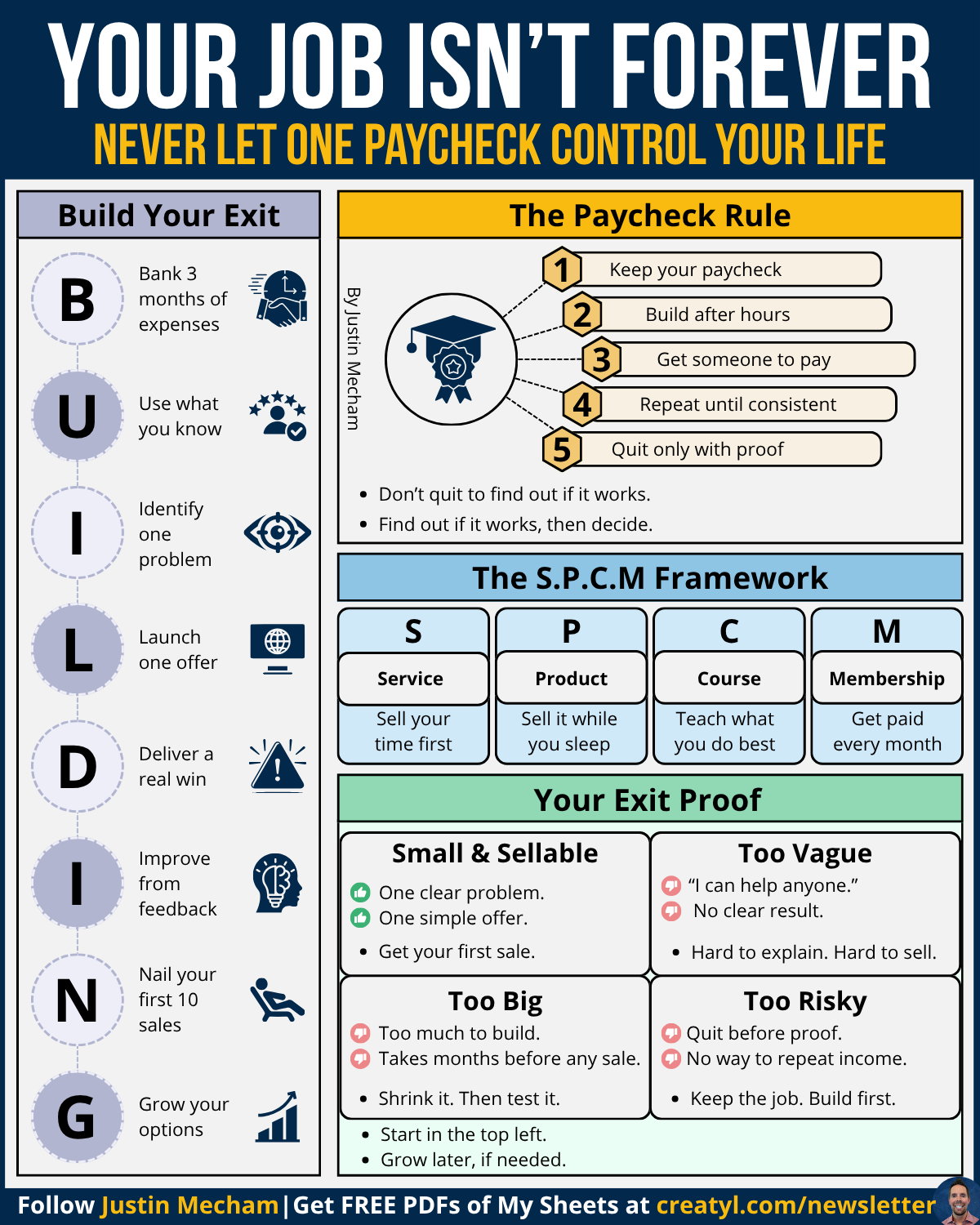
The infographic uses the word BUILDING for a reason.
A good exit is not one dramatic move. It is a sequence.
Each step makes the next one safer.
B: Bank Three Months of Expenses
Before building anything ambitious, understand your financial floor.
How much does your household actually need each month?
Not your salary.
Your needs.
Housing, food, transportation, insurance, debt, utilities, healthcare, family responsibilities, taxes, and essential expenses.
Then start building a buffer.
Three months is a useful starting concept, but the right number is personal. Someone supporting children, carrying large fixed expenses, or working in an unpredictable industry may want considerably more. Someone with lower expenses and another stable household income may need less.
The point is not hitting a magical universal number.
The point is creating room.
Savings change the quality of your decisions.
If you desperately need every customer to say yes, you price differently.
You tolerate worse-fit work.
You accept projects you should decline.
You abandon good ideas too quickly.
Financial room gives you time to learn.
That time is one of the most valuable advantages an early business can have.
U: Use What You Already Know
You do not need to become an entirely different person before you can build something useful.
Start with the skills you already use.
Think about the tasks you perform almost automatically.
What do coworkers ask you to explain?
What process have you improved?
What problems repeatedly land on your desk?
What can you do faster now because you spent years learning it?
What mistake can you help somebody else avoid?
Your first offer does not need to use your most glamorous skill.
It needs to use a useful one.
Maybe you know how to organize messy projects.
Maybe you are excellent at interviews.
Maybe you know how to structure a sales presentation.
Maybe you can simplify AI tools for non-technical professionals.
Maybe you can create strong onboarding systems.
Maybe you can help someone turn raw expertise into clear writing.
One of those skills may already contain the beginning of a product or service.
I: Identify One Problem
Do not package the skill broadly.
Connect it to one painful problem.
“Leadership coaching” is broad.
“Helping first-time managers run better performance conversations” is clearer.
“Marketing” is broad.
“Helping consultants turn LinkedIn profile views into sales conversations” is clearer.
“Operations” is broad.
“Helping small agencies stop projects from getting stuck during client handoffs” is clearer.
Specific problems create specific buyers.
Specific buyers create better conversations.
Better conversations create better offers.
Your first business does not need to solve an industry.
It needs to solve something somebody already wants fixed.
L: Launch One Offer
Avoid building a whole product ecosystem before you have one sale.
Create one offer.
One result.
One buyer.
One price.
One path to purchase.
That offer might be a service, digital product, workshop, short course, template pack, consulting session, coaching package, or membership.
The format comes after the problem.
If the buyer needs hands-on help, start with a service.
If the problem is highly repeatable, a product may work.
If the result requires teaching, a short course or workshop might be appropriate.
If people need ongoing accountability, a membership could eventually fit.
Do not choose the format because it looks exciting online.
Choose it because it helps the buyer reach the result.
D: Deliver a Real Win
Selling matters.
Results matter more.
Your first buyers teach you whether the offer actually works.
Stay close to them.
Where do they get confused?
What do they skip?
What do they use repeatedly?
What question comes up every time?
What gives them the fastest result?
What did they expect before buying?
What did they value afterward?
One customer getting a meaningful outcome is more useful than a hundred people telling you the concept sounds interesting.
Your future marketing will become stronger when it is built around actual outcomes rather than promises you invented alone.
I: Improve From Feedback
The first version is not supposed to be the final version.
It is supposed to teach you.
Use customer feedback to remove unnecessary pieces, clarify confusing instructions, improve delivery, and strengthen the promise.
Do not respond to every individual request by immediately adding features.
Look for patterns.
One request is useful information.
Five buyers asking the same thing is stronger evidence.
Over time, the offer becomes simpler because you learn what people actually need.
That is one of the counterintuitive parts of building well.
Version five may contain less than version one.
It simply contains more of what matters.
N: Nail Your First Ten Sales
One sale proves possibility.
Ten sales begin revealing patterns.
Where did the buyers come from?
What did they have in common?
What message caught their attention?
What objections appeared?
Which buyers got the strongest results?
What did they pay?
What was delivery actually like?
Could you serve another ten without destroying your schedule?
Your first ten customers are incredibly valuable because they transform vague assumptions into usable business information.
Do not rush past this stage.
Study it.
If ten people bought for the same reason and received the same meaningful result, you may be building something worth repeating.
G: Grow Your Options
Once something works, then you can expand.
Maybe your service becomes a product.
Maybe the product leads to a course.
Maybe the course develops into a membership.
Maybe you continue building while remaining employed.
Maybe the side income simply creates a financial buffer.
Maybe you eventually reduce your hours.
Maybe you leave entirely.
The business does not need to force one outcome.
Its first job is to increase your choices.
That is why I think “exit plan” can sometimes be misleading.
You may eventually decide you do not want to exit.
The real goal is to stop being financially trapped into staying.
The Paycheck Rule: Keep the Job While You Test the Future
One of the strongest ideas in this framework is simple:
Do not quit to find out whether something works.
Find out whether it works, then decide.
That reverses the risk.
Step 1: Keep the Paycheck
Your salary covers the learning period.
It pays the bills while you test the offer.
It gives you the ability to hear “no” without panicking.
It gives you time to improve.
This is not a weakness.
It is leverage.
Step 2: Build After Hours
You do not need four hours every night.
An intentional hour can be enough to begin.
But the hour needs a purpose.
Not endless research.
Not scrolling through other people's businesses.
Not changing colors on a logo.
Use the hour to build proof.
Speak with a potential buyer.
Write the offer.
Create the first version.
Follow up.
Deliver.
Collect feedback.
One focused hour repeated five times a week can create more progress than an occasional twelve-hour burst followed by two weeks of exhaustion.
Step 3: Get Someone to Pay
This is where the business leaves your imagination.
A paying customer tells you more than a hundred likes.
Money is not the only form of evidence, but it is a powerful one because it creates a real decision.
Someone is saying the problem matters enough to exchange money for the result.
That is different from someone telling you the idea is cool.
Step 4: Repeat Until the Pattern Becomes Clear
Once is useful.
Repeatability is stronger.
Can you find another buyer?
Then another?
Can you deliver without rebuilding everything each time?
Can the offer generate profit?
Can you explain why people buy?
Can you identify where customers come from?
The goal is not endless side-hustle work.
It is understanding the system well enough that you are no longer relying on luck.
Step 5: Quit Only With Proof
A resignation date should ideally follow evidence, not create it.
Before leaving, you should understand your expenses, savings, real profit, buyer acquisition, workload, taxes, and financial obligations.
You should also know whether you actually enjoy the work you are building.
A profitable business that makes you miserable is not much of an escape.
The S.P.C.M. Framework: Four Ways to Package What You Know
Once you identify the problem, you still need to decide how to sell the solution.
A useful framework is S.P.C.M.:
Service, Product, Course, Membership.
Each model solves a different problem.
Service: Sell Your Time First
Services are often the fastest route to initial revenue because you can begin without building much infrastructure.
You solve the problem directly for the customer.
Consulting, freelancing, audits, implementation, editing, strategy, design, coaching, and done-for-you work all fit here.
Services are especially useful early because customer interaction is high.
You hear objections.
You see the real problem.
You discover what people value.
You understand how they describe the issue.
That customer insight can later become the foundation of scalable products.
The limitation is obvious: your capacity is tied to time.
But that does not make services a bad starting point.
Sometimes the fastest way to learn what product to create later is to solve the problem manually first.
Product: Sell the Solution Repeatedly
A digital product packages something repeatable.
Templates.
Checklists.
Guides.
Swipe files.
Toolkits.
Workbooks.
Systems.
A product allows you to separate delivery from your calendar.
That creates leverage.
But a product works best when the problem and solution are already clear.
Building digital products before understanding buyers can create months of beautiful work nobody purchases.
Validation still comes first.
Course: Teach the Process
A course fits when the customer needs to learn a sequence of ideas or skills to reach the result.
The biggest mistake is assuming a course must be enormous.
It does not.
Teach only what the result requires.
A short course someone completes is more useful than an encyclopedic course people abandon after module two.
Course quality should be measured by movement, not minutes of video.
Membership: Build Ongoing Value
Memberships make sense when the problem does not disappear after one transaction.
Maybe buyers need continued accountability.
Regular updates.
New resources.
Community.
Office hours.
Ongoing coaching.
A membership creates recurring income, but only if the recurring value is real.
Do not force a subscription onto a one-time problem.
Recurring billing requires recurring usefulness.
Your Exit Proof: Small and Sellable Beats Big and Impressive
Your first offer should be small enough to explain quickly and useful enough to buy.
That is the sweet spot.
Small and Sellable
One clear problem.
One clear buyer.
One result.
One simple offer.
A straightforward way to buy.
This creates the fastest learning loop.
Too Vague
“I can help anyone.”
“I help people improve their lives.”
“I help businesses grow.”
The buyer has to do too much interpretation.
If the buyer cannot immediately tell whether the offer is for them, selling becomes harder.
Too Big
A six-month build.
Thirty modules.
A giant platform.
Multiple audiences.
Seven offers.
The longer you build before anyone can buy, the more assumptions accumulate.
Shrink the idea until a real person can respond to it.
Too Risky
Leaving the paycheck before you have customer proof.
Depending on one untested idea.
Having no repeatable way to create income.
You do not get bonus points for making entrepreneurship unnecessarily dangerous.
Keep the job.
Build first.
Here’s An Example: Let’s Imagine…
Imagine Maya, a senior HR professional who has spent nine years helping managers interview candidates and make better hiring decisions.
Her company restructures.
Several people she knows lose their roles.
Maya keeps hers, but the event changes how she thinks.
She realizes almost all her income depends on one employer, even though she has years of expertise that other people regularly ask her about.
She wants another option but has no idea what business to start.
Maya initially thinks about creating a massive course called “Become a Better Hiring Manager.”
She outlines thirty lessons.
Interviewing.
Job descriptions.
Compensation.
Onboarding.
Culture.
Performance.
Legal considerations.
The project immediately becomes overwhelming.
She works on it for three weeks and stops.
The idea is too broad, the customer is unclear, and she has no evidence anyone wants the course.
If she keeps building this way, she could spend six months preparing a product without learning whether buyers care.
Instead, Maya looks at the questions managers repeatedly ask her.
One appears constantly:
“How do I stop getting fooled by polished interviews and actually know whether someone can do the job?”
That is much more specific.
She creates a simple paid hiring interview kit for first-time managers.
It contains structured interview questions, a scorecard, a candidate comparison sheet, and a short guide explaining how to use them.
Before building more, she offers it to people in her network.
Four people buy.
During follow-up conversations, she discovers that managers particularly value the scoring system because it prevents interviews from becoming subjective.
She improves that section.
One buyer asks for help implementing the process with their team, creating a higher-priced service opportunity.
Another recommends the kit to a colleague.
Maya still has her job.
Her salary still pays her bills.
But she has changed her financial position.
Her HR expertise now creates value in two places instead of one.
That is the beginning of optionality.
The One-Hour-After-Work Rule
If you are employed full-time, time is probably your biggest objection.
So keep the system small.
Give yourself one focused hour.
A productive weekly rhythm could look like this:
Monday: Speak with one potential buyer and understand the problem better.
Tuesday: Improve your offer based on what you learned.
Wednesday: Build or refine one piece of the product.
Thursday: Sell. Make direct offers or follow up with interested people.
Friday: Review the numbers and document what worked.
The purpose is not to squeeze an entire second career into every evening.
It is to create enough consistent movement that the business exists outside your imagination.
Three Financial Milestones Before Making a Major Move
Before relying heavily on independent income, pay attention to three stages.
Milestone 1: Proof
Someone pays.
The idea has crossed from theoretical to commercial.
Milestone 2: Repeatability
Multiple people pay for the same or similar result.
You begin seeing a pattern.
Milestone 3: Stability
Revenue becomes consistent enough that you can estimate what happens next month with reasonable confidence.
That does not mean perfect certainty.
It means the business no longer resets to zero every thirty days.
Do not confuse the three stages.
A great launch is not automatically stable income.
A profitable month is not automatically a durable business.
Build the evidence in layers.
Create a Personal Risk Dashboard
Every month, track the factors affecting your dependence on one paycheck.
You might include:
Monthly essential expenses.
Cash savings.
Months of runway.
Side-business revenue.
Side-business profit.
Number of customers.
Repeat customers.
Largest customer's percentage of revenue.
Number of qualified leads.
Sales conversion.
Hours spent delivering.
Customer outcomes.
These numbers turn anxiety into something you can actually manage.
Instead of vaguely thinking, “I hope I would be okay if something happened,” you can see where you are strong and where you remain exposed.
Do Not Replace One Dependency With Another
This matters more as the side business grows.
If you leave one employer but depend entirely on one customer, you have not created much diversification.
If all sales depend on one social platform, understand that risk.
If every customer requires you personally to work ten hours, understand that limitation.
If the business collapses whenever you take a week off, there is still work to do.
The goal is not simply changing who pays you.
It is gradually creating more control over how income is generated.
That takes time.
And that is fine.
Your Job Can Become the Investor in Your Future
One of the most useful mindset shifts is viewing your current job as the thing financing your independence.
The paycheck covers your life while you learn.
It can fund your savings.
It can pay for business software.
It can give you room to test ideas.
It can allow you to reject poor-fit customers.
It can make experimentation much less stressful.
That does not mean staying forever.
It means extracting value from the current season instead of only resenting it.
You can dislike aspects of a role and still use the income strategically.
Suddenly, the job becomes part of the exit plan.
That feels very different from feeling trapped by it.
Questions to Ask Before You Ever Consider Leaving
Before making a major career decision, ask yourself:
What are my essential monthly expenses?
How much runway do I have?
How much profit does the business actually generate?
Have several unrelated people paid?
Are customers getting real results?
Do I know how to reach additional buyers?
Can I explain why people buy?
Do I have more than one customer?
Could I survive a slow quarter?
Have I planned for taxes, insurance, retirement, and business expenses?
Is the workload sustainable?
Would I still want this business if my current job became dramatically better tomorrow?
That last question helps distinguish building toward something from simply running away from something.
Both emotions can exist at once.
But the business should eventually have a reason to exist beyond your frustration with employment.
Recommended Resources
Book: The Mom Test by Rob Fitzpatrick
A practical guide for having useful customer conversations before you build. It is particularly good at showing why people often receive encouraging feedback that does not translate into purchases.
Book: Company of One by Paul Jarvis
Useful for anyone who wants to build a profitable business without automatically assuming success requires endless growth, employees, overhead, and complexity.
Book: The $100 Startup by Chris Guillebeau
A collection of examples showing how people used existing skills and relatively small investments to create independent sources of income.
Podcast: The Side Hustle Show with Nick Loper
A useful source of real examples from people building businesses alongside regular jobs. Hearing how small many of these businesses started can make the first step feel much more practical.
Practical Tool: Your Second-Income Tracker
Create a simple document with these fields:
Skill: What can I do?
Problem: What does it solve?
Buyer: Who needs it?
Offer: What will I sell?
Price: What will I charge?
Proof: Who has paid?
Result: What happened for them?
Next Move: What will I test next?
Review it every Sunday.
Your goal is not making the spreadsheet impressive.
Your goal is making the evidence stronger.
The Goal Is Not to Fear Your Job Less. It Is to Need It Less.
There is a subtle change that happens once you create another source of value.
At first, your job feels like the thing holding everything together.
You need the paycheck.
You need the benefits.
You need someone else to keep choosing you.
That dependency affects more decisions than we like to admit.
You hesitate to challenge something that feels wrong.
You tolerate situations longer.
You worry more about organizational politics.
You attach too much of your identity to a manager's opinion.
You fear changes you cannot control.
Then you make your first dollar somewhere else.
Nothing dramatic happens externally.
You still go to work Monday.
The mortgage still exists.
Your salary still matters.
But internally, the structure has changed.
You have evidence that value can move in another direction.
Then you repeat it.
You improve the offer.
You help another customer.
You save the money.
You create a process.
You start seeing patterns.
A second source becomes less theoretical.
The fear does not disappear overnight.
It gradually loses leverage.
And eventually, something important happens.
You realize you are no longer asking:
“What would happen to me if this job disappeared?”
You are asking:
“Which option makes the most sense for me now?”
That is a very different life.
Maybe you choose to stay.
Maybe you negotiate differently.
Maybe you pursue another role.
Maybe you build your business further.
Maybe you eventually leave.
The specific decision matters less than possessing the ability to make it.
Your job can be a good option.
It should not have to be your only option.
Because no company, manager, budget committee, or quarterly forecast should permanently determine whether your skills are allowed to create value.
Your employer can pay you for your abilities.
It does not own them.
So use the paycheck.
Learn.
Save.
Experiment.
Build.
Get the first customer.
Then the next one.
Create enough proof that if one door closes unexpectedly, you already know another one exists.
That is what real career security looks like.
Not believing nothing will ever change.
Knowing that when it does, you have somewhere else to go.
Download the Related Infographic
Want the entire framework as a practical visual guide?
Download the Your Job Isn’t Forever: Never Let One Paycheck Control Your Life infographic PDF. It walks through the full BUILDING process, the five-step Paycheck Rule, four ways to package your knowledge through services, products, courses, or memberships, and the proof you should create before making a major career move.
Use it as a working reference while you identify your first skill, test your offer, create your first independent sale, and gradually build another source of income while your current paycheck is still doing its job.