

Click Here to Download the PDF.
For two years, I kept searching for the perfect side hustle.
I would come home from work, open my laptop, and type the same questions into Google.
What are the best side hustles?
How can I make money online?
What business can I start without much money?
What can I sell with the skills I already have?
I would find articles with 25 ideas, 50 ideas, sometimes 100 or more.
And I would read every single one.
The frustrating part?
I already knew how to do many of the things on those lists.
I could create content. I knew how to organize information, build systems, and simplify complicated processes. I had experience solving problems that other people struggled with.
But every time I found something I could actually do, my brain immediately found a reason not to try it.
Someone else was already doing it.
It seemed too simple.
I didn't have enough followers.
I wasn't an expert.
Why would anyone pay me for something they could probably learn online?
So I kept researching.
And researching.
And researching.
For two years, I confused looking for an opportunity with actually creating one.
Then something happened that made me question the entire way I had been approaching it.
People started asking how I created my infographics.
One person asked.
Then another.
Then another.
I had spent years searching for a business idea while people were practically handing me one.
So I packaged what I knew into a simple PDF.
I started sharing it on social media.
I charged $25.
People bought it.
Then more people bought it.
Eventually, that one PDF was generating more than $7,000 per month.
That experience taught me something I wish I had understood much earlier.
The best side hustle is often not something you need to discover. It's something you already know how to do but have never considered selling.
And once you understand that, the process of starting a business becomes much less intimidating.
1. Why Most People Never Start a Side Hustle
The biggest obstacle to starting a side hustle isn't always money.
It isn't necessarily time.
And it is rarely a shortage of ideas.
For many people, the real obstacle is that they cannot recognize the commercial value of their own experience.
Think about something you do well.
Maybe you can organize complicated projects.
Maybe you write excellent emails.
Maybe you know how to make professional presentations.
Maybe you help friends prepare for interviews.
Maybe you can take a messy spreadsheet and turn it into something useful.
You probably don't consider these abilities extraordinary.
Why?
Because they're familiar to you.
You've repeated them so many times that they no longer feel difficult.
But familiarity is not the same as lack of value.
A task that takes you fifteen minutes might take another person three hours.
A mistake you learned to avoid years ago might cost someone else hundreds of dollars.
A template you created once might save another person an entire weekend.
People don't pay because something is difficult for you. They pay because it makes something easier for them.
That distinction is the foundation of a good side hustle.
The Familiarity Trap
We tend to underestimate the value of things we know well.
A graphic designer assumes everyone can make a decent presentation.
A project manager assumes everyone knows how to organize a workflow.
An experienced salesperson assumes everyone knows how to handle objections.
A teacher assumes everyone can explain complicated concepts clearly.
But those assumptions are often wrong.
What feels ordinary to one person can be a valuable shortcut for another.
The challenge is learning to see your experience from the buyer's perspective.
Instead of asking:
"What am I exceptionally talented at?"
Ask:
"What can I make easier for someone else?"
That is a much more useful business question.
Try This Exercise
Write down five things you can do comfortably that other people regularly struggle with.
For each one, answer:
- Who struggles with this?
- Why is it difficult for them?
- What happens if they don't solve it?
- How long would it take me to help them?
- Could I package the solution into something repeatable?
Don't worry about whether the answers sound impressive.
You're looking for useful problems, not impressive job titles.
2. Stop Looking for Ideas. Start Looking for Problems.
An idea is not automatically a business opportunity.
Consider these two statements.
Idea: I want to sell digital planners.
Problem: Freelancers struggle to track deadlines, client payments, and unfinished projects in one place.
The second statement is more valuable because it identifies a real situation someone wants to improve.
Now the product has a purpose.
You could create a spreadsheet, a Notion template, a printable planner, a short course, or a consulting service.
The format is secondary.
The problem comes first.
This is where many beginners make their first expensive mistake.
They fall in love with a product before understanding whether anyone needs it.
They spend weeks creating something.
They build a website.
They design a logo.
They write descriptions.
They launch.
And nothing happens.
Not necessarily because the product is bad.
Because they never established whether the problem mattered enough for someone to pay.
The Three-Question Problem Test
Before choosing a side hustle, ask yourself three questions.
Question 1: Who has this problem?
Be specific.
"People who want to be more productive" is too broad.
"Freelance designers who struggle to manage multiple client deadlines" is much clearer.
Question 2: How are they solving it today?
Are they using spreadsheets?
Hiring freelancers?
Buying courses?
Searching for tutorials?
Complaining in online communities?
Existing workarounds and purchases are useful clues about demand.
Question 3: What does the problem cost them?
Think beyond money.
Does it waste time?
Create stress?
Cause mistakes?
Delay important work?
Make them lose opportunities?
The more clearly you understand the consequences, the easier it becomes to design something genuinely useful.
A Realistic Example
Imagine someone wants to sell resume templates.
That is a product idea.
But a more useful opportunity might be helping experienced professionals explain a career change when applying for jobs in a new industry.
Now you have a specific customer, a recognizable problem, and a result people can understand.
The clearer the problem, the easier it becomes to create an offer.
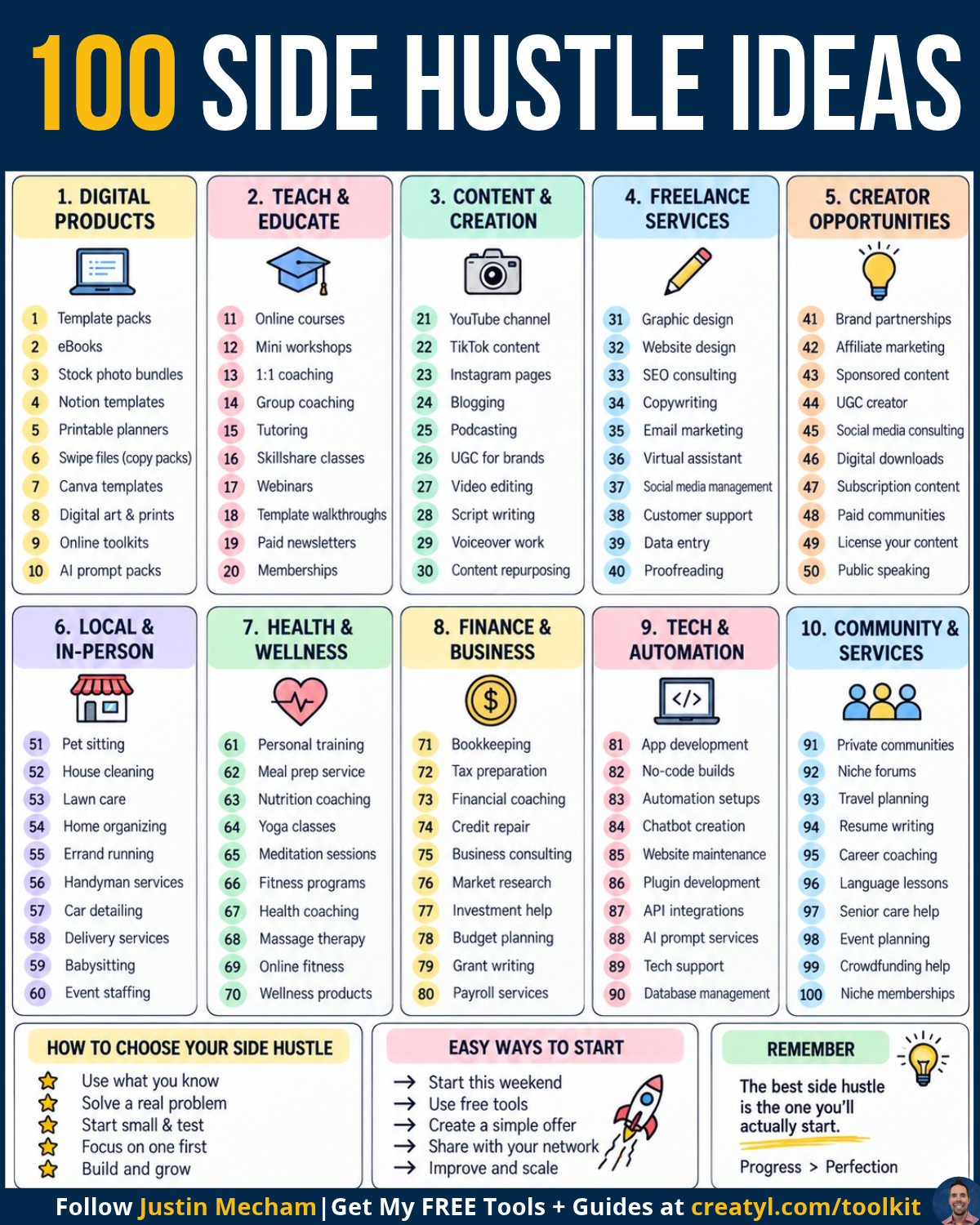
3. The 100 Side Hustle Ideas: Ten Categories Worth Exploring
The infographic accompanying this article includes 100 possibilities organized into ten categories.
You don't need to try all of them.
The purpose of the list is to help you recognize opportunities hiding inside skills you may already possess.
Category 1: Digital Products
Digital products can be especially attractive because you can create a resource once and sell copies without
manually delivering every order.
Ten ideas to consider:
- Template packs
- eBooks
- Stock photo bundles
- Notion templates
- Printable planners
- Swipe files and copy packs
- Canva templates
- Digital art and prints
- Online toolkits
- AI prompt packs
Imagine you've spent years working in human resources.
You might already have a structured onboarding checklist that helps new employees understand their responsibilities.
That knowledge could become a digital onboarding toolkit for small-business owners.
The customer isn't paying for a PDF.
They're paying to avoid starting from a blank page.
The lesson: The value of a digital product isn't measured by its file size. It's measured by the useful outcome it helps someone achieve.
Category 2: Teaching and Education
If you know how to do something other people want to learn, you may be able to teach it.
Ten ideas:
- Online courses
- Mini-workshops
- One-on-one coaching
- Group coaching
- Tutoring
- Skillshare classes
- Webinars
- Template walkthroughs
- Paid newsletters
- Memberships
But don't assume you need to create a twenty-hour course.
A focused workshop that solves one problem can be more useful than an enormous program covering everything.
For example, instead of creating a course called "Learn Excel," offer a workshop called "Build Your First Monthly Business Dashboard in 90 Minutes."
One is a broad subject.
The other promises a specific result.
People can understand what they'll receive before buying.
The lesson: The narrower your first teaching offer, the easier it is to explain, deliver, and improve.
Category 3: Content Creation
Content creation isn't limited to becoming an influencer.
You can help other people create better content.
Ten possibilities:
- YouTube channels
- TikTok content
- Instagram pages
- Blogging
- Podcasting
- User-generated content for brands
- Video editing
- Scriptwriting
- Voiceover work
- Content repurposing
For example, a professional who knows how to turn complicated information into clear visuals might offer infographic design or educational content packages.
Someone who understands short-form video might help businesses turn long interviews into useful clips.
You don't need millions of followers to offer a valuable service.
You need to demonstrate that you can produce something a customer needs.
The lesson: You can make money helping other people create content before building a large audience of your own.
Category 4: Freelance Services
Freelancing is often one of the quickest ways to test whether a skill has market value.
Ten possibilities:
- Graphic design
- Website design
- SEO consulting
- Copywriting
- Email marketing
- Virtual assistance
- Social media management
- Customer support
- Data entry
- Proofreading
Unlike a digital product, a freelance service can often be sold before you create a standardized system.
That makes it useful for gathering customer feedback.
You discover what buyers request, which problems repeat, and what they're willing to pay.
Those discoveries can eventually become templates, guides, courses, or other products.
The lesson: Sometimes the best way to discover what digital product to create is to solve the problem manually for a few customers first.
Category 5: Creator Opportunities
These opportunities often become easier when you have an audience or a recognizable area of expertise.
Ten ideas:
- Brand partnerships
- Affiliate marketing
- Sponsored content
- UGC creation
- Social media consulting
- Digital downloads
- Subscription content
- Paid communities
- Licensing content
- Public speaking
A large following isn't the only path.
A small audience with a specific problem can be commercially useful.
Someone with 800 highly relevant followers may have a clearer business opportunity than someone with 50,000 followers who have no particular reason to buy.
Attention is useful.
Relevant trust is more useful.
The lesson: Don't build an audience just to collect followers. Build relationships with people who care about a problem you understand.
Category 6: Local and In-Person Services
Not every side hustle needs a website or digital product.
Ten possibilities:
- Pet sitting
- House cleaning
- Lawn care
- Home organizing
- Errand running
- Handyman services
- Car detailing
- Delivery services
- Babysitting
- Event staffing
These businesses can be easier to explain because the result is tangible.
The customer needs a task completed.
You complete it.
You get paid.
Some services require insurance, licensing, equipment, or local regulatory compliance, so investigate those requirements before accepting work.
The lesson: A business doesn't need to be innovative to be valuable. Reliability can be a competitive advantage.
Category 7: Health and Wellness
This category includes opportunities for people with relevant experience and, where required, professional qualifications.
Ten ideas:
- Personal training
- Meal preparation services
- Nutrition coaching
- Yoga classes
- Meditation sessions
- Fitness programs
- Health coaching
- Massage therapy
- Online fitness
- Wellness products
Medical advice, nutrition treatment, therapy, and certain fitness or wellness services may require professional qualifications or licenses.
Choose work that fits your actual competence and applicable regulations.
For example, a qualified fitness instructor might create a beginner workout planner or offer supervised sessions.
The lesson: Build around what you can responsibly deliver. Customer safety and trust are more important than a quick sale.
Category 8: Finance and Business
People and companies regularly pay for help managing complicated financial and operational tasks.
Ten ideas:
- Bookkeeping
- Tax preparation
- Financial coaching
- Credit repair
- Business consulting
- Market research
- Investment consulting
- Budget planning
- Grant writing
- Payroll services
Some financial services, including investment advice, tax preparation, and credit-related services, may be regulated.
Make sure you have any required qualifications or authorizations.
For someone with relevant expertise, this category can contain highly practical opportunities.
A small business might not need a complicated financial transformation.
It might simply need someone to organize its invoices, improve its expense tracking, or explain its monthly numbers.
The lesson: Helping people understand and manage important information can be valuable even when the solution looks simple.
Category 9: Technology and Automation
Technology creates opportunities to solve repetitive problems.
Ten ideas:
- App development
- No-code builds
- Automation setups
- Chatbot creation
- Website maintenance
- Plugin development
- API integrations
- AI prompt services
- Tech support
- Database management
One particularly useful starting point is repetitive work.
If a business spends hours each week manually moving information between systems, a simple automation may save substantial time.
You don't need to build a revolutionary app.
Sometimes a reliable solution to an ordinary workflow problem is enough.
The lesson: Look for work people repeat unnecessarily. Repetition often reveals an opportunity to save time.
Category 10: Community and Personal Services
This category focuses on helping people navigate specific situations.
Ten possibilities:
- Private communities
- Niche forums
- Travel planning
- Resume writing
- Career coaching
- Language lessons
- Senior care assistance
- Event planning
- Crowdfunding support
- Niche memberships
A career professional, for example, could help candidates prepare for interviews in a particular industry.
A language teacher could create a short program for professionals preparing for international meetings.
A community organizer could build a paid membership around a specific shared interest.
The lesson: People often pay for guidance, accountability, convenience, or access to a useful community, not just information.
4. How to Choose One Side Hustle From 100 Possibilities
A list of 100 ideas is useful for inspiration.
It can also become another excuse to avoid starting.
If you keep evaluating every possible opportunity, you never gather evidence about any of them.
Here's a simple system.
Choose five ideas that genuinely match your experience.
Then rate each one from 1 to 5 across five factors.
Factor 1: Skill Fit
Can I deliver something useful with what I know today?
Factor 2: Demand
Can I identify people who already need this?
Factor 3: Access
Can I reach potential buyers without a large budget?
Factor 4: Speed
Can I test the offer within seven days?
Factor 5: Sustainability
Would I be willing to deliver this repeatedly?
Add your scores.
The maximum is 25.
A high score doesn't prove an idea will succeed.
It simply helps you prioritize which idea deserves a real test.
Example
Imagine you're considering three opportunities.
A general productivity course might be interesting, but it could take weeks to build and the audience is broad.
A custom project-planning service could be offered this week using skills you already have.
A project tracker template might be quick to create, but you'd still need to verify that buyers want that particular format.
The service may be the best first test.
Not necessarily the best long-term business.
The best first test.
That distinction matters.
Your initial side hustle doesn't have to be your final business model.
It has to teach you something useful.
5. Find the Skill People Already Trust You With
This is the exercise I would give anyone who says they have nothing to sell.
Take a piece of paper and answer these questions.
Question 1: What do people repeatedly ask me for help with?
Look at your work conversations, personal messages, and recurring requests.
Do people ask you to review presentations?
Explain technology?
Organize projects?
Prepare for interviews?
Help with writing?
Repeated requests are clues.
Question 2: What have I figured out through experience?
Think about difficult processes, expensive mistakes, and practical lessons.
You may know how to avoid a problem that someone else is about to encounter for the first time.
Question 3: What have I built to make my own life easier?
Templates, spreadsheets, checklists, scripts, workflows, and planning systems all count.
Something you created for yourself may be useful to someone facing the same problem.
Question 4: What can I explain more clearly than most beginners?
Teaching is often the ability to make complicated things understandable.
You don't need to know everything about a subject to explain a specific process effectively.
Question 5: What problem could I help someone solve in seven days?
Short, achievable results make excellent first offers.
People often find it easier to commit to a small, specific outcome than an enormous transformation.
The Repeated-Question Rule
When people keep asking you the same question, pay attention.
A repeated question may indicate:
- A confusing process.
- An unmet educational need.
- A task people want to complete faster.
- A mistake people want to avoid.
- A result people cannot achieve alone.
Don't immediately assume every repeated question represents a profitable opportunity.
But investigate it.
Sometimes the earliest signal of demand is something you've been answering for free for years.
6. Turn Your Skill Into an Offer Someone Understands
One of the biggest mistakes new entrepreneurs make is selling a skill instead of a result.
Consider these statements.
"I do graphic design."
"I help small businesses turn complicated information into clear, professional presentations."
The second tells a potential buyer much more.
It identifies the customer and the improvement.
Try this framework:
I help [specific person] achieve [specific result] by [your method].
For example:
"I help new managers run better one-on-one meetings using a simple weekly conversation system."
Or:
"I help freelancers organize client deadlines and payments with one ready-to-use tracker."
Or:
"I help job seekers turn their experience into stronger interview answers."
A strong offer answers four questions.
- Who is it for?
- What problem does it solve?
- What will the buyer receive?
- What should improve after using it?
If you cannot answer those questions, your idea probably needs more definition.
The One-Sentence Test
Explain your offer to someone who knows nothing about your industry.
If they need five minutes of additional explanation just to understand what you're selling, simplify it.
A clear offer makes it easier for buyers to recognize whether it's relevant to them.
7. Why Starting With a Small Product Is Often Smarter
Many people make their first business unnecessarily complicated.
They want a website.
A course.
An email funnel.
A membership.
A community.
A content strategy.
Multiple products.
And a complete brand identity.
Before they've made a single sale.
Start smaller.
One useful PDF.
One checklist.
One spreadsheet.
One workshop.
One service package.
One template bundle.
The advantage isn't merely that small products are easier to create.
They're easier to test.
You can discover whether customers understand the promise, value the result, and use what they buy.
Example: A $25 Digital Product
Suppose you have experience creating professional LinkedIn infographics.
People regularly ask how you design them.
Instead of building an enormous design course, you create a practical starter kit.
It includes:
- Five reusable layouts.
- A guide to organizing information visually.
- A checklist for improving readability.
- Examples of weak and strong headlines.
- A simple workflow for producing a finished graphic.
You price it at $25.
Now you can test the offer.
If ten people buy, you've generated $250 in gross sales before expenses and taxes.
More importantly, you have ten buyers who can tell you what they liked, what confused them, and what they still need.
That feedback may be worth more than the first revenue.
Because it can show you what to build next.
8. The Mathematics of a Simple Digital Product
A digital product doesn't need an enormous price to generate meaningful revenue.
But it does need enough buyers.
Consider a product priced at $25.
If you sell 10 copies, you generate $250.
If you sell 25 copies, you generate $625.
If you sell 50 copies, you generate $1,250.
If you sell 100 copies, you generate $2,500.
If you sell 200 copies, you generate $5,000.
If you sell 280 copies, you generate $7,000.
These figures represent gross revenue, not profit.
Platform fees, refunds, marketing expenses, taxes, and other costs must still be considered.
And none of these sales volumes is guaranteed.
But the math helps explain why a simple product can become meaningful over time.
It also exposes the real challenge.
Creating a $25 PDF isn't the hard part.
Finding enough people who want it is.
That requires understanding demand, earning trust, making an offer, and delivering a product worth recommending.
The opportunity is real.
So is the work.
Reverse-Engineer Your Income Goal
Instead of asking how much money you could theoretically make, work backward from a realistic target.
Let's say your first goal is $500 per month.
At $25 per product, you need 20 sales.
Now ask:
How many qualified people would need to see the offer?
How many typically buy?
How will you reach those people?
What will it cost to acquire them?
How much profit remains?
This turns a vague financial dream into a business question you can test.
9. Sell Before You Spend Months Building
You don't need to finish a large product before learning whether anyone wants it.
Start by describing the offer.
Share the problem.
Explain the result.
Ask people whether they'd be interested.
Better yet, invite qualified buyers to purchase a clearly described early version, with honest delivery dates and refund terms.
You can also test demand through a paid workshop or small service.
A Seven-Day Validation Experiment
Day 1: Choose one audience and one problem.
Be specific about who you want to help and what they're struggling with.
Day 2: Speak with three people who experience that problem.
Ask how they currently handle it, what they've tried, and what makes it frustrating.
Day 3: Write a clear offer.
Describe the result, format, price, and delivery.
Day 4: Create a simple sales page or offer message.
Keep it focused on the buyer's problem and the result.
Day 5: Share the offer with relevant potential buyers.
Reach out respectfully and make the next step clear.
Day 6: Follow up and record objections.
Pay attention to what people don't understand or don't believe.
Day 7: Review what happened.
Did people understand the offer?
Did they recognize the problem?
Did anyone ask about pricing?
Did anyone buy?
What objections appeared repeatedly?
If nobody buys, don't immediately conclude that you have no valuable skills.
Investigate whether you reached the right audience, described the right problem, established enough trust, and offered an appropriate result.
The first test is information.
Not a final judgment on your potential.
10. Your Customers Can Tell You What to Build Next
One of the most useful habits in business is writing down customer language.
Not what you wish people would say.
What they actually say.
Imagine you're selling a time-management template.
You describe it as:
"An advanced productivity optimization system."
But customers keep saying:
"I just want to stop forgetting things."
That second sentence may be a much better marketing message.
People recognize their own problems faster than they recognize your technical description.
Create a Customer Language Document
Every time someone asks a question, makes a complaint, or describes a frustration, write it down.
For example:
Customer statement: "I keep missing follow-ups."
Underlying problem: No reliable reminder system.
Possible improvement: Add a follow-up tracker.
Another example:
Customer statement: "I never know what to do first."
Underlying problem: Unclear priorities.
Possible improvement: Add a daily priority section.
Another:
Customer statement: "This takes too long to set up."
Underlying problem: Too much initial work.
Possible improvement: Add a five-minute setup guide.
Over time, customer feedback can help you improve the product, explain it more clearly, and decide which features are worth adding.
The important rule is simple.
Don't build features just because you can. Build improvements that solve problems customers actually experience.
11. Why You Don't Need a Huge Audience to Start
A large audience can help you reach more potential buyers.
But you don't need thousands of followers to make your first sale.
You need access to people who have the problem you solve.
That might come from:
- Former colleagues.
- Professional communities.
- Local business networks.
- Relevant online groups.
- Existing social media connections.
- Referrals.
- Direct conversations.
An audience becomes more valuable when it's connected to a clear problem.
Imagine two creators.
One has 20,000 followers who enjoy general motivational content.
Another has 600 followers who are freelance designers struggling to manage client projects.
If the second creator sells a well-designed client-management template, their smaller audience may be more relevant.
The lesson isn't that audience size never matters.
It's that relevance and trust matter alongside reach.
The First 20 People Exercise
Identify twenty people or businesses that fit your target audience.
Don't begin by trying to sell to everyone.
Instead, understand their situation.
What are they struggling with?
What have they already tried?
What would make the problem easier?
You may discover that your original offer needs adjustment.
That's useful information.
Twenty meaningful conversations can teach you more about your first offer than months of guessing.
12. Use Content to Demonstrate Your Value
When I started sharing my infographics, I was showing people how I understood and organized information.
That content did more than attract attention.
It demonstrated a skill.
People could see the result before deciding whether they wanted to learn the process.
That's an important distinction.
Content doesn't always need to entertain.
It can provide evidence.
If you sell resume-writing help, share examples of stronger bullet points.
If you sell spreadsheet templates, demonstrate how a confusing workflow becomes easier.
If you teach public speaking, explain how to improve a weak opening.
If you offer marketing services, break down a real campaign and explain what made it effective.
The Four-Part Content Framework
Step 1: Show the problem.
Describe something your audience recognizes.
Step 2: Explain the method.
Teach one practical way to approach it.
Step 3: Demonstrate the result.
Show an example, improvement, or finished outcome.
Step 4: Invite the next step.
Explain how someone can get additional help.
You don't need to give away everything.
You need to give people enough value to understand what you know and how you can help.
13. Build One Simple Sales Page
Your first offer doesn't need a complicated website.
One page can be enough.
The page should answer five questions.
Who Is This For?
Name the person or situation clearly.
For example:
"For freelance designers who struggle to track client deadlines."
What Problem Does It Solve?
Describe the frustration in language the buyer recognizes.
For example:
"Stop losing track of revisions, payments, and delivery dates across multiple projects."
What Result Will They Get?
Be specific without promising outcomes you cannot reasonably guarantee.
For example:
"Organize your active projects, deadlines, and payments in one reusable tracker."
What Is Included?
List the product, service, templates, lessons, or deliverables.
How Do They Buy?
Make the next step obvious.
You can use a platform such as creatyl to package a guide, template, workshop, course, or other digital offer and make it available for purchase.
But remember that the platform isn't the business.
The business is the problem you solve, the customer you serve, and the result you deliver.
The software simply helps you operate it.
14. Start With One Offer, Not Ten
This may be the most important discipline for someone who loves new ideas.
Don't build ten products because you have ten skills.
Choose one.
Test it.
Improve it.
Sell it again.
The temptation to keep starting something new usually appears when the current idea becomes uncomfortable.
The first sale takes longer than expected.
A customer asks a difficult question.
A post gets little attention.
Someone says the price is too high.
Suddenly a new idea looks exciting.
But constantly changing direction prevents you from learning whether your original offer could work.
Give an idea a reasonable testing period with clear measures.
Track conversations, sales, delivery results, and feedback.
Then make a decision based on evidence.
Sometimes the right decision is to change the offer.
Sometimes it's to change the audience.
Sometimes it's to improve the message.
And sometimes it's to continue doing what is already working.
The people who make progress aren't necessarily the people with the most ideas. They're often the people who give one promising idea enough attention to learn what works.
15. How to Turn a Side Hustle Into Something Repeatable
A side hustle becomes more useful when it stops depending on reinventing everything for each customer.
Suppose you begin by helping clients create better presentations.
At first, every project is custom.
You spend time asking questions, reviewing material, designing slides, and making revisions.
After several projects, you notice the same needs appear repeatedly.
Clients struggle with structure.
Their headlines are unclear.
Their slides contain too much text.
They don't know how to present data.
Now you have an opportunity to build a repeatable process.
You might create:
- A client questionnaire.
- A presentation outline.
- Reusable slide templates.
- A checklist for reviewing clarity.
- A guide to presenting numbers.
Eventually, some of those resources may become standalone digital products.
You've moved from selling only your time to also selling a repeatable solution.
That doesn't guarantee passive income.
Products still require customer acquisition, support, maintenance, and updates.
But a repeatable process can make growth less dependent on performing every task from scratch.
The Repeatability Test
Ask yourself:
Can I explain the delivery process in five steps?
Can I create templates for recurring tasks?
Can someone else follow the instructions?
Can I deliver a consistent result?
What requires my personal attention, and what doesn't?
The answers help you identify where systems can make the business more manageable.
16. The Five Numbers Worth Tracking
You don't need a complicated analytics dashboard.
At the beginning, five numbers can tell you a great deal.
1. Buyer Conversations
How many relevant people have you spoken with?
This reveals whether you're reaching the market.
2. Offers Made
How many people have actually been invited to buy?
This matters because useful conversations don't automatically become sales.
3. Sales
How many purchases have occurred?
Sales provide stronger evidence of demand than compliments alone.
4. Profit
How much remains after relevant expenses?
Revenue is useful, but profit determines whether the business is financially worthwhile.
5. Customer Results
Are buyers receiving the value you promised?
Satisfied customers can help you improve the offer and earn referrals.
Each metric answers a different question.
Don't confuse views, likes, or comments with these outcomes.
Attention can support a business.
It doesn't automatically make one.
A Simple Weekly Review
Every Sunday, spend fifteen minutes answering:
What generated the most useful conversations?
What resulted in sales?
What confused potential buyers?
What did customers appreciate?
What should I stop doing?
What should I repeat next week?
A short review can prevent months of repeating activities that produce little value.
17. Five Mistakes That Keep People Researching Instead of Earning
Mistake 1: Waiting Until You Feel Like an Expert
You don't need to know everything about a subject.
You do need to be competent enough to deliver the result you promise.
A person who is three steps ahead of a beginner may be able to teach those first three steps effectively.
Be honest about the limits of your knowledge.
Mistake 2: Copying a Popular Idea Without Understanding the Buyer
An idea that works for someone else may not work for you.
Your experience, audience, resources, and ability to reach buyers are different.
Use successful products as evidence that a category exists, not proof that your particular offer will sell.
Mistake 3: Spending Money Before Testing Demand
Expensive branding, subscriptions, equipment, and advertising can wait.
Start with the least costly credible way to test the offer.
Mistake 4: Confusing Posting With Selling
Content can create awareness.
But eventually you must make a clear offer.
Tell people what you sell, who it helps, and how they can buy.
Mistake 5: Quitting Too Early
A first sale is exciting.
It isn't automatically a replacement for a stable paycheck.
Build savings, understand business expenses, test repeatability, and evaluate your financial responsibilities before making major employment decisions.
A side hustle should create more options, not force you into unnecessary financial pressure.
18. A 30-Day Plan to Start Your First Side Hustle
Here's how I would approach the first month if I were starting again with one skill and limited time.
Week 1: Find Your Opportunity
List ten things people ask you to help with.
Identify five problems you understand well.
Choose three ideas that could be tested quickly.
Speak with potential buyers.
Select one specific problem.
Your goal: One clearly defined audience and problem.
Week 2: Create Your Offer
Write the promised result.
Choose a simple format.
Decide what is included.
Set a starting price.
Create a basic sales page or offer message.
Your goal: One offer that someone can understand and purchase.
Week 3: Put It in Front of People
Reach out to relevant potential buyers.
Share useful content related to the problem.
Explain the offer.
Ask for the sale.
Record objections and questions.
Your goal: Real market feedback and, ideally, initial paid demand.
Week 4: Deliver, Learn, and Improve
Deliver what was promised to any buyers.
Ask what worked.
Identify what was confusing.
Improve the product or service.
Review sales and costs.
Decide what to repeat next month.
Your goal: A better offer and a clearer understanding of demand.
At the end of thirty days, you may not have a large business.
But you should have something more valuable than another saved list of side hustle ideas.
You should have evidence.
19. What I Would Do Differently If I Were Starting Today
I would stop researching after finding three realistic ideas.
I wouldn't spend months choosing a business name.
I wouldn't buy expensive software before making a sale.
I wouldn't create a large course.
I wouldn't try to build an audience on five platforms simultaneously.
I would start with the question people already ask me.
Then I would find out whether the answer solves a problem someone considers worth paying to fix.
I would package the smallest useful version.
I would show it to potential buyers.
I would charge a clear price.
I would learn from what happened.
And I would repeat the process.
The goal wouldn't be building a perfect business in thirty days.
It would be replacing assumptions with evidence.
Because the first time someone pays you for something you created, you learn something that research alone cannot teach.
Your knowledge has value beyond the role someone hired you to perform.
20. Recommended Books and Resources
If you want to go deeper, these resources can help you develop the skills behind a sustainable side hustle.
The Mom Test by Rob Fitzpatrick
A practical guide to customer conversations.
Particularly useful for learning the difference between polite encouragement and meaningful evidence of demand.
Show Your Work! by Austin Kleon
Helpful for people who feel uncomfortable sharing their knowledge publicly.
It explores how documenting your process can help others discover your work.
Company of One by Paul Jarvis
A useful reminder that a successful business doesn't necessarily need employees, complicated systems, or constant expansion.
The $100 Startup by Chris Guillebeau
Explores small businesses built around practical skills, customer needs, and relatively modest initial resources.
The Lean Startup by Eric Ries
Useful for understanding how to test assumptions, gather feedback, and improve an offer without investing everything in an unproven idea.
Frequently Asked Questions
What Is the Best Side Hustle for Beginners?
The best starting point is often a service or small digital product based on a skill you already have and a problem you can verify people want solved.
It depends on your experience, available time, resources, and access to potential buyers.
Can I Start a Side Hustle Without Money?
Some service-based businesses and simple digital products can be tested with little upfront spending.
However, costs such as equipment, internet access, software, registration, taxes, or insurance may still apply.
Do I Need a Website?
Not necessarily.
A simple offer page, marketplace listing, or direct sales conversation may be sufficient to test early demand.
What if Someone Else Already Sells the Same Thing?
Existing competitors can be evidence that customers buy solutions in that category.
Your task is to find a specific audience, problem, or approach you can serve effectively.
Competition alone doesn't prove your offer will succeed.
What if I Don't Have an Audience?
Start with direct conversations, relevant communities, referrals, and useful content.
Focus on reaching the right people rather than accumulating followers without a clear purpose.
Should I Start With a Service or Digital Product?
A service can be useful for learning directly from customers and earning early revenue.
A digital product can be useful when the same solution can be packaged and delivered repeatedly.
Some businesses begin with services and later turn repeated processes into products.
How Long Does It Take to Make Money From a Side Hustle?
There is no reliable universal timeline.
Some people secure a customer quickly; others need weeks or months to identify a viable offer.
Focus on controllable actions and meaningful market evidence rather than guaranteed income deadlines.
Can a Side Hustle Replace My Salary?
It's possible, but not guaranteed.
Replacing employment income requires sufficient and sustainable profit, not simply a few sales or a strong revenue month.
Account for taxes, expenses, savings, benefits, and income variability.
How Do I Know Whether My Idea Is Worth Pursuing?
Look for repeated customer problems, existing spending, paid purchases, successful delivery, and evidence that you can acquire additional customers without unsustainable effort or cost.
The Skill You Keep Dismissing Might Be the One Someone Needs Most
For two years, I thought the answer was hiding somewhere in another article.
Another list.
Another video.
Another business idea I hadn't discovered yet.
But the opportunity was much closer than I realized.
It was in the questions people kept asking.
The processes I had learned.
The mistakes I had already made.
The things I could explain without opening a textbook.
The work I considered ordinary.
And that's what I want you to understand.
You don't need to be the most talented person in your industry to create something valuable.
You need to recognize a problem you can solve, find people who experience it, and offer a result they consider worth paying for.
Your first product may be small.
Your first customer may pay $25.
Your first attempt may not work.
None of that makes the effort meaningless.
Because the purpose of starting isn't to prove that you already know how to build a successful business.
It's to begin learning how.
And there is one question worth asking before you spend another evening searching for ideas:
What have people thanked you for that you've never considered charging for?
Start there.
Not because every skill can automatically become a profitable business.
But because that's where you already have something many beginners spend months trying to find.
Experience.
A problem you understand.
And a possible reason for someone to trust you.
The best side hustle isn't necessarily the one with the highest advertised earning potential.
It's the one you can test, deliver, improve, and keep building.
You don't need another hundred ideas.
You need to give one good idea a real chance.
Download the Free 100 Side Hustle Ideas Infographic
If you're struggling to identify what you could sell, start with the infographic that inspired this article.
It includes 100 possibilities across digital products, education, content creation, freelance services, creator opportunities, local businesses, wellness, finance, technology, and community services.
Use it as a brainstorming tool, not another list to scroll through and forget.
Choose three ideas that match your experience.
Identify the problem each could solve.
Then test one.