Click Here to Download the PDF
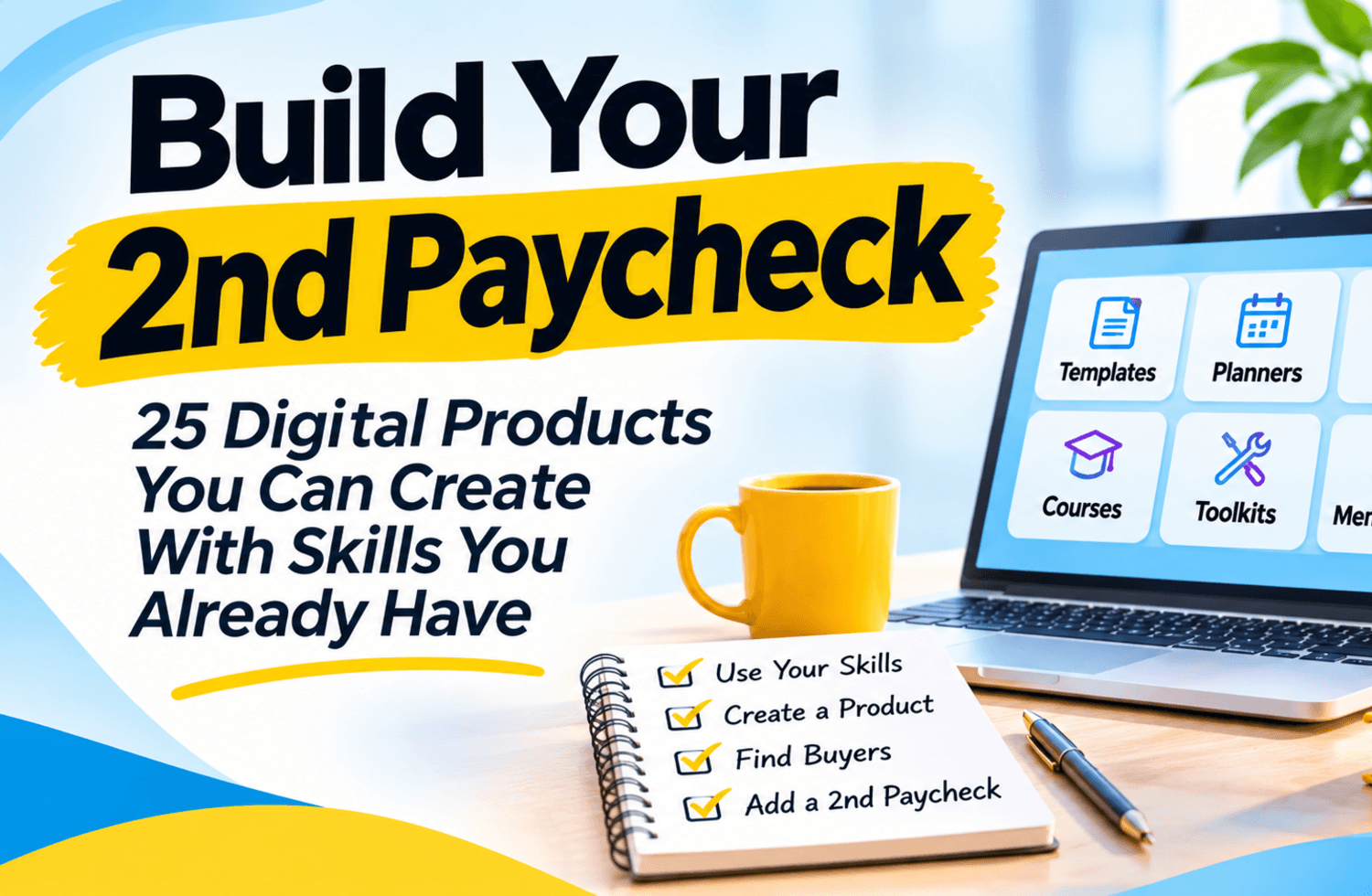
Build Your 2nd Paycheck: 25 Digital Products You Can Create With Skills You Already Have
You don't need a second job to earn extra income. Sometimes, you just need to realize that something you already know could be worth paying for.
The $25 That Changed How I Thought About Money
I still remember the morning I made my first $25 online.
It was around 6 a.m. when my phone buzzed. I was half asleep, and I assumed it was an alarm I'd forgotten to turn off.
But it wasn't an alarm.
It was a payment notification.
Someone I'd never met, living on the other side of the country, had just paid $25 for a simple template pack
I'd created the previous weekend.
I remember sitting there looking at my phone, trying to process what had happened.
Twenty-five dollars.
It wasn't going to pay my bills. It wasn't going to replace my salary. And it certainly wasn't enough to change my family's financial situation overnight.
But something about that payment felt completely different from every other dollar I'd earned.
Nobody had hired me.
Nobody had approved my hours or decided what my work was worth.
I had made something, put it online, and someone I'd never spoken to decided it was worth buying.
For the first time, my income wasn't directly connected to an employer.
And that changed how I looked at everything.
The following week, I made another $50. Then $200. I started sharing what I was learning on social media, experimenting with different ideas, and discovering that there were people willing to pay for knowledge and resources I'd previously taken for granted.
I didn't suddenly become an entrepreneur with all the answers.
I was figuring things out as I went.
But I'd learned something I wish someone had told me years earlier.
Your second paycheck doesn't have to come from a second job.
It can come from something you already know how to do.
And sometimes, all it takes to discover that possibility is one person willing to pay you $25.
Why a Second Paycheck Matters More Than You Might Think
For most of my working life, I thought earning more money meant doing one of three things.
I could ask for a raise, find a better-paying job, or work additional hours.
Those seemed like the only realistic options.
And while there's nothing wrong with any of them, they all have something in common.
Your income is still tied to someone else's decisions or to the number of hours you can work.
If you want more money, you generally have to give up more time, take on more responsibility, or convince someone you're worth paying more.
That's a difficult position to be in, especially when you have a family, bills, and responsibilities that aren't going anywhere.
I know what that feels like.
You can be doing everything you're supposed to do, working hard, showing up every day, and still feel like you're one unexpected expense away from a serious problem.
That's why I started looking at income differently.
I didn't necessarily need to replace my paycheck immediately.
I needed to create another way for money to come in.
Even if it was small.
Because an extra $100 earned independently isn't just $100.
It's evidence that someone outside your workplace values something you can offer.
And once you understand how to create that value, you can begin working toward something bigger.
Not overnight. Not without effort. And certainly not with guaranteed results.
But with a level of control that simply wasn't available to me before.
You Probably Already Know Something People Would Pay For
Here's something I've noticed after spending years around people building online businesses.
A lot of people underestimate their own knowledge.
They assume that if something feels easy to them, it must be easy for everyone else.
But that's rarely true.
Think about the things people regularly ask you for help with.
Maybe you're the person everyone calls when they need to organize a spreadsheet.
Maybe you know how to create presentations that actually make sense.
Maybe you're great at planning meals, managing projects, writing emails, organizing finances, or explaining complicated subjects in simple language.
You probably don't consider those things particularly special.
They're just things you know how to do.
But somewhere, someone is struggling with the exact problem you've already learned how to solve.
And they might be willing to pay for a shortcut.
Imagine a small business owner who spends three hours every week trying to organize client information.
You could create a spreadsheet template that helps them do it in 20 minutes.
Or imagine a new freelancer who has no idea what to send a client after someone agrees to work with them.
A simple client onboarding kit could save that person hours of uncertainty.
Neither product requires you to invent something revolutionary.
You're taking knowledge you already have and making it easier for someone else to use.
That's what makes a good digital product valuable. It helps someone get a result without having to figure everything out themselves.
25 Digital Product Ideas Worth Exploring
One of the biggest reasons people never start is that they get stuck trying to come up with the perfect business idea.
They spend weeks researching opportunities, watching videos, and comparing different business models.
Eventually, they convince themselves that everything worth doing has already been done.
But the internet doesn't need another completely original idea.
It needs useful solutions to real problems.
And there are dozens of ways to package those solutions.
For example, here are a few categories I particularly like for someone starting from scratch.
1. Templates That Save People Time
Templates are one of the simplest digital products to understand because they solve an obvious problem.
Instead of asking someone to create something from a blank page, you give them a useful starting point.
That could be a social media calendar for a small business, a budget spreadsheet for freelancers, a client proposal template, or a weekly planner for busy parents.
The important part is making it specific.
A general business template might appeal to everyone in theory, but a client onboarding template designed for freelance designers gives a particular person a clear reason to buy.
And that's what you want.
You don't need thousands of people to be interested in your product.
You need the right people to recognize that it solves something they're already dealing with.
2. Guides That Turn Experience Into Clear Steps
Sometimes, the most valuable thing you can sell is an explanation.
Not a 300-page book. Not a complicated training program.
Just a practical guide that shows someone how to accomplish a specific result.
Imagine you've spent years working in customer service and know how to handle difficult conversations.
You could create a guide with real examples, response scripts, and common mistakes to avoid.
Or perhaps you've figured out a reliable way to prepare for job interviews in your industry.
You could organize that knowledge into a short guide that helps someone else prepare with more confidence.
People can find information for free almost anywhere.
What they often struggle to find is information that's organized around their exact situation.
That's where your experience becomes valuable.
3. Checklists, Toolkits, and Ready-to-Use Systems
I particularly like products that remove decisions.
Because sometimes people don't need another explanation.
They need someone to show them exactly what to do next.
A checklist for launching a small business.
A toolkit for preparing a workshop.
A collection of email templates for following up with potential clients.
A simple system for organizing a team's weekly tasks.
These products might seem too basic to charge for.
But think about how often you've searched for a checklist, downloaded a template, or followed a step-by-step process because you didn't want to miss something important.
That's the value you're creating.
You're saving someone time, reducing uncertainty, and making a difficult task feel manageable.
4. Small Courses That Teach One Useful Skill
When people hear the word course, they often imagine recording dozens of videos and spending months building an entire learning platform.
It doesn't have to be that complicated.
A useful course can teach one specific skill.
For example, you could show someone how to build their first spreadsheet dashboard, create a professional presentation, organize their digital files, or use a particular software tool.
The key is to focus on a clear outcome.
Rather than teaching everything you know about a subject, teach someone how to accomplish one thing they care about.
A short course that helps someone solve a real problem can be more useful than a huge course they never finish.
5. Resource Libraries and Memberships
Some problems don't disappear after someone buys a single template or guide.
People need ongoing resources, fresh examples, or help as their situation changes.
That's where resource libraries and memberships can make sense.
Imagine a collection of ready-to-use teaching materials for educators.
Or a regularly updated library of content templates for small business owners.
Or a membership where people working in the same industry can access tools, training, and a community of others facing similar challenges.
These models require more ongoing work, so I wouldn't automatically recommend starting with them.
But they can become a natural next step once you understand what your customers need.
And that brings me to something important.
You don't have to build all five of these.
You don't even have to build two.
You need one product that solves one problem for one specific group of people.
That's enough to get started.
What Could Your First Digital Product Actually Earn?
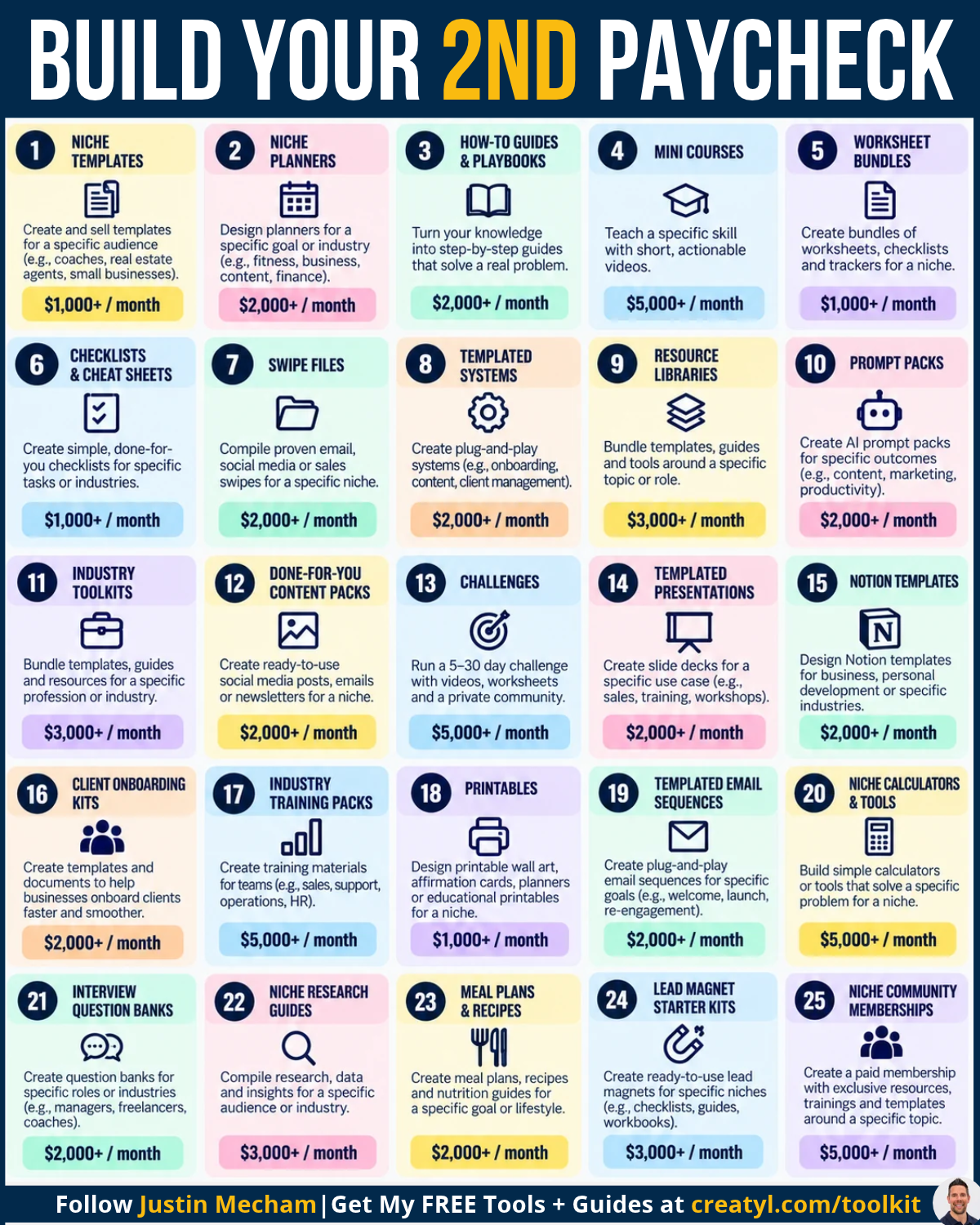
The infographic accompanying this article includes 25 digital product ideas with illustrative monthly income goals ranging from $1,000 to $5,000 or more.
Those figures aren't guarantees or typical earnings. They're possibilities to explore, and actual results depend on your audience, pricing, demand, costs, and ability to reach buyers.
But I want to show you something that makes the numbers easier to understand.
Let's say you create a $25 template pack.
If four people buy it, that's $100 in gross sales.
If 20 people buy it, that's $500.
And if 40 people buy it, that's $1,000.
You don't need to imagine becoming famous online or attracting millions of followers to understand the math.
You need to figure out whether there's a real group of people who want what you're creating.
Of course, selling 40 products isn't automatic. Finding customers, building trust, and getting your product in front of the right people takes work.
But breaking the goal into smaller numbers makes the process feel less mysterious.
And your first target doesn't have to be $1,000.
It can be $25.
Because your first sale teaches you something that researching business ideas never will.
It tells you that someone was willing to exchange their money for something you created.
That's a meaningful place to begin.
The Mistake I'd Avoid If I Were Starting Again
If I could go back and give myself one piece of advice, it would be this:
Don't spend months building something before finding out whether anyone wants it.
I see people make this mistake all the time.
They come up with an idea, spend weeks creating the product, design a beautiful website, and finally announce that it's available.
Then nothing happens.
Not necessarily because the product is bad.
But because they never stopped to ask whether anyone actually needed it.
I'd do things differently.
I'd start by talking to people.
I'd look at the questions they ask, the problems they complain about, and the tasks they keep putting off.
I'd pay attention to what they're already trying to solve.
Then I'd choose one problem I genuinely knew how to help with.
For example, imagine you're good at creating presentations.
Instead of building a massive library of 100 presentation templates, you could talk to five consultants who regularly prepare client proposals.
Ask what takes them the most time.
Maybe they struggle to structure their proposals. Maybe they need a better way to explain pricing. Maybe they waste hours making every presentation look professional.
Now you have something useful to work with.
You could create a small template pack designed around those exact problems.
Show it to the same people.
Ask whether they'd use it and whether they'd pay for it.
And if the response is encouraging, you can build a more complete version.
That's a much better starting point than spending months guessing.
How I'd Build a Second Paycheck With Just Four Hours a Week
One of the biggest objections I hear is that people simply don't have enough time to start something.
And I understand that.
When you're already working full-time, managing a household, and trying to spend time with people you care about, the idea of building a business can feel exhausting.
But you don't need to immediately create another full-time job for yourself.
You can start with a few focused hours each week.
Here's how I'd approach the first month.
Week 1: Find the Problem
Spend your first four hours identifying something you know how to help people do.
Write down the questions people ask you.
Look at problems you've solved at work or in your personal life.
Choose one that is specific, common enough to have potential customers, and realistic for you to address.
By the end of the week, aim to finish this sentence:
I help [specific person] accomplish [specific result] without [specific frustration].
If you can't explain your idea simply, narrow it down.
Week 2: Talk to Potential Buyers
Before creating the product, find a few people who experience the problem.
Ask how they're currently solving it.
Find out what's frustrating, what they've tried, and what a better solution would look like.
You don't need a formal survey or complicated market research.
A few genuine conversations can reveal things you'd never discover by guessing.
The goal isn't to convince people that your idea is brilliant.
It's to learn whether the problem is worth solving.
Week 3: Build the Simplest Useful Version
Now create something small.
A five-page guide.
A spreadsheet.
A collection of templates.
A checklist.
A short video tutorial.
Whatever format makes the solution easiest to use.
Focus on making it useful rather than impressive.
Your first version doesn't need to contain everything you know.
It needs to help someone get the result you promised.
Week 4: Put It in Front of People
This is the part that can feel uncomfortable.
You have to give people an opportunity to buy.
You might share the product with people who expressed interest during your research.
You might write a helpful social media post explaining the problem it solves.
Or you might reach out to a small group of potential customers and show them what you've created.
Don't assume people will discover your product simply because it exists.
Make it easy for the right people to understand what it does, who it's for, and how to get it.
Your goal for the first month isn't to build a huge business.
It's to create something useful, test whether people want it, and learn from the response.
If you make your first sale, that's wonderful.
If you don't, you still have information that can help you improve the offer.
Either way, you've moved further than you would have by spending another month thinking about starting.
Why You Don't Need to Be an Expert to Begin
There's another reason people hesitate to create their first product.
They don't feel qualified.
They assume someone else knows more, has better credentials, or has already created something similar.
And they're probably right.
There will almost always be someone who knows more than you.
But your customer doesn't necessarily need the world's leading expert.
They need someone who can help them solve their particular problem.
Think about learning something new.
Sometimes, the person who helps you most isn't the one with 30 years of experience.
It's the person who recently figured out the exact thing you're struggling with and remembers what made it confusing.
They can explain the steps in a way that makes sense because they haven't forgotten what it's like to be a beginner.
That doesn't mean you should pretend to have expertise you don't have.
It means you can be useful without knowing everything.
You can share a process you've tested, a skill you've developed, or a system that's helped you accomplish something.
Be clear about what you know, what you've experienced, and what your product can realistically help someone do.
Then let the usefulness of your work speak for itself.
From Your First Sale to Something Bigger
That first $25 payment didn't immediately change my finances.
But it changed what I believed was possible.
Before that morning, I had always thought of income as something an employer provided in exchange for my time.
Afterward, I started seeing my knowledge and experience differently.
I began asking myself questions I'd never considered before.
What else do I know that could help someone?
What problems do people keep asking me to solve?
Could I turn one useful resource into something more valuable?
Those questions eventually led me to create more products, share what I was learning, and become involved with creatyl, where the goal is to make building an online business simpler for people who are starting from scratch.
What I've learned along the way is that creating a product is only one part of the process.
You also need to explain its value, find the right customers, make it easy to purchase, and keep learning from what people actually want.
That's why having the right tools and guidance can make such a difference.
But no platform, software, or clever marketing strategy can replace the most important starting point.
You have to solve a real problem for a real person.
Everything else becomes easier to figure out once you know what you're helping someone accomplish.
Get the Free Build Your 2nd Paycheck Infographic
If you're wondering what kind of digital product you could create, I've put together a free infographic with 25 digital product ideas you can explore using skills and knowledge you may already have.
It includes ideas such as niche templates, planners, practical guides, mini courses, checklists, resource libraries, prompt packs, client onboarding kits, Notion templates, and more.
Each idea includes a short explanation and an illustrative monthly revenue goal to help you think through what's possible.
You don't need to try all 25.
In fact, I'd encourage you to do the opposite.
Look through the ideas, find one that connects with something you already know, and ask yourself whether there's a specific person you could help with it.
Then start there.