Click Here to Download the PDF.
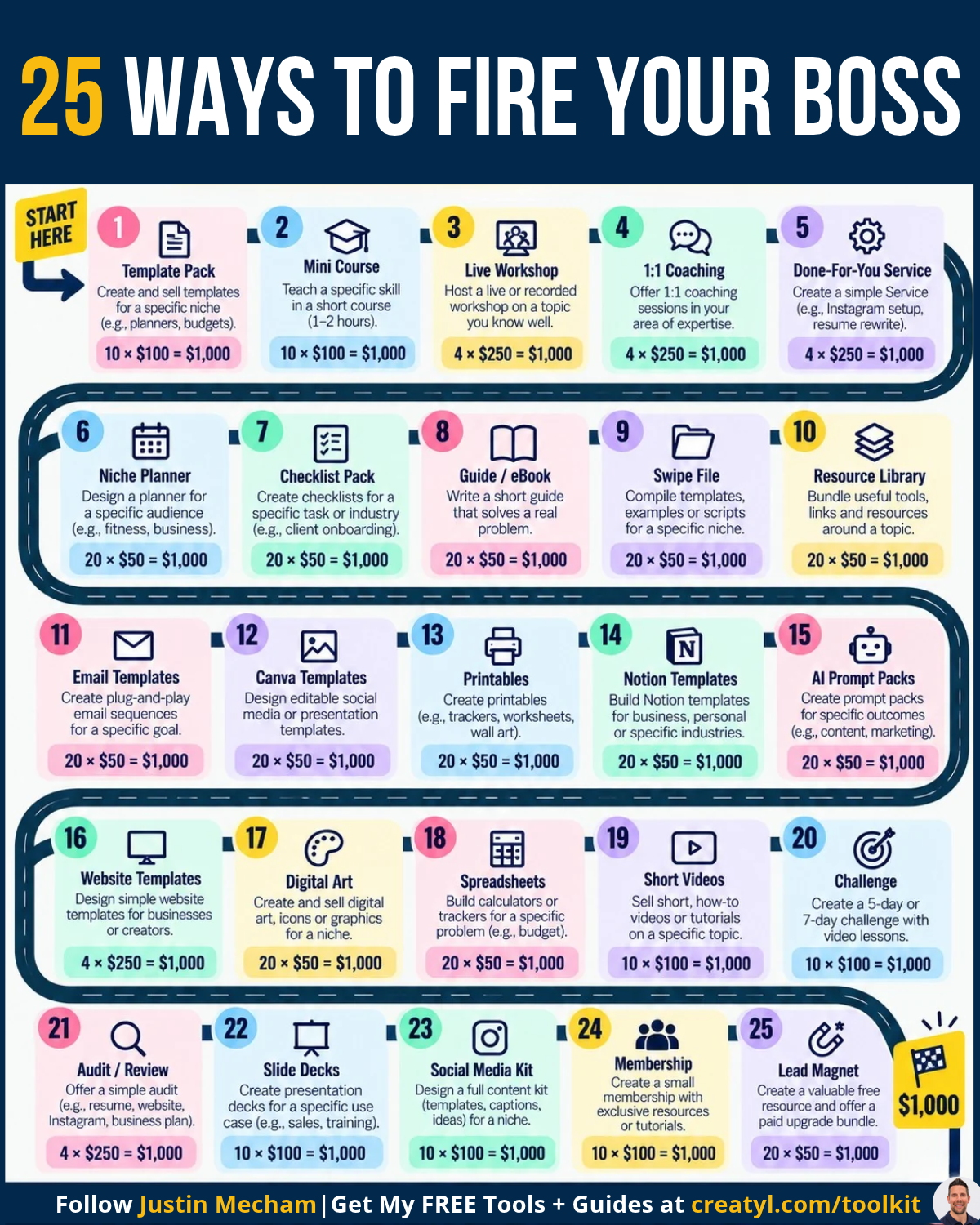
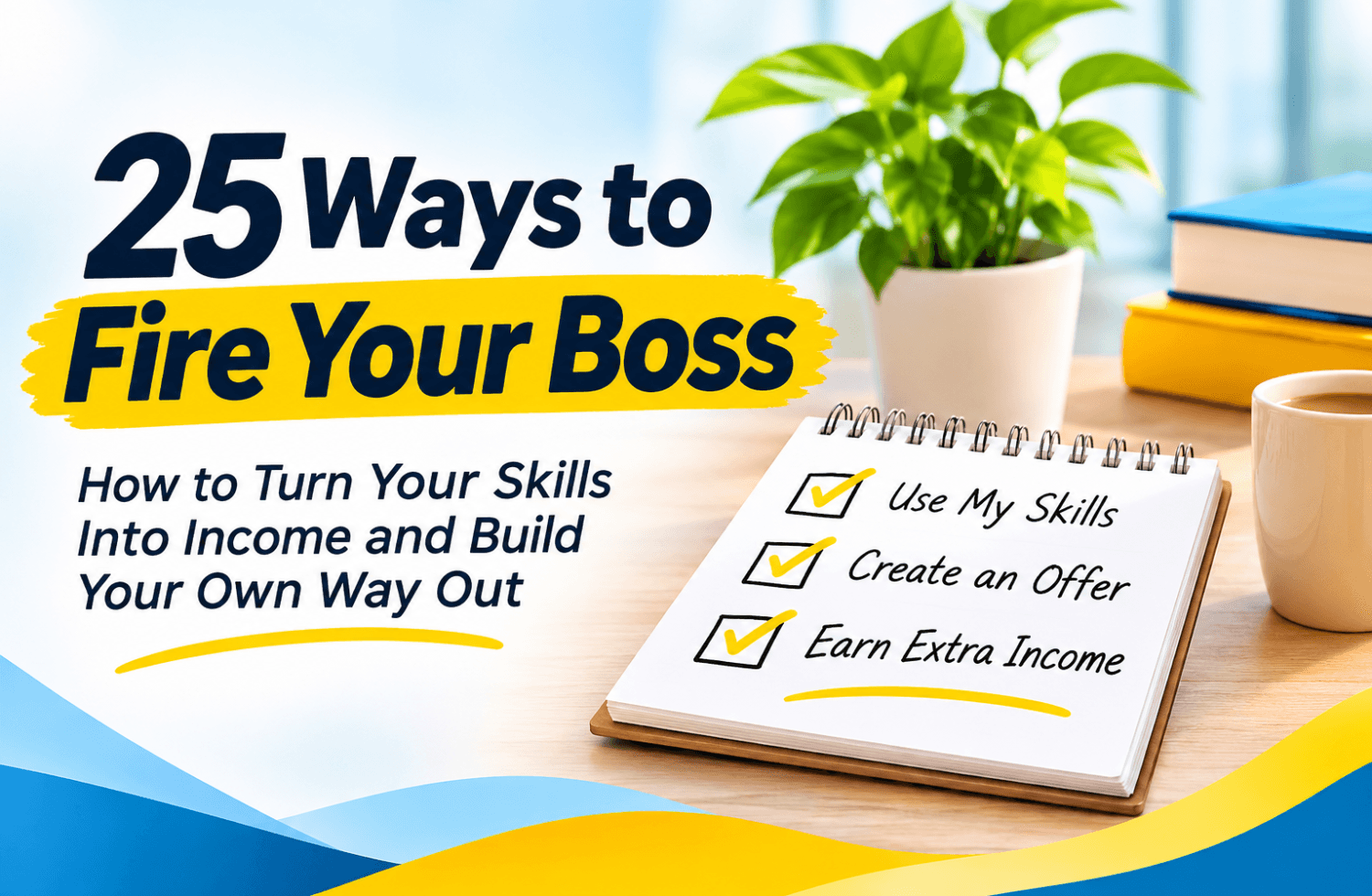
25 Ways to Fire Your Boss: How to Turn Your Skills Into Income and Build Your Own Way Out
You don't have to quit your job to start building a life where you no longer depend on it.
I remember sitting in a meeting when my boss said something I'll probably never forget.
"Anyone here is replaceable by Friday."
He looked right at me when he said it.
And I nodded.
That's the part that still bothers me.
Not that he said it. Not even that he seemed to believe it.
It's that I sat there and nodded like he was right.
Like the years I'd spent learning, solving problems, building relationships, and getting better at my work could all be replaced by a job posting.
The strange thing is, I wasn't even angry at first.
I just accepted it.
When you spend enough years working for someone else, it's easy to start measuring your value by what that person thinks you're worth.
Your salary becomes your value.
Your job title becomes your identity.
And your manager's opinion starts carrying more weight than your own.
But that meeting made me question something I'd never seriously considered before.
What if I was worth more outside that building than I'd ever allowed myself to discover?
That question eventually changed the direction of my life.
And if you've ever felt trapped in a job you can't afford to leave, I want to share what I learned.
Because there are more ways to earn money from what you already know than most people realize.
And you don't have to risk everything to find out.
The Problem With Having Only One Paycheck
For a long time, I thought having a steady job meant having security.
I had responsibilities. A family. Bills that needed paying whether I enjoyed my work or not.
So I did what most responsible people do.
I worked hard.
I tried to make myself valuable.
I took on more responsibilities, learned new things, and did everything I could to become someone the company needed.
But there was a problem with that plan.
No matter how valuable I became, someone else still controlled my paycheck.
They decided how much I earned.
They decided whether I got a raise.
They decided whether I still had a job next month.
And I had built my entire financial life around those decisions.
I remember driving home after that meeting and telling my daughter I couldn't play with her because I needed to prepare for work the next day.
That moment stayed with me.
I was giving up time with someone I loved to prepare for a job where I'd just been reminded how replaceable I was.
And I started wondering whether I'd confused being responsible with being dependent.
Because those aren't the same thing.
Being responsible means taking care of the people and commitments that matter to you.
Being dependent means having no real alternative if the thing supporting those commitments disappears.
A steady paycheck can make life easier. But having more than one way to earn money gives you choices.
And choices are what I'd been missing.
You Probably Have More Valuable Skills Than You Realize
One evening, I opened my phone and started making a list.
Not a list of businesses I wanted to start.
Not a list of qualifications I needed.
Just things I knew how to do.
I wrote down problems I'd solved at work.
Things colleagues regularly asked me for help with.
Tasks I'd become good at because I'd done them hundreds of times.
Things that seemed completely ordinary to me but were difficult for someone else.
And something interesting happened.
The list kept growing.
I'd spent years thinking about my experience in terms of job titles.
But when I stopped thinking about the job and started thinking about the actual skills, I saw something different.
Those skills weren't owned by my employer.
They were mine.
And they could be useful to people who had never heard of the company I worked for.
That's something I wish I'd understood earlier.
Your employer is one customer for your skills. They don't have to be the only one.
Think about your own experience for a moment.
Maybe you're the person who knows how to organize complicated projects.
Maybe you're great at making spreadsheets that actually make sense.
Maybe you can explain difficult topics in a way beginners understand.
Maybe people always ask you to review their resumes, improve their presentations, plan their finances, or help them use technology.
You probably don't consider those things business ideas.
They're just things you do.
But to someone who struggles with them, they could be incredibly valuable.
The question isn't whether you have something worth selling.
It's whether you've taken the time to recognize what someone else might pay you to help them accomplish.
Stop Looking for a Business Idea. Start Looking for a Problem.
This is where I see a lot of people get stuck.
They decide they want to earn money outside their job.
Then they immediately start searching for the perfect business idea.
They watch videos about online businesses.
They read about passive income.
They research websites, software, marketing strategies, and all the different ways people make money online.
A few weeks later, they have 15 possible ideas and haven't sold anything.
I understand why.
Starting a business sounds like a huge commitment.
It feels like you need a brilliant idea, a detailed plan, and enough money to survive if everything goes wrong.
But your first independent income doesn't need to come from a big business.
It can come from solving one small problem for one person.
Imagine you're good at organizing information.
You could spend months trying to build a productivity brand.
Or you could create a simple weekly planning template for overwhelmed freelancers.
Imagine you've spent years creating presentations at work.
You could start a complicated design agency.
Or you could offer to turn someone's messy notes into a professional presentation for a fixed price.
Imagine you're great at explaining software.
You could spend six months building an online course.
Or you could offer a one-hour session helping beginners learn one specific tool.
These aren't glamorous ideas.
And that's exactly why I like them.
They're understandable.
They're useful.
And you can test whether someone wants them without changing your entire life.
The best first business idea is often something you've already done successfully for someone else.
You just haven't charged for it yet.
Your First $1,000 Might Be Simpler Than You Think
One of the biggest mistakes people make is assuming they need thousands of followers or hundreds of customers before they can earn meaningful money online.
But let's look at the numbers differently.
What you sell | Sales needed | Total |
|---|---|---|
$25 digital resource | 40 | $1,000 |
$50 template pack | 20 | $1,000 |
$100 mini course | 10 | $1,000 |
$250 workshop | 4 | $1,000 |
$500 service package | 2 | $1,000 |
These are examples of revenue, not guaranteed earnings or take-home profit.
But they show something important.
You don't necessarily need a massive audience to get started.
You need a specific problem, a useful solution, and a way to reach people who need it.
Of course, finding those customers takes work.
Not every product will sell. Not every idea will work. And some offers will need to change before anyone buys.
But I'd rather learn that from a small experiment than spend a year building something nobody wants.
That's why I recommend starting with the simplest version of your idea.
If you want to sell a course, teach one paid workshop first.
If you want to sell templates, make one template that solves a specific problem.
If you want to offer coaching, start with one clear result you can help someone achieve.
Your first goal isn't to build an entire business.
It's to discover whether someone will pay for the value you can provide.
Because once that happens, everything changes.
You stop wondering whether your knowledge has value.
You have proof.
And proof gives you something much more useful than motivation.
It gives you a reason to keep going.
The 5 Types of Income You Can Build From What You Know
When people hear about starting an online business, they often imagine becoming influencers, launching huge courses, or building complicated websites.
But there are simpler ways to begin.
Most of the opportunities I recommend fit into five categories.
1. Sell Something You've Already Created
Think about the documents, systems, and resources you've built over the years.
Spreadsheets.
Checklists.
Templates.
Planners.
Presentations.
Guides.
Some of these could become products that other people download and use.
For example, someone who manages projects could create a project-tracking spreadsheet for small business owners.
Someone experienced in recruitment could create a job application toolkit.
Someone who's good at planning meals could create a weekly meal planner for busy families.
The important thing isn't how impressive the product looks.
It's how much easier it makes someone's life.
And unlike a service, a digital product can potentially be sold multiple times without recreating it for every customer.
2. Teach Something You Know
You don't need to be the world's leading expert to teach someone who is a few steps behind you.
Maybe you've learned how to use a particular software tool.
Maybe you're great at public speaking.
Maybe you know how to create a budget, edit videos, or organize a small business.
You can package that knowledge into a mini course, workshop, or beginner-friendly guide.
The mistake is trying to teach everything you know at once.
Instead, choose one outcome.
Help someone create their first spreadsheet.
Help them prepare for their first job interview.
Help them learn how to edit their first short video.
A clear result is easier to explain, easier to deliver, and easier for customers to understand.
3. Offer a Service That Solves One Problem
If you want to earn money sooner, services can be a practical place to start.
You don't have to create a product and hope someone buys it.
You can speak directly with a potential customer, understand what they need, and offer to do the work.
For example, you could offer website reviews, presentation design, resume editing, or simple business setup assistance.
Start with a clearly defined package.
Instead of offering general business support, offer to organize a small business owner's client onboarding process.
Instead of offering design services, offer to create a professional 10-slide presentation.
The more specific your offer, the easier it is for someone to decide whether they need it.
4. Help People One-on-One
Sometimes people don't need another downloadable resource.
They need someone to sit with them, answer their questions, and help them move forward.
That's where coaching and consulting can work.
You could help someone prepare for a career transition, improve a particular skill, or work through a business challenge you have experience solving.
The key is being clear about your expertise and the limits of what you can responsibly advise on.
You don't need to promise life-changing results.
You need to provide useful guidance that helps someone make progress.
5. Build Something People Can Keep Using
Once you've helped a few people, you might notice they keep asking similar questions.
Maybe they need new resources each month.
Maybe they want ongoing lessons.
Maybe they would benefit from a community of people working toward the same goal.
That could eventually become a membership, resource library, or paid learning community.
But I wouldn't start here unless you already understand what people consistently need.
Recurring income sounds attractive.
Recurring responsibility is part of the deal, too.
Start by proving that people value your work before promising to deliver it every month.
How to Find Your First Paying Customer Without a Big Audience
Here's something I learned after spending far too much time worrying about building an audience.
You don't need everyone to know what you do.
You need the right people to understand how you can help them.
And those are very different goals.
Imagine you've created a spreadsheet that helps freelancers track invoices and payments.
You could spend weeks posting general productivity tips and hoping someone notices.
Or you could find places where freelancers are already discussing late payments, messy records, and difficulty tracking their income.
You could contribute useful advice.
Share a practical example.
Explain how you solve the problem.
And when appropriate, let people know you've created something that might help.
The goal isn't to turn every conversation into a sales pitch.
It's to become genuinely useful to people who have the problem you solve.
That's also why I started sharing what I was learning on social media.
Not because I had everything figured out.
But because I realized that the lessons I was learning might help someone else.
You don't have to pretend to be an expert in everything.
You can share what you've tried, what worked, what didn't, and what you'd do differently.
Over time, people begin to understand what you're good at.
And some of those people may become customers.
You don't need to be famous to make your first sale. You need to be useful to someone who knows you exist.
A Simple 7-Day Plan to Get Started
If you've been thinking about building another income stream but haven't done anything yet, I'd encourage you to give yourself seven days.
Not to build an entire business.
Just to find out whether one of your skills could become something people will pay for.
Day 1: Make Your Skills List
Write down 20 things you know how to do.
Include professional skills, personal experience, and problems you've solved for others.
Don't worry about whether they're impressive.
Just get them out of your head.
Day 2: Find the Problems Behind Those Skills
Look at your list and ask who might need help with each skill.
What are they struggling with?
What takes them too much time?
What do they wish someone could make easier?
Try to identify three specific problems.
Day 3: Choose One Small Result
Pick the problem you understand best.
Then decide on one result you could help someone achieve.
Not an entire transformation.
Something small, clear, and useful.
For example, helping a freelancer organize their invoices or helping a job seeker improve their resume.
Day 4: Talk to Potential Customers
Find three to five people who experience that problem.
Ask how they're currently handling it.
Find out what's frustrating.
Ask what they've already tried.
Listen more than you talk.
You might discover that your original idea needs to change.
That's useful information, not failure.
Day 5: Create a Simple Offer
Write one sentence that explains what you're selling.
Use this structure:
I help [specific person] achieve [specific result] without [specific frustration].
Then decide what you'll deliver, how long it will take, and what you'll charge.
Keep it simple enough that someone can understand it in a few seconds.
Day 6: Put Your Offer in Front of People
You don't need an elaborate launch.
Share your offer with people who have expressed interest.
Publish a helpful post explaining the problem you solve.
Reach out personally when it's relevant and welcome.
Make sure people understand exactly what they're getting and how to buy it.
Day 7: Learn From the Response
Maybe someone buys.
Maybe someone asks a question.
Maybe nobody responds.
Whatever happens, don't immediately assume your idea is terrible.
Look at what you've learned.
Was the problem specific enough?
Did people understand the offer?
Were you speaking to the right audience?
Did the price make sense for the value?
Then make one improvement.
Seven days might not produce a sale.
But they can take you from endlessly thinking about starting something to having a real offer you can test.
And that's meaningful progress.
Don't Quit Your Job. Build Until You Have a Choice.
I want to be clear about something.
When I talk about firing your boss, I'm not suggesting you should walk into work tomorrow and resign.
Especially if you have a family to support, financial commitments, or people depending on you.
I've been there.
I know what it's like to want more freedom while also needing the stability of a regular paycheck.
That's why I believe in building your way out rather than jumping without a plan.
Keep your job.
Pay your bills.
Use a few hours each week to test an idea.
Make your first sale.
Then work toward your next five.
Learn how to find customers consistently.
Understand your expenses, taxes, and how much income you actually keep.
Build savings and a financial cushion.
And only consider leaving when the numbers, your responsibilities, and your personal circumstances support that decision.
For some people, that might take months.
For others, it could take years.
And for plenty of people, the goal won't be quitting at all.
Maybe they just want an extra $500 each month.
Maybe they want to pay down debt.
Maybe they want to save for something important.
Maybe they want the confidence that comes from knowing their employer isn't their only source of income.
All of those are worthwhile goals.
The real goal isn't to stop working for someone else. It's to stop feeling like you have no other option.
The First Sale Changes More Than Your Bank Account
I still remember how strange it felt to realize someone could pay me for something I'd created outside my job.
It wasn't about suddenly becoming wealthy.
It was about seeing something I'd never fully believed before.
Someone valued what I could do without needing to see my resume.
They didn't care about my job title.
They didn't need my manager's approval.
They had a problem, and I'd created something useful.
That was enough for them to make a purchase.
There's something powerful about that experience.
When you've spent years relying on one employer, it's easy to forget that your knowledge has value in the wider world.
Your first independent sale challenges that belief.
It doesn't mean you've built a sustainable business.
It doesn't mean you can quit your job.
But it proves that the door you thought was locked might actually be open.
And once you've made one sale, you can start asking better questions.
How did that customer find me?
What made them decide to buy?
What else do they need?
How can I make the product better?
How could I help more people like them?
That's how something small can begin to grow.
Not through one dramatic decision.
Through a series of practical steps that gradually give you more control over your future.
Your Experience Is Worth More Than a Job Title
I sometimes wonder how many people are sitting in meetings like the one I sat through.
People with years of experience.
People who solve difficult problems every day.
People who have spent their careers learning valuable skills.
And yet, they go home believing they have nothing to offer outside their current job.
Maybe that's you.
Maybe you've been waiting until you have more experience, more qualifications, or more confidence before starting something of your own.
But what if you already know enough to help someone?
What if the spreadsheet you built last month could save a small business owner hours every week?
What if the process you use every day could become a guide that helps someone avoid months of frustration?
What if the thing your colleagues constantly ask you to explain could become a workshop?
You don't need to know everything.
You don't need to have the perfect idea.
And you certainly don't need permission from your employer to recognize the value of what you've learned.
You just need to start looking at your experience differently.
Free Download: 25 Ways to Fire Your Boss
If you're reading this and thinking, "I understand the idea, but I still don't know what I could actually sell," I made something for you.
It's a free infographic called 25 Ways to Fire Your Boss.
Inside, you'll find 25 practical ways to turn your existing knowledge and skills into potential income.
From templates and digital products to workshops, services, coaching, and memberships, each idea includes a simple example of what you could create.
It also shows how different combinations of prices and sales could add up to $1,000 in revenue.
Not as an earnings promise, but as a way to make the possibilities easier to understand.
You don't need to try all 25.
In fact, I'd encourage you not to.
Look through the ideas.
Find one that fits something you already know how to do.
And ask yourself whether you could create a simple version of it this week.
Because the purpose of this guide isn't to give you 25 more things to think about.
It's to help you finally choose one thing to start.