Click Here to Download the PDF.
You’re doing the work.
You’re hitting the deadlines.
You’re showing up and quietly keeping things running.
But somehow… it feels like no one notices.
Your name doesn’t come up in the meetings where it matters.
Your ideas sound familiar when someone else says them.
And the projects you’ve pulled across the finish line barely get a mention when credit is handed out.
You’re not alone — and you’re not doing anything wrong.
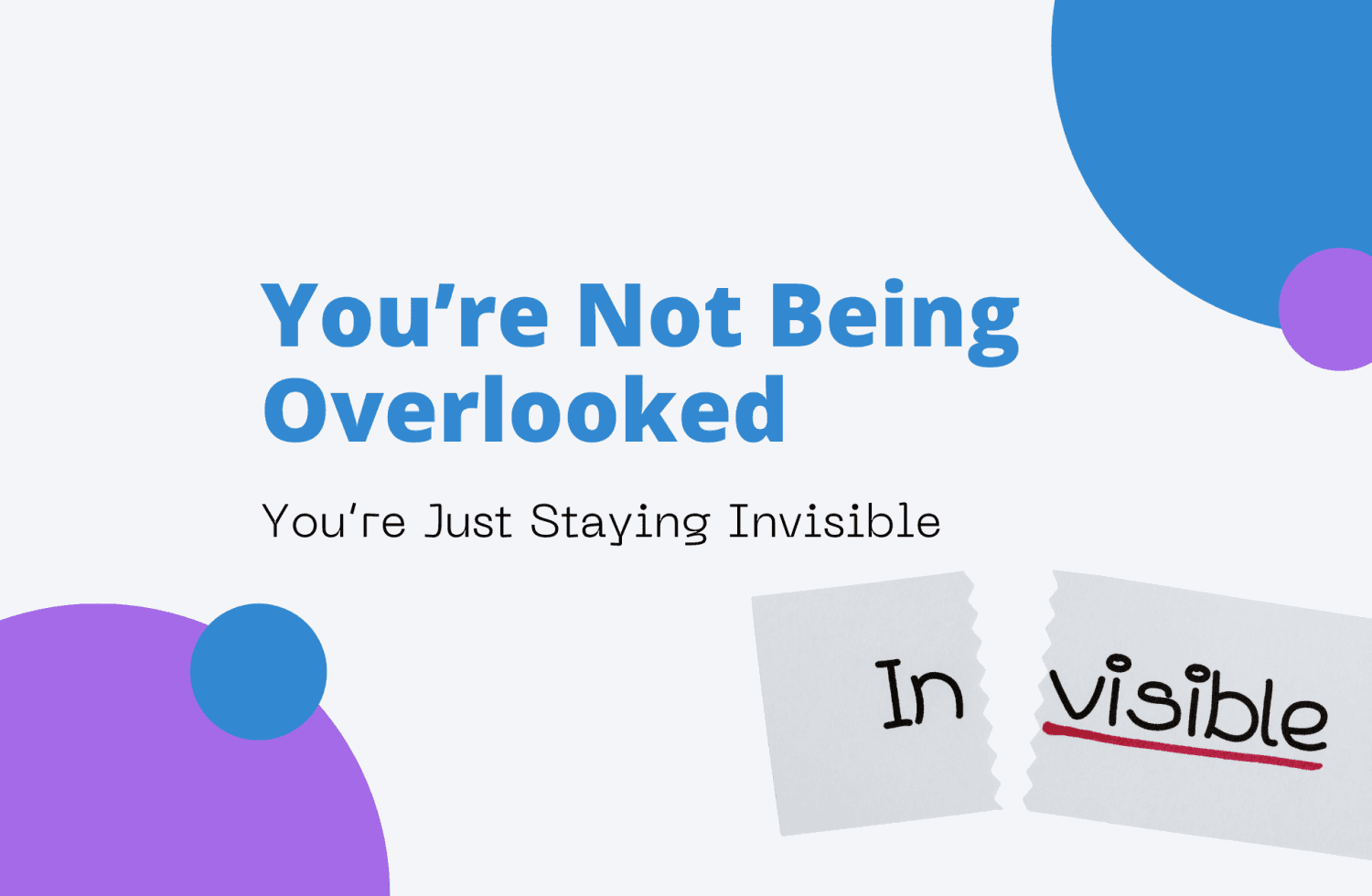
You’re just staying invisible.
And in today’s world of constant noise, where everyone is competing for attention and every channel is crowded, being invisible doesn’t mean you’re not valuable.
It just means people can’t see the value you’re already creating.
Visibility isn’t bragging. It’s how good work gets remembered.
It’s how leaders make decisions, how teams grow trust, and how you build momentum for what’s next.
Let’s be honest — hard work doesn’t automatically speak for itself anymore.
You have to give it a microphone.
Why Visibility Matters (Now More Than Ever)
We were all taught that if we just do great work, someone will eventually notice.
That’s the advice that came from parents, mentors, teachers — and for a long time, it worked.
But workplaces have changed.
Managers are stretched thin, juggling multiple teams and time zones.
Projects move faster. Priorities shift daily.
And in a hybrid world, half the team is often working behind a screen.
No one has the mental bandwidth to see every unseen effort.
So if your impact isn’t easy to find, it quietly disappears.
Meanwhile, people who speak up — even briefly — are remembered longer.
They’re not necessarily better at what they do; they’re simply easier to recall.
That’s how bias works.
The loudest voice isn’t always the smartest one — but it’s the one people remember when opportunities arise.
The truth is, visibility isn’t vanity.
It’s accountability. It’s the bridge between the work you do and the recognition you deserve.
Being seen is not about stealing the spotlight.
It’s about making sure the light actually reaches the work.
The Problem, The Pain, and The Fix
The Hidden Work Trap
I once worked with a hybrid team that was quietly exceptional.
They built solid systems, never missed deadlines, and always came through when things got messy.
But no one outside their immediate group seemed to notice.
When promotion time came around, other teams were getting recognition — sometimes even for projects this group had led behind the scenes.
The reason? They weren’t showing their work.
They didn’t share progress updates.
They stayed silent in meetings.
They avoided sending summaries because they didn’t want to seem self-promotional.
They were doing everything right — except being visible.
Their effort was invisible because it lived in private threads, long documents, or closed channels.
It wasn’t that their work wasn’t impactful — it’s that no one could see the impact.
The Cost of Silence
As months went by, frustration crept in.
Team morale dropped.
People started feeling like their work didn’t matter, even though they were holding everything together.
The quiet ones — the ones who did the deep thinking, the extra troubleshooting, the behind-the-scenes heavy lifting — began to disconnect.
They stopped volunteering ideas in meetings.
They stopped taking initiative.
They weren’t burnt out. They were just unseen.
And when people stop being seen, they stop stretching themselves.
They start doing the minimum because effort that disappears eventually stops feeling worth it.
That’s when I stepped in.
Not to change how they worked — but to change how their work showed up.
The Visibility Reset
We built a system that helped their work do the talking — without forcing anyone to be louder or different than they naturally were.
Here’s what worked:
1. The Impact Log
Every team member kept a one-line daily record:
Date → Result → Proof → Who benefited.
It sounds simple, but this tiny habit created a clear, running story of impact.
At the end of each week, everyone could literally see what they’d built — and when review time came, they had evidence ready to share.
2. The 3-3-30 Update
Every Friday, each person sent one update:
- Three bullets
- Three links
- Thirty seconds to read
That’s it.
It forced clarity and brevity.
Managers didn’t need to dig.
They saw the results immediately — with proof attached.
3. Visibility Through Artifacts
For the remote employees, I replaced status reports with two-minute screen recordings.
Quick Loom videos showing “before and after.”
It was the easiest way to make invisible work visible — without more meetings, without more talking.
4. One Fix Before It’s Needed
Each week, I asked them to identify one small improvement: a faster process, a recurring issue solved early, a smoother handoff.
The result?
Their names became linked with problem-solving and initiative — not just reliability.
5. Cross-Team Bridges
We paired people across departments for short, 20-minute “show-and-solve” sessions.
One insight, one friction point, one fix.
That simple format expanded visibility beyond their manager and gave them new advocates across the company.
Within two months, everything shifted.
The same team that used to be overlooked was now being cited in leadership meetings.
Their work became reference points for other teams.
Their confidence came back — not because they changed who they were, but because their work finally had visibility.
They weren’t louder.
They were just easier to see.
What You Can Do To Be Seen (Without Being Loud)
These are the small, repeatable actions that will get you noticed — for the right reasons.
1. Build Your Impact Log
Keep a running list of results.
Don’t just record what you did — record what changed because you did it. That’s the difference between activity and impact.
2. Send Short, Smart Updates
Use the 3-3-30 rule.
Three bullets. Three links. Thirty seconds.
Your manager will thank you — and more importantly, they’ll remember you.
3. Show Up in Remote Work
Visibility isn’t about being “always on.”
It’s about being present where it matters.
Comment on key threads. Send a quick note in Slack.
Drop a short video walkthrough. Small moments of presence build trust and credibility.
4. Connect Beyond Your Team
The most visible employees are the ones who build bridges.
Every month, collaborate briefly with another department.
You’ll learn more — and people across the company will start associating your name with momentum.
5. Solve, Don’t Complain
When you spot an issue, pair it with a fix.
One solution offered before it’s needed speaks louder than ten complaints after the fact.
6. Keep Growing — And Let People See It
Share what you’re learning.
It’s not showing off; it’s showing growth.
People respect progress they can see, and sharing it helps normalize learning for everyone else.
Tools That Help You Stay Visible (Without Self-Promotion)
Book
Quiet: The Power of Introverts in a World That Can’t Stop Talking — Susan Cain
A modern classic that transformed how people think about quiet leadership.
Cain’s insights help you turn introspection into influence and show how to contribute meaningfully without performing.
TED Talk
The Power of Introverts — Susan Cain
One of the most-viewed talks ever — a must-watch for anyone who’s ever felt undervalued for not being loud. It’s a masterclass in why reflection, depth, and calm confidence often drive the most lasting impact.
AI Tool
Otter Meeting Agent — Otter.ai
Perfect for capturing what you say in meetings — without you lifting a finger.
Otter automatically records, transcribes, and summarizes, so your ideas are logged, shareable, and remembered.
Tool
Loom — Loom
The ultimate visibility tool for remote teams. Record quick, clear video updates showing your work in motion. Two minutes. One link. Infinite context.
The Real Meaning of Being Seen
Visibility Is Not About Noise — It’s About Connection
Recognition doesn’t always follow effort.
It follows what people remember — and people remember what they can see.
But this isn’t about chasing attention. It’s about connection.
When you share your progress clearly, you’re helping others understand how their work fits with yours.
You’re creating alignment. You’re making teamwork easier.
You’re not showing off. You’re showing up.
Being visible doesn’t mean being loud, it means being clear.
It’s not about spotlighting yourself — it’s about removing the fog around what you’ve already achieved.
And that’s the shift that changes everything.
Once people can see the value you bring, they start including you in conversations that shape the future.
You stop waiting to be invited. You start being needed.
If there’s one truth to take from this:
You were never being overlooked because you weren’t capable — you were being overlooked because your value was hidden.
And the moment you start showing it — even in small, consistent ways — you’ll realize that visibility isn’t vanity.
It’s how great work earns its place.
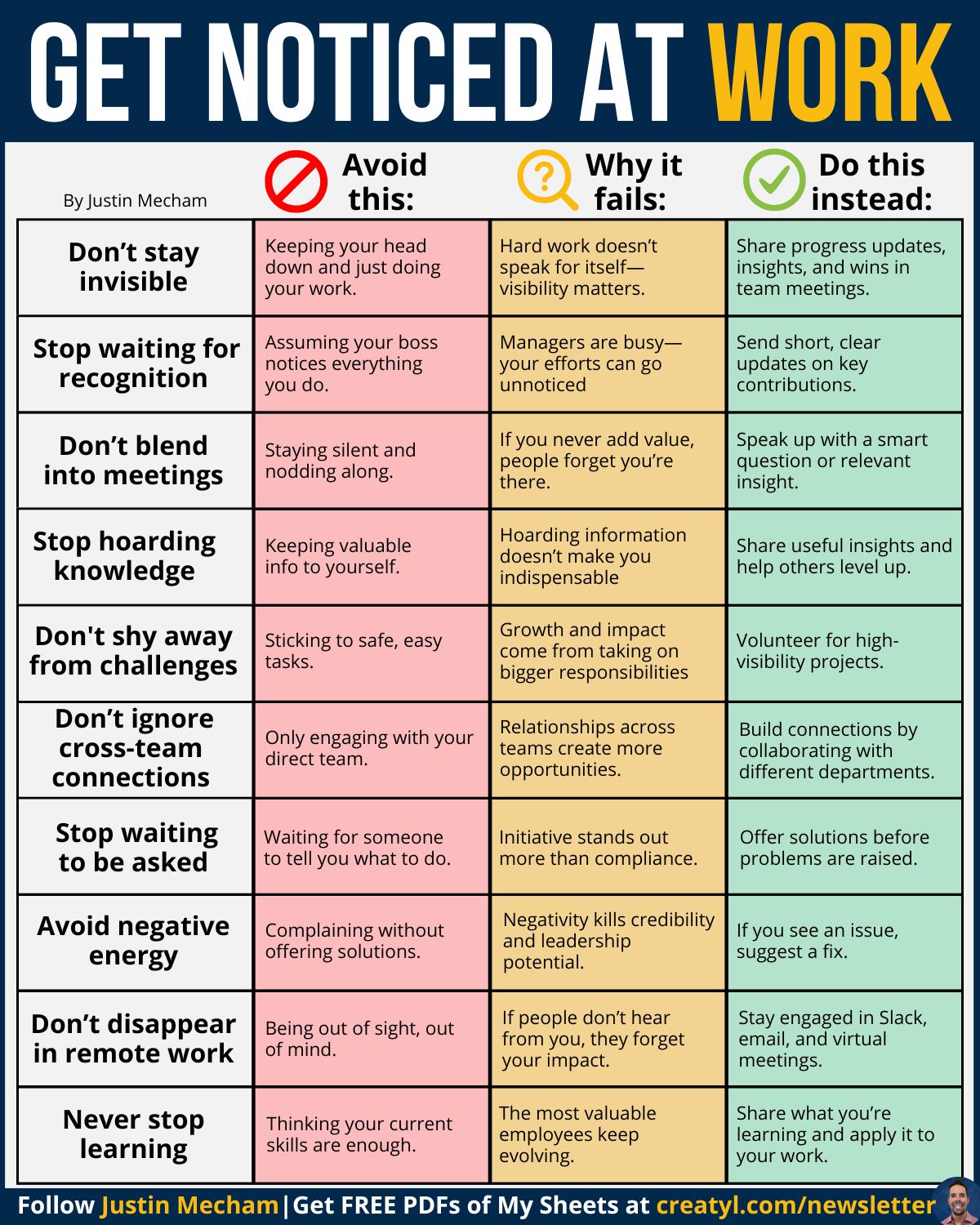
Download the Infographic (PDF)
If you want to keep these steps within reach, download the “Get Noticed at Work” infographic as a free PDF guide here:
It breaks down every action from this article into a simple, visual checklist you can actually use.
Pin it by your desk. Share it with your team.
Let it remind you that visibility isn’t about being louder — it’s about being seen for what you’re already doing right.