Click Here to Download the PDF.
Most leaders don’t wake up one day and decide to be “bad.”
They don’t plan to lose trust, drain morale, or confuse their teams.
It happens slowly—and quietly.
Bad leadership rarely looks like what we imagine.
It’s not yelling in meetings or harsh decisions.
It’s what’s missing.
It’s when clarity fades into confusion.
When presence turns reactive instead of steady.
When effort gets mistaken for impact.
When a team stops feeling safe to speak up.
These aren’t dramatic failures—they’re silent ones.
But over time, they corrode trust, clarity, and confidence.
Let’s break down the real patterns that create unintentional damage—
and the small, practical ways to turn them around.
1. Giving Unclear Direction — When Good Intentions Create Chaos
Every leader wants to empower their team.
But when “empowerment” means lack of clarity, what your people actually feel is anxiety.
Unclear direction doesn’t look like confusion in the moment. It looks like slow progress, repeated questions, and missed expectations.
And it usually sounds like this:
“Just make it great.”
“I trust you—figure it out.”
“You know what I mean.”
Except, they don’t.
I worked with a manager once whose team kept missing deadlines.
They weren’t lazy—they were lost.
Everyone had a slightly different picture of what success looked like.
After one session of aligning deliverables with outcomes, the team cut rework by half in a week.
How to fix it:
- Be specific about what success looks like—show examples.
- Use check-ins to confirm understanding, not to micromanage.
- Clarify the “why,” not just the “what.”
Clarity isn’t control—it’s kindness.
2. Leading Based On Mood — When Emotion Becomes The Metric
Leadership isn’t about never feeling frustrated—it’s about what your team feels safe to expect from you.
If one day you’re upbeat and available, and the next you’re quiet or cold, your people start guessing which version of you they’ll get.
They stop bringing ideas. They play it safe. They protect themselves instead of contributing.
I saw this in a creative agency I consulted.
The founder was brilliant but reactive—ecstatic about an idea one day, dismissive the next.
Over time, the team stopped sharing early drafts.
They waited until things were “perfect,” which meant deadlines blew up and creativity shrank.
How to fix it:
- Anchor your decisions to principles, not moods.
- Create a few non-negotiable leadership rules: how you start meetings, how you give feedback, how you handle disagreement.
- When you’re having a rough day, name it—don’t project it.
Stability isn’t robotic—it’s responsible.
It’s what makes people feel safe enough to do their best work.
3. Rewarding Effort, Not Impact — When Hard Work Isn’t The Goal
Every leader loves to see their team working hard.
But there’s a difference between rewarding effort and recognizing results.
When we praise people only for hours or hustle, we teach them to equate exhaustion with value.
And that’s how burnout gets mistaken for dedication.
I once worked with a department where long hours had become a badge of honor.
Emails flew at midnight, and people proudly said they were “cranking through the weekend.”
But projects still lagged, and the best employees quietly started leaving.
Why? Because effort wasn’t the issue—direction was.
When we shifted the focus to measurable outcomes—impact, clarity, quality—morale went up, and hours actually went down.
How to fix it:
- Recognize progress that matters, not just effort spent.
- Ask, “What result did this create?” instead of “How long did it take?”
- Model healthy boundaries yourself.
Impact builds momentum.
Effort without direction builds fatigue.
4. Confusing Motion With Progress — When Busy Feels Productive
Busyness feels satisfying.
It gives the illusion of movement, the comfort of activity.
But it’s often just well-organized stagnation.
Leaders fall into this trap when every hour looks full but nothing actually moves forward.
Calendars packed, meetings stacked—but no clarity gained.
I coached a team once that had 22 recurring meetings per week.
Twenty-two.
Everyone was “aligned” but no one had time to execute.
When we cut the meetings in half and added simple weekly goal tracking, results skyrocketed.
How to fix it:
- Replace “What are we doing?” with “What are we achieving?”
- Audit your meetings: cancel, shorten, or repurpose them.
- Protect time for actual work.
Progress isn’t about how much you move—it’s about how much you advance what matters.
5. Saying “My Door’s Always Open” — But Never Truly Listening
Availability isn’t the same as approachability.
Many leaders proudly say, “My door’s always open,” but their team never walks through it—and that silence isn’t peace, it’s distance.
I’ve seen this countless times.
A leader says they’re “always there,” but when people finally speak up, they’re met with defensiveness, interruptions, or quick fixes instead of real listening.
So the team stops trying.
True listening is presence without preloaded answers. It’s curiosity without control.
How to fix it:
- Schedule “listening blocks” instead of waiting for people to approach you.
- When someone shares a problem, ask: “What do you need from me?” before responding.
- Resist the urge to solve immediately—sometimes people need to be heard before they need direction.
When people feel heard, they bring problems early instead of hiding them late. That’s how trust grows—quietly, and over time.
6. Only Showing Up When There’s A Fire — When Leadership Becomes Damage Control
Some leaders appear calm because they disappear until something’s on fire.
But when you only show up during chaos, your team starts believing your presence equals trouble.
One company I advised had a VP who prided himself on being “hands-off.”
He thought it meant trust. But his team saw it as absence.
When things went wrong, he swooped in, fixed everything, and disappeared again.
Eventually, people stopped taking ownership—why bother, when he’d do it anyway?
How to fix it:
- Don’t wait for problems to engage—check in regularly, even when things are going well.
- Ask your team what’s working, not just what’s broken.
- Shift from firefighter to coach.
Presence doesn’t mean hovering—it means caring before it’s urgent.
7. Avoiding Hard Feedback — When Comfort Costs Growth
Giving tough feedback isn’t easy.
But avoiding it doesn’t protect your team—it limits them.
Leaders often skip the hard conversations to keep things “positive.” But silence doesn’t prevent conflict; it delays it.
Over time, it builds resentment, confusion, and missed potential.
I remember one marketing director who avoided confronting a high-performing but difficult employee.
The tension built quietly until others started leaving.
When she finally addressed it directly—with respect and honesty—the entire team’s tone shifted.
People started speaking up again.
How to fix it:
- Give feedback as data, not judgment.
- Address issues when they’re small—before they become culture.
- Praise in public, correct in private, but never avoid the truth.
Hard feedback handled well is a sign of respect, not rejection.
Real-Life Example: Turning Around A Struggling Team
I once worked with a mid-sized software company where the culture looked calm on the surface—but underneath, trust was eroding.
Leaders weren’t toxic, just detached.
Directions were vague, meetings were reactive, and the phrase “we’re doing our best” was everywhere.
After running a leadership audit, the real issues became clear:
- Managers only met with employees during reviews or emergencies.
- Feedback was soft, unclear, and often avoided.
- People worked long hours but didn’t know if it mattered.
We implemented five changes in 30 days:
- Weekly 1:1s—no agenda, just conversation.
- Clear project outcomes and definitions of success.
- “Listening hours” blocked on leaders’ calendars.
- Team-wide goals focused on results, not effort.
- Biweekly reflection meetings where people could discuss what was working.
Within a quarter, employee engagement rose.
People started speaking up, meetings became shorter and sharper, and managers began leading with intention instead of reaction.
The truth? The leaders weren’t bad.
They were just blind to what was breaking beneath the surface.
The Hardest Part Of Leadership Is Looking In The Mirror
The moment you stop assuming you’re a “good leader” and start asking where you might be slipping—that’s when real leadership begins.
Leadership isn’t about never making mistakes. It’s about noticing them faster and fixing them sooner.
It’s about choosing stability when your emotions want control.
It’s about showing up before the fire, not after it.
It’s about creating clarity where confusion hides, and listening when it would be easier to talk.
The best leaders aren’t perfect—they’re consistent.
They don’t chase being liked. They focus on being trusted.
If you want to know how you’re really leading, don’t look at your title. Look at your team.
Are they speaking up? Growing? Taking ownership? Feeling seen?
That’s the real scoreboard.
Because at the end of the day, leadership isn’t about how you look from the outside.
It’s about what happens to people when they work with you.
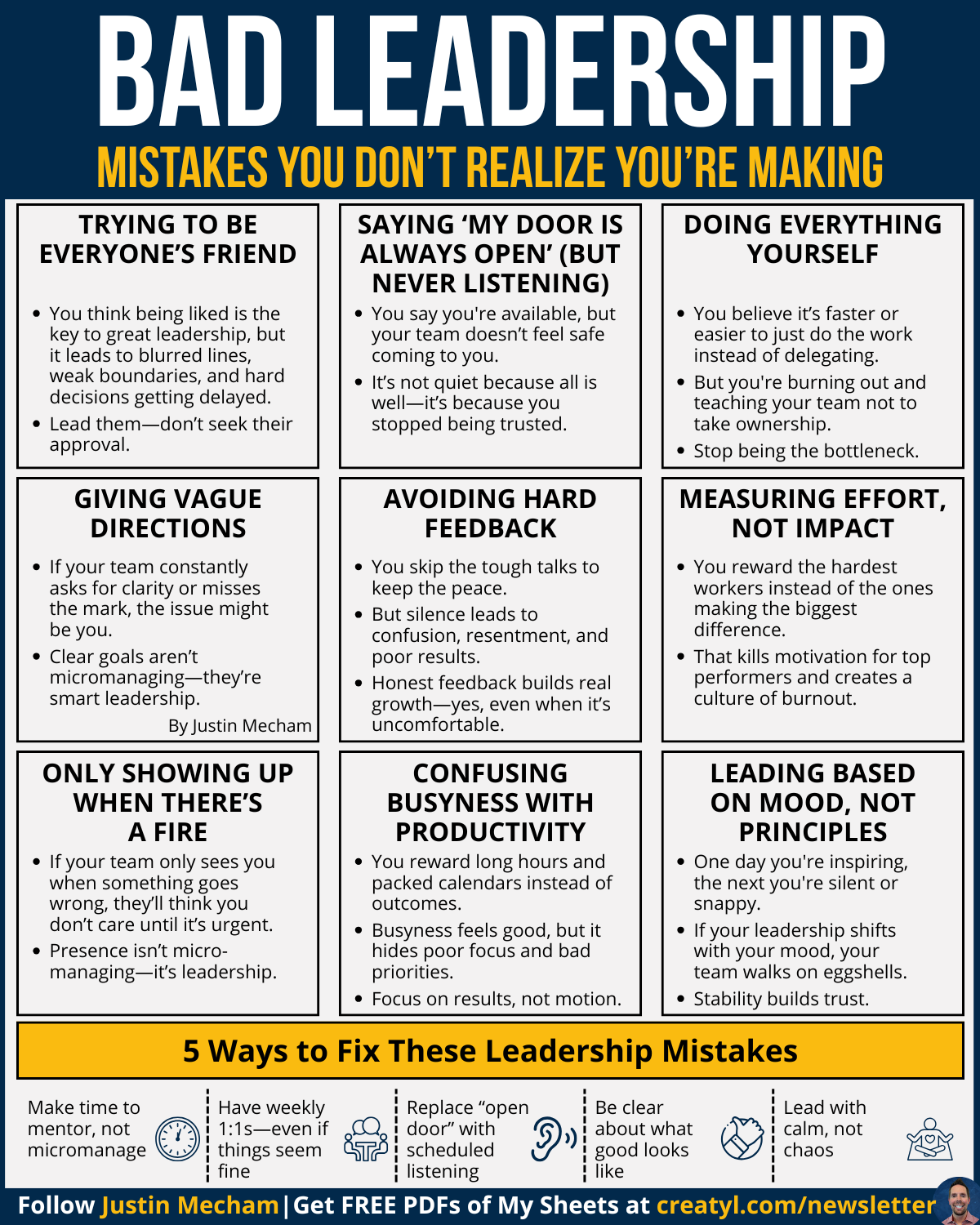
Download The Infographic
If you want a clear, visual reminder of these lessons, download the full Bad Leadership: Mistakes You Don’t Realize You’re Making infographic as a printable PDF.
Keep it where you’ll see it daily—a quick guide to staying aware, aligned, and better than you were yesterday.
-
Justin