Click Here to Download the PDF.
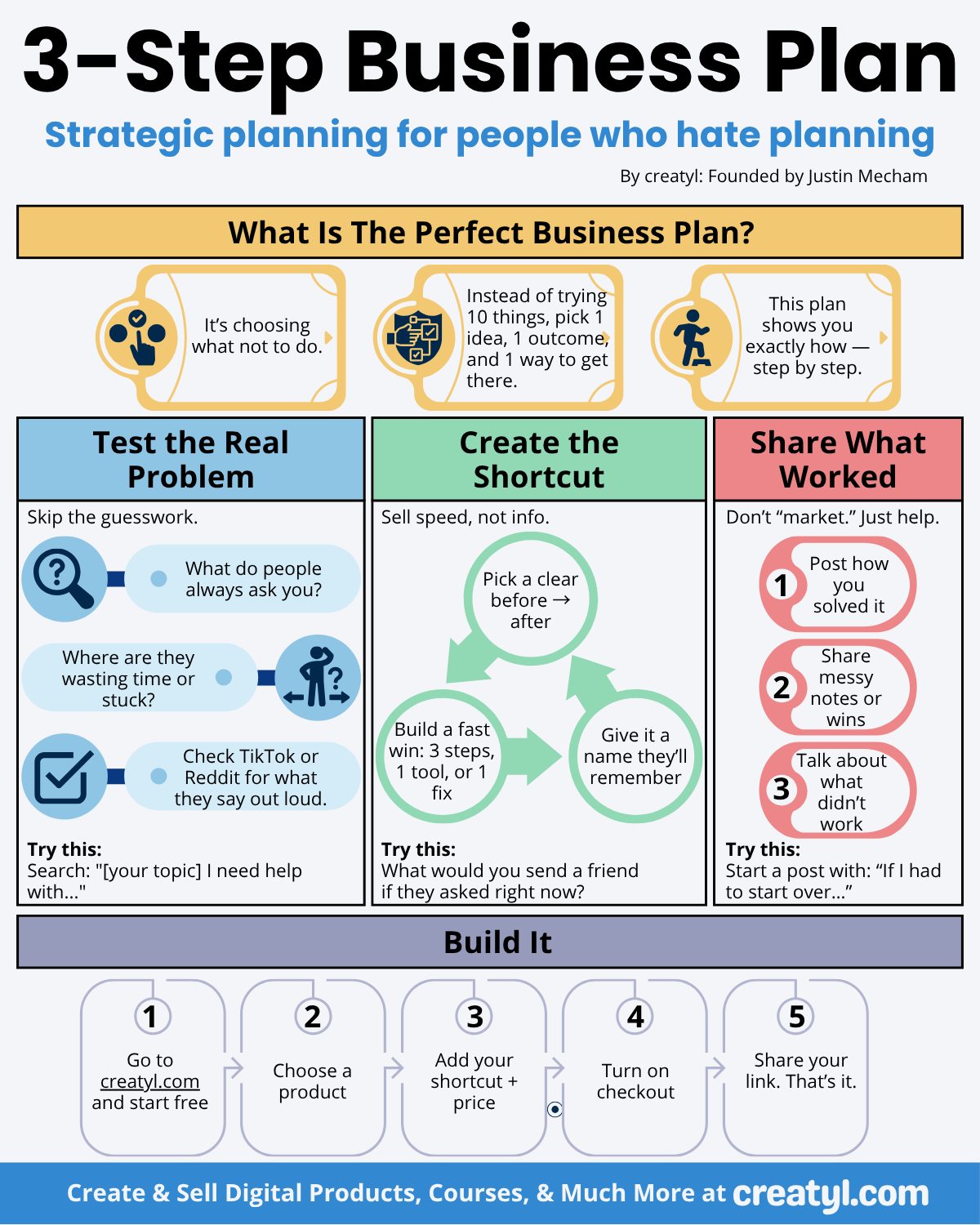
Why Most Plans Never Make It Past the Page
Most people don’t fail because they lack ambition.
They fail because they over-plan and under-finish.
We live in a world obsessed with strategy decks, long roadmaps, and color-coded timelines — yet the projects that actually ship are often the simplest ones.
The truth?
The best business plan isn’t the most detailed one. It’s the one you’ll actually finish.
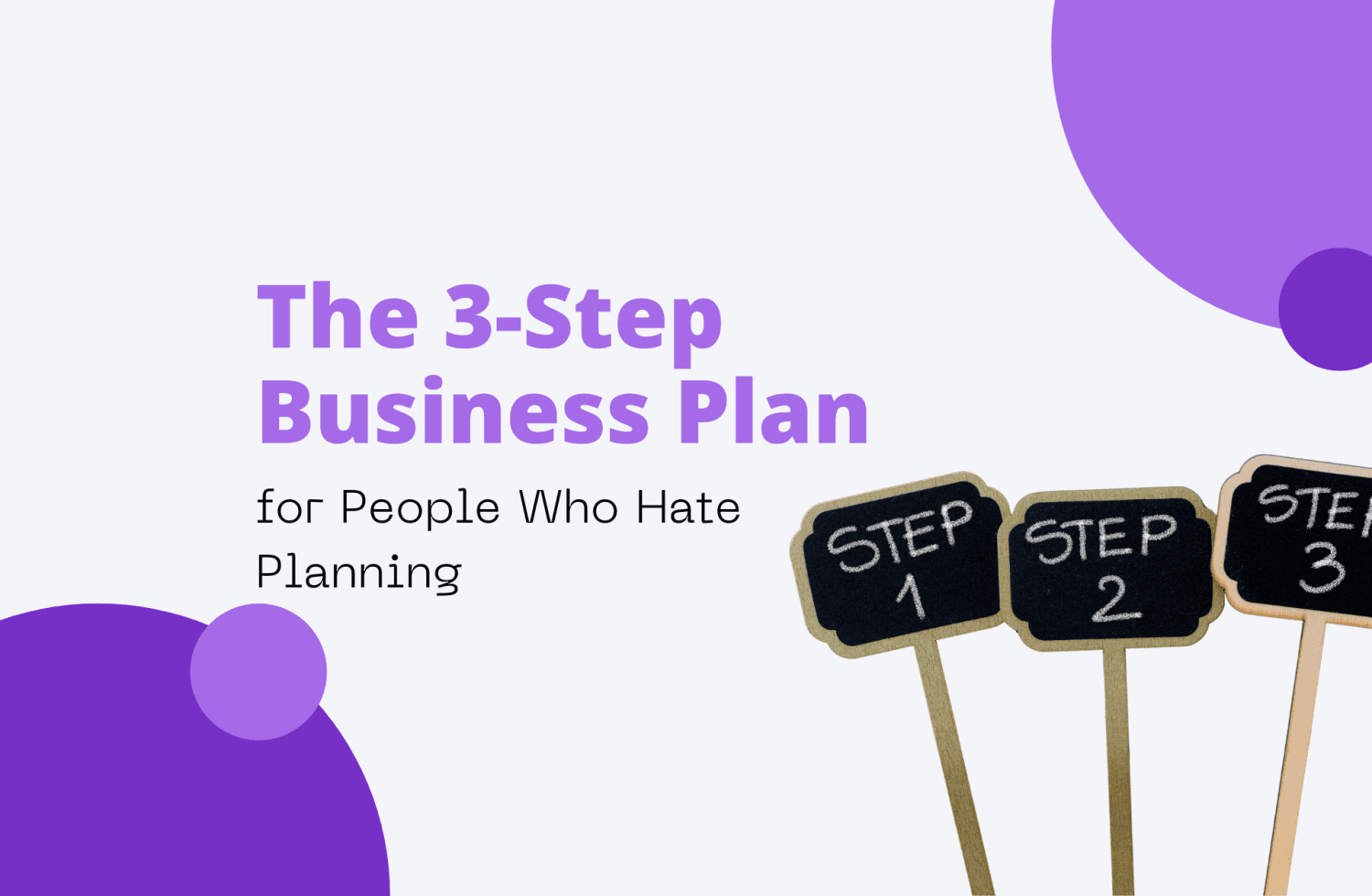
This is where the 3-Step Business Plan comes in — a framework for people who hate planning but love finishing.
It’s built on a simple truth: progress doesn’t come from having the perfect plan; it comes from completing a simple one.
Let’s break it down — step by step.
Step 1: Test the Real Problem
Before you build anything, make sure it solves something real.
Most people guess what the market needs — they build in isolation, then wonder why no one buys.
The smarter way is to listen first, build second.
Start by finding what people are already asking for help with. Look through Reddit, TikTok, and comment sections.
Search phrases like:
“I need help with [your topic]…”
This isn’t about data — it’s about pain signals.
When you hear people talk about frustration, wasted time, or confusion, you’re not guessing anymore. You’re diagnosing.
Real-World Example: The Designer Who Stopped Guessing
A freelance designer kept creating templates that no one bought.
They assumed small businesses wanted custom logo packages.
But when they checked TikTok and Reddit, they found people asking for “quick, editable templates I can use today.”
So they pivoted — building a 3-template “Brand Starter Kit” that solved that exact pain.
Within two weeks, sales replaced guessing.
The takeaway:
You don’t need surveys.
You need curiosity.
Spend less time planning what you think people want, and more time finding what they’re already struggling with.
Step 2: Create the Shortcut
Once you know the real problem, don’t build the biggest thing you can — build the fastest fix that actually helps.
This is where most creators go wrong.
They turn one small idea into a 10-module course, a full membership, or a 6-month project.
That’s not strategy — that’s procrastination in disguise.
The secret is to sell speed, not size.
Turn your insight into one simple transformation:
“Before → After.”
Then design a shortcut that delivers that transformation quickly — maybe a 3-step guide, a 1-page PDF, or a single tool that saves time.
Real-World Example: The Coach Who Simplified Her Offer
A business coach spent months building a high-ticket program on “How to Launch a Brand.”
But no one finished it.
She realized people didn’t want to learn the whole process — they wanted help with one thing: “How to write a brand statement that converts.”
She turned that into a 90-minute workshop with a simple 3-step framework.
It sold out in days.
She didn’t change her skill — she changed her scope.
People don’t pay for volume.
They pay for velocity — for results that happen fast and feel clear.
Step 3: Share What Worked
This step separates those who plan from those who finish.
Don’t “market.” Just share what worked.
When you talk openly about what you tried, what failed, and what finally clicked — people trust you.
You’re not selling; you’re showing.
Start small: post a short story that begins with,
“If I had to start over, here’s what I’d do differently…”
Then walk through your process.
Share your messy notes, your small wins, even the ideas that didn’t work.
Real-World Example: The Marketer Who Built Credibility by Being Honest
A freelance marketer started posting weekly “mini case studies” — not polished success stories, but lessons from failed campaigns.
One post read:
“We wasted $500 on the wrong audience. Here’s what we changed and how it turned into $2,000 profit the next week.”
That transparency built more leads than any ad campaign she had ever run.
Clients didn’t just see her skills — they saw her thinking.
People don’t connect with perfection. They connect with progress.
And that’s the best kind of marketing there is.
Step 4: Build It in 5 Minutes
Now that you’ve tested the problem, built the shortcut, and shared what worked — it’s time to make it real.
Here’s how:
- Go to creatyl.com and start free.
- Choose your product.
- Add your shortcut and price.
- Turn on checkout.
- Share your link.
That’s it.
You don’t need a launch plan, a content calendar, or a fancy website.
You just need a clear link and a clear offer.
Momentum doesn’t come from more thinking.
It comes from making something live.
From Idea to Income
A copywriter wanted to start a side income stream but felt overwhelmed by planning.
They had too many ideas — courses, guides, and templates — but couldn’t decide where to start.
Weeks turned into months of “reworking the plan.”
Nothing shipped. Motivation faded.
They were stuck in the loop of endless preparation — no progress.
They applied the 3-Step Business Plan.
- Tested the problem: Found people online asking “How do I write an About page that doesn’t sound robotic?”
- Created the shortcut: Made a “1-Page About Template” — three steps, one example, one editable file.
- Shared what worked: Posted how they built it and why it mattered.
Within 48 hours, the product made its first sale.
Within a week, it became their most shared post.
It wasn’t the perfect plan — it was a finished one.
Final Thought
Small Plans Win Because They Get Finished
Finishing is the forgotten skill in business.
Most people chase more — more research, more ideas, more planning — and never realize that simplicity is what creates speed.
The work that changes your business is the work that gets done.
When you choose one idea, one outcome, and one clear way to get there, you stop waiting for perfect conditions and start building progress.
You gain something more valuable than perfection — you gain momentum.
Finishing doesn’t mean rushing.
It means committing.
It means you choose clarity over complexity and action over anxiety.
Every time you finish one small plan, you get sharper, faster, and more confident.
So build small. Ship fast. Learn publicly.
Because in the end, success doesn’t come from planning more.
It comes from finishing what matters most.
Download the Infographic
Want to keep this framework by your side?
Download the 3-Step Business Plan infographic as a free PDF — the same one that shows you how to go from idea to income without overthinking or overplanning.
It’s your shortcut to real progress — one problem, one shortcut, one shared story at a time.
Keep it where you’ll see it often.
It’s the reminder that the best plan isn’t the longest one — it’s the one you’ll actually finish.